In the modern economic landscape, business longevity depends on far more than traditional financial returns. Rapid regulatory shifts, heightened investor scrutiny, and evolving stakeholder expectations mean that environmental, social, and governance (ESG) factors now sit at the very core of resilient corporate strategy. For organizations operating in Egypt, adapting to these changing standards is essential for maintaining operational licenses, avoiding costly regulatory penalties, and securing long term market access.
Navigating this complex regulatory environment requires specialized guidance. Partnering with an experienced ESG consultant ensures that enterprises can accurately decode legal mandates, manage hidden operational risks, and build robust corporate structures. Implementing structured ESG consulting services in Egypt allows businesses to move beyond reactive box ticking, transforming sustainability requirements into a strategic competitive advantage.
The Evolving Regulatory Landscape for Egypt’s Businesses
Corporate accountability has undergone a profound transformation. Regulatory bodies, financial institutions, and international trade partners now demand transparent disclosures regarding how companies manage their environmental footprint and social impact. In Egypt, businesses face a dual mandate: aligning with local statutory requirements while meeting the rigorous expectations of global supply chains and international markets.
Without dedicated expertise, internal teams often struggle to interpret fast-changing guidelines or establish the data tracking systems required for verification. This is where professional ESG consulting firms add immense value. By delivering targeted ESG strategy and compliance consulting, these advisory partners help organizations map their current operational baseline directly against recognized national and international benchmarks, ensuring total compliance alignment.
What Do ESG Consulting Services Include in Egypt?
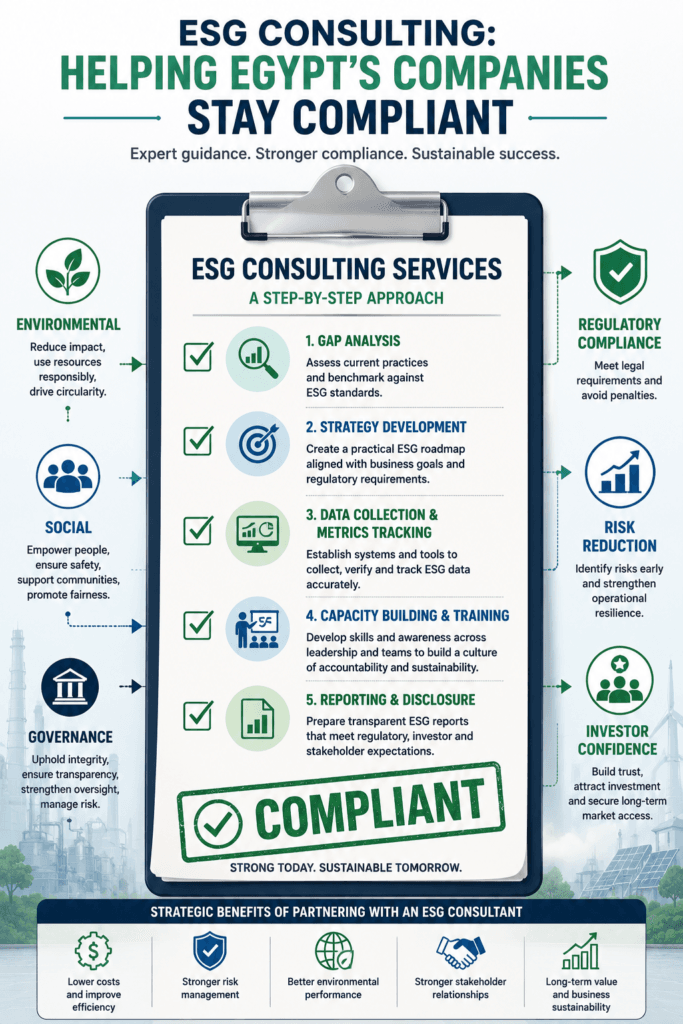
Comprehensive ESG consulting services cover a broad spectrum of corporate activities, aligning internal operations with recognized international and regional standards. A qualified ESG consultant in Egypt assists organizations in establishing operational frameworks that address three core pillars:
- Environmental Responsibility: Focuses on carbon footprint reduction, decarbonization strategies, waste reduction, water stewardship, and circular economy initiatives. Guidance helps firms optimize resource consumption, lower energy overheads, and minimize adverse environmental impacts across all production stages.
- Social Responsibility: Evaluates how a company manages relationships with its workforce, supply chain partners, customers, and local communities. This includes fair labor practices, occupational health and safety standards, diversity initiatives, and employee wellness programs.
- Corporate Governance: Establishes robust board oversight, ethical guidelines, transparency measures, data privacy protocols, and anti-corruption policies to ensure transparent, accountable, and legally sound management practices.
Through tailored corporate sustainability advisory services, organizations seamlessly integrate these pillars into their daily workflows, ensuring continuous compliance and operational integrity.
Why Compliance and Risk Management Matter
Companies that treat compliance as an afterthought expose themselves to severe financial penalties, operational delays, legal friction, and sudden reputational damage. Investors and lenders increasingly favor organizations that demonstrate proactive risk management.
Through rigorous ESG risk management and reporting, enterprises can identify vulnerabilities before they escalate into compliance failures. A professional ESG consultant helps build transparent reporting architectures that satisfy statutory disclosures, attract institutional investors, and retain customer trust. This structured approach shifts compliance from a burdensome administrative task into a powerful engine for operational stability.
The Step-by-Step Approach of an ESG Consulting Firm in Egypt
An expert ESG consultant acts as a strategic partner, guiding executive teams through the intricacies of sustainability frameworks. Rather than applying a generic template, professional advisors evaluate an organization’s unique operational footprint to design customized compliance pathways:
- Gap Analysis and Benchmarking: Evaluating current operational practices against national and international ESG benchmarks to uncover hidden compliance gaps and data collection deficiencies.
- Strategy Formulation: Collaborating with leadership to design a pragmatic roadmap that aligns sustainability targets with core business objectives.
- Data Collection and Metrics Tracking: Establishing robust internal controls and digital tools to gather, verify, and report non-financial data accurately without manual errors.
- Capacity Building and Training: Conducting specialized workshops for leadership and frontline employees to foster an internal culture of accountability, safety, and environmental awareness.
Through these targeted interventions, a qualified ESG consulting firm helps businesses streamline audits, eliminate operational blind spots, and secure long term stakeholder confidence.
Integrating Sustainability into Core Corporate Strategy
True compliance goes far beyond checking boxes on a regulatory checklist. To achieve lasting success, organizations must embed sustainability into their overarching business model. When companies integrate environmental and social criteria into daily decision-making, they unlock new avenues for cost savings, operational efficiency, and innovation.
For instance, optimizing energy consumption reduces utility expenses, while improving workplace safety lowers insurance costs and boosts employee retention. A dedicated ESG consultant helps management teams identify these overlapping opportunities, ensuring that compliance initiatives also deliver tangible financial returns. Furthermore, embedding these practices early prepares enterprises for future legislative tightening, protecting them from unexpected market shocks.
Overcoming Common Implementation Challenges
Organizations embarking on their sustainability journey often encounter internal resistance, data silos, and a lack of standardized reporting tools. Overcoming these hurdles requires a structured change management approach led by experienced ESG consulting services.
- Breaking Down Data Silos: Consolidating environmental and social data from disparate departments into a unified reporting system.
- Engaging Stakeholders: Securing buy-in from both executive leadership and frontline employees through transparent communication and targeted training.
- Continuous Monitoring: Establishing ongoing review cycles to adapt to shifting regulations and emerging industry best practices.
By addressing these challenges proactively, businesses build a resilient foundation capable of withstanding regulatory scrutiny, satisfying modern investors, and securing enduring market leadership in a rapidly evolving economy.
Frequently Asked Questions
When do companies need ESG consulting services in Egypt?
Companies typically engage consulting services when preparing for mandatory non-financial disclosures, seeking international or local investment, expanding market reach, or responding to tightening environmental and governance regulations.
How do ESG consulting firms improve sustainability in Egypt?
They help organizations map carbon footprints, optimize resource allocation, establish fair labor standards, build transparent governance frameworks, and integrate sustainable practices into core business strategies.
What do ESG consulting services include in Egypt?
Services encompass environmental footprint reduction, waste management strategies, social responsibility and labor practice audits, board governance advisory, and comprehensive sustainability reporting.
Why choose an ESG consultant for compliance?
An experienced consultant provides deep technical expertise, helps navigate complex regulatory frameworks, mitigates compliance risks, and builds transparent reporting structures that satisfy investors and regulators.
Contact us