
Lean inventory management focuses on maintaining the inventory required to support operations while reducing unnecessary stock, movement, waiting, handling, and other forms of waste. For manufacturers in Saudi Arabia, Lean inventory strategies can help connect inventory management with broader operational improvement goals.
The approach is not simply about reducing inventory. It involves understanding material flow, identifying the causes of inventory accumulation, improving process stability, and creating more reliable replenishment systems.
When supported by standardized processes, accurate information, workforce involvement, and continuous improvement, Lean inventory can contribute to better flow, improved visibility, and more effective use of resources.
Key Takeaways
- Lean inventory focuses on reducing waste while protecting the availability required by operations.
- Excess inventory often indicates underlying problems involving flow, quality, reliability, planning, or replenishment.
- Value Stream Mapping (VSM) can help identify where inventory accumulates and why.
- Just-in-Time (JIT) inventory works best when processes, information, and replenishment systems are sufficiently reliable.
- Sustainable Lean inventory improvement requires standardization, measurement, workforce involvement, and continuous improvement.
What Is Lean Inventory Management?
Lean inventory management applies Lean thinking to the way organizations purchase, store, move, and consume inventory.
The fundamental question is:
What inventory is genuinely required to create value and maintain operational flow?
Inventory can be necessary. However, inventory beyond what the process requires may create additional cost and complexity.
Lean therefore examines inventory in relation to:
- Material flow
- Process stability
- Demand
- Lead times
- Quality
- Equipment reliability
- Replenishment
- Workforce practices
- Information flow
This broader perspective is important because inventory can sometimes hide problems elsewhere in the process.
Why Lean Inventory Matters for Saudi Manufacturers
Manufacturing operations depend on a continuous flow of materials.
When inventory is poorly managed, manufacturers may experience:
- Production interruptions
- Excess material
- Congested storage
- Increased handling
- Long material movement
- Slow-moving stock
- Replenishment problems
- Working capital pressure
Lean inventory approaches aim to improve this flow.
The objective is not to create the lowest possible inventory level. It is to create an inventory system that supports production reliably without unnecessary stock and waste.
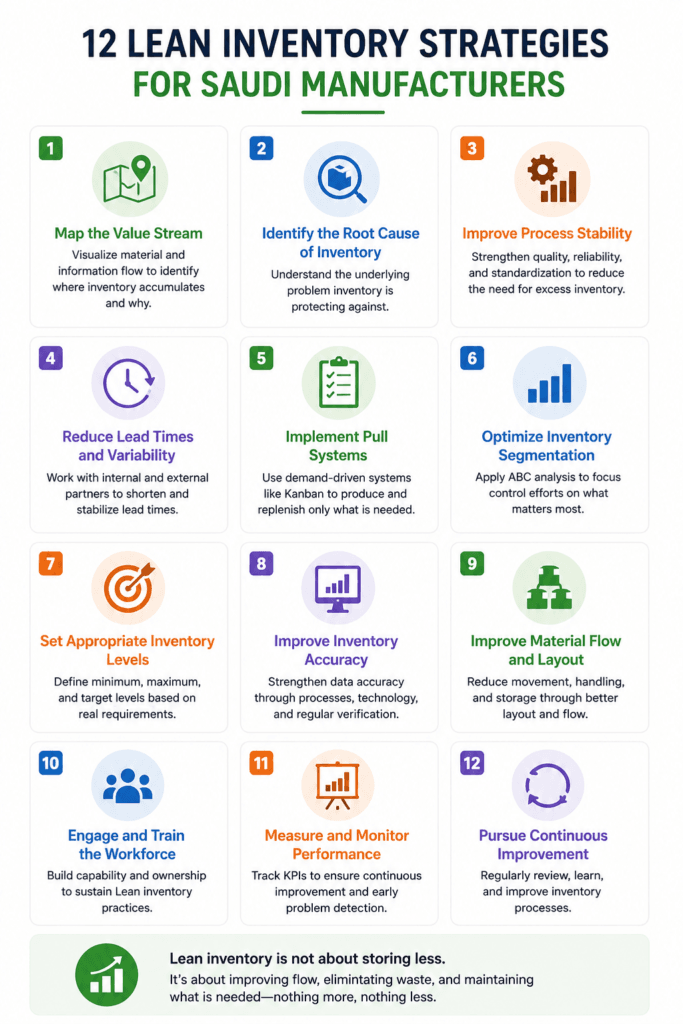
The Relationship Between Inventory and Waste
Lean identifies different forms of waste that can influence inventory performance.
Inventory itself is traditionally recognized as one of the major forms of waste, but excess inventory can also create other forms of waste.
For example, excessive stock may lead to:
- Additional movement
- Additional storage
- Additional inspection
- Additional handling
- Increased risk of damage
- Increased risk of obsolescence
This is why inventory improvement can have effects beyond the warehouse.
Lean Inventory Strategy 1: Map the Value Stream
Value Stream Mapping is a useful starting point for Lean inventory improvement.
It helps organizations visualize the flow of:
- Materials
- Information
- Work
- Inventory
A current-state map can show where inventory accumulates between processes. It can also reveal:
- Waiting
- Bottlenecks
- Unnecessary movement
- Repeated handling
- Information delays
- Process interruptions
Once these issues are visible, teams can investigate why the inventory exists.
Lean Inventory Strategy 2: Identify the Root Cause of Inventory
Inventory is often created as protection against uncertainty. For example, an organization may hold additional stock because:
- Equipment is unreliable
- Suppliers are inconsistent
- Quality problems create rework
- Production schedules frequently change
- Lead times are long
- Demand is difficult to predict
Reducing the inventory without addressing these conditions can create operational risk. A better approach is to ask:
What problem is this inventory protecting us from?
The answer can point toward the real improvement opportunity.
Lean Inventory Strategy 3: Improve Process Stability
Stable processes make inventory management easier. If production processes are unpredictable, organizations may use inventory to compensate.
Process stability can be improved through:
- Standardized work
- Root cause analysis
- Quality improvement
- Equipment reliability
- Preventive maintenance
- Clear operating procedures
- Continuous improvement
This demonstrates why Lean inventory should be connected with broader Operational Excellence initiatives.
Lean Inventory Strategy 4: Improve Material Flow
Efficient material flow reduces unnecessary movement and waiting.
Manufacturers can review:
- Material routes
- Storage locations
- Work-In-Progress (WIP) accumulation
- Handling activities
- Process sequence
- Material delivery frequency
The objective is to create a smoother flow from incoming materials through production and onward to the next process.
Poor flow can encourage organizations to maintain additional buffers. Improving the flow can reduce that dependency.
Lean Inventory Strategy 5: Standardize Replenishment
Replenishment should not depend entirely on individual judgment.
Standardized replenishment rules can establish:
- When materials should be replenished
- How replenishment should occur
- Who is responsible
- What information is required
- How exceptions are handled
The specific approach should reflect the organization’s demand patterns and operational requirements.
Standardization creates greater consistency and makes improvement easier to measure.
Lean Inventory Strategy 6: Use Pull-Based Systems Where Appropriate
Pull systems aim to replenish materials based on actual consumption or downstream requirements rather than relying solely on forecasts.
A pull approach can help reduce unnecessary inventory when process conditions support it.
Potential benefits include:
- Better material flow
- Reduced excess inventory
- Clearer replenishment signals
- Improved visibility
However, pull systems require disciplined processes.
Organizations need to understand:
- Consumption patterns
- Replenishment times
- Material availability
- Process capacity
- Inventory accuracy
A poorly designed pull system can simply move shortages through the process.
Lean Inventory Strategy 7: Apply Just-in-Time Principles
Just-in-Time inventory strategies for KSA focus on providing materials when required rather than maintaining unnecessary quantities.
JIT can support Lean inventory when supported by:
- Reliable processes
- Accurate inventory information
- Effective replenishment
- Suitable supplier coordination
- Appropriate planning
- Stable quality
JIT should not be interpreted as eliminating inventory buffers regardless of operating conditions.
The required inventory level depends on the characteristics of the process and supply system.
Lean Inventory Strategy 8: Improve Inventory Accuracy
Lean inventory systems depend on reliable information.
If system records do not match physical inventory, pull signals and replenishment decisions can become unreliable.
Manufacturers can improve accuracy through:
- Standardized transactions
- Cycle counting
- Defined inventory ownership
- Clear receiving procedures
- Clear issuing procedures
- Root cause analysis of discrepancies
Accurate information helps organizations make better decisions without maintaining unnecessary inventory as a precaution.
Lean Inventory Strategy 9: Reduce Lead Times
Long lead times can encourage organizations to hold additional inventory.
Lead time improvement should examine the complete process rather than only supplier delivery.
Potential sources of delay can include:
- Purchasing approvals
- Internal movement
- Waiting
- Processing
- Inspection
- Scheduling
- Supplier response
Value Stream Mapping can help identify where time is being consumed.
Reducing unnecessary lead time can make inventory systems more responsive.
Lean Inventory Strategy 10: Improve Quality
Quality problems can increase inventory requirements.
Defects may require:
- Replacement materials
- Rework
- Additional production
- Additional inspection
- Additional stock
Quality improvement can therefore contribute to inventory efficiency.
Manufacturers can use root cause analysis and process improvement to reduce recurring quality problems. The goal is to prevent defects rather than compensate for them with additional inventory.
Lean Inventory Strategy 11: Improve Equipment Reliability
Equipment interruptions can disrupt production flow.
When equipment performance is unpredictable, organizations may maintain additional inventory to protect downstream processes.
Equipment reliability improvement can therefore support Lean inventory.
Relevant practices may include:
- Preventive maintenance
- Planned maintenance
- Autonomous maintenance
- Root cause analysis
- Equipment performance monitoring
- Standardized maintenance practices
This creates a connection between Lean inventory initiatives and broader Total Productive Maintenance (TPM) practices across Saudi Arabia.
Lean Inventory Strategy 12: Involve the Workforce
Inventory improvement should not be treated solely as a management or warehouse initiative.
Employees working with materials and production processes often have direct knowledge of:
- Material shortages
- Repeated delays
- Storage problems
- Process interruptions
- Quality issues
- Replenishment difficulties
Organizations can use this knowledge through:
- Improvement meetings
- Problem-solving activities
- Standard work reviews
- Suggestion systems
- Continuous improvement programs
Workforce involvement can make Lean inventory improvements more practical and sustainable.
Illustrative Example: Reducing Work-in-Progress Inventory
The following is an illustrative example, not a documented company case study.
Situation
Consider a manufacturing organization where large amounts of work-in-progress accumulate between production stages.
Management believes the inventory is necessary to prevent downstream interruptions.
Investigation
A Value Stream Mapping exercise identifies inconsistent process times and recurring equipment interruptions.
The inventory is partly functioning as a buffer against these problems.
Improvement Approach
Instead of immediately removing the inventory, the organization could:
- Investigate equipment interruptions
- Improve process stability
- Standardize work
- Address recurring quality issues
- Improve production synchronization
- Establish clearer replenishment signals
Expected Direction
As the underlying processes become more predictable, the organization may be able to reduce unnecessary work-in-progress without compromising production continuity.
Key Lesson
Reducing inventory is more sustainable when the process problems creating the excess inventory are addressed first.
Lean Inventory and Digital Transformation
Digital tools can support Lean inventory practices when they solve clearly defined operational problems.
Potential applications include:
- Automated inventory data capture
- Inventory dashboards
- Warehouse management systems
- Barcode tracking
- Inventory analytics
- Replenishment support
- Connected inventory information
The technology should support Lean principles rather than replace them.
A useful sequence is:
Stabilize → Standardize → Improve → Digitize → Measure → Improve Again
This reduces the risk of using technology to automate inefficient processes.
Smart Inventory Solutions KSA Manufacturers Can Evaluate
Manufacturers evaluating smart inventory solutions that KSA organizations can use should begin by identifying the inventory problem.
Potential use cases include:
Inventory Visibility
Improving awareness of stock levels, locations, and movement.
Automated Data Collection
Reducing repetitive manual inventory transactions.
Replenishment Support
Providing more consistent information for replenishment decisions.
Inventory Analytics
Identifying patterns involving consumption, movement, or stock levels.
Warehouse Management
Improving the organization and tracking of inventory movement.
The appropriate technology depends on the organization’s operational requirements and readiness.
Inventory Management: Digital Transformation in Saudi Arabia
Digital transformation initiatives for inventory management can support Lean inventory when digital systems are connected to clearly defined process improvements.
A practical roadmap can involve:
Assess
Understand current inventory processes and information.
Map
Visualize material and information flow.
Improve
Address waste and root causes.
Standardize
Create consistent processes.
Digitize
Introduce appropriate technology.
Integrate
Connect relevant systems and information.
Measure
Track performance.
Sustain
Continue improving the system.
This sequence keeps technology connected to operational improvement.
How to Implement Lean Inventory Processes in Saudi Factories
Organizations considering how to implement Lean inventory processes in Saudi factories can begin with a structured approach.
Step 1: Establish a Baseline
Measure current inventory performance.
Step 2: Identify Waste
Look for excess stock, waiting, movement, defects, and unnecessary handling.
Step 3: Map the Flow
Use Value Stream Mapping to understand material and information movement.
Step 4: Identify Root Causes
Determine why inventory accumulates.
Step 5: Stabilize Processes
Address quality, equipment, workforce, and process issues.
Step 6: Standardize
Create consistent replenishment and inventory procedures.
Step 7: Introduce Pull or JIT Where Appropriate
Use demand-driven replenishment when process conditions support it.
Step 8: Measure
Track inventory and operational performance.
Step 9: Continue Improving
Use performance information to identify further opportunities.
How to Measure Lean Inventory Performance
Lean inventory improvement should be evaluated through a balanced set of measures.
Potential indicators include:
- Inventory accuracy
- Inventory turnover
- Stock availability
- Stockout frequency
- Work-in Progress levels
- Slow-moving inventory
- Replenishment performance
- Material movement
- Lead time
- Order fulfillment
The appropriate measures depend on the organization’s objectives.
Reducing inventory should never be considered successful if it causes unacceptable operational disruption.
Common Lean Inventory Mistakes
Treating Inventory Reduction as the Main Goal
Inventory reduction should support better operational performance.
Removing Buffers Without Understanding Their Purpose
Some inventory exists because of real process or supply uncertainty.
Implementing JIT Too Quickly
JIT requires appropriate process stability.
Ignoring Quality
Quality problems can continue creating inventory requirements.
Ignoring Equipment Reliability
Unreliable equipment can encourage excessive buffers.
Digitizing Before Improving
Technology should support an improved process.
Excluding the Workforce
Employees are important sources of practical process knowledge.
Failing to Standardize
Without standards, improvements can gradually disappear.
When Inventory Management Consulting May Help
Some manufacturers can implement Lean inventory improvements using internal resources. Others may require structured external support.
Inventory management consultants in Saudi Arabia can potentially support organizations with areas such as:
- Inventory assessment
- Inventory optimization
- Lean inventory improvement
- Value Stream Mapping
- Material flow analysis
- Process standardization
- Inventory performance measurement
- Digital inventory improvement
Inventory management consulting in KSA should be based on the organization’s actual challenges and improvement requirements. The objective should be to build sustainable capability rather than simply introduce isolated inventory initiatives.
Conclusion
Lean inventory management is fundamentally about improving flow and eliminating unnecessary waste.
For Saudi manufacturers, effective Lean inventory strategies can involve Value Stream Mapping, process stabilization, standardized replenishment, pull systems, Just-in-Time principles, inventory accuracy, quality improvement, equipment reliability, and workforce involvement.
The most important principle is that inventory should not be viewed independently from the processes around it.
For manufacturers considering inventory management consulting in Saudi Arabia, the focus should remain on practical operational improvement, measurable performance, and the ability to sustain Lean inventory practices over time.
Frequently Asked Questions
What is Lean inventory management?
Lean inventory management applies Lean principles to inventory processes to reduce unnecessary stock, movement, waiting, handling, and other forms of waste while maintaining the inventory required for effective operations.
How can manufacturers implement Lean inventory processes in Saudi Arabia?
Manufacturers can begin by establishing an inventory baseline, mapping material flow, identifying waste, addressing root causes, stabilizing processes, standardizing replenishment, and introducing pull or JIT methods where appropriate.
What are the benefits of JIT inventory systems for Saudi manufacturers?
JIT can help manufacturers reduce unnecessary inventory, improve material flow, and strengthen replenishment discipline when supported by reliable processes, accurate information, and suitable supply conditions.
How does Value Stream Mapping help inventory optimization?
Value Stream Mapping shows how materials and information move through a process. It can help identify excess inventory, waiting, bottlenecks, unnecessary movement, and other sources of waste.
How can digital transformation support Lean inventory?
Digital transformation can improve inventory visibility, data collection, analytics, and replenishment processes. The strongest results come when digital tools support standardized and improved processes rather than automate inefficient ones.