
Lean Six Sigma combines process improvement, waste reduction, and variation control into a structured improvement approach. Traditional quality methods remain valuable, particularly for inspection, compliance, defect detection, and quality assurance.
The difference is largely in how organizations approach problems. Traditional methods may focus strongly on identifying and controlling quality issues, while Lean Six Sigma places greater emphasis on understanding process causes and improving the process itself.
For organizations in Saudi Arabia, understanding this distinction can help management teams choose the right improvement approach for their operational objectives without treating either methodology as universally superior.
Key Takeaways
- Traditional quality methods and Lean Six Sigma serve different but complementary purposes.
- Lean Six Sigma combines waste elimination with structured variation and defect reduction.
- DMAIC provides a systematic framework for solving complex process problems.
- Quality inspection remains important, but preventing defects at the source can create stronger process control.
- The right improvement approach should depend on the organization’s problem, process maturity, and performance objectives.
What Is Lean Six Sigma?
Lean Six Sigma is a process improvement methodology that combines two complementary approaches.
Lean focuses on improving flow and eliminating activities that do not create value.
Six Sigma focuses on reducing process variation and defects through structured problem solving and data analysis.
Together, they provide a framework for improving:
- Quality
- Productivity
- Process flow
- Lead time
- Waste
- Process consistency
- Customer value
Lean Six Sigma is not simply a collection of tools. It is a structured way of understanding problems, identifying causes, implementing improvements, and sustaining results.
For organizations evaluating Lean Six Sigma initiatives in Saudi Arabia, this distinction is important because successful implementation requires more than training employees in individual techniques.
What Are Traditional Quality Methods?
Traditional quality management can include a broad range of activities designed to ensure that products, services, and processes meet defined requirements.
Examples can include:
- Inspection
- Testing
- Quality audits
- Quality control
- Corrective actions
- Quality assurance
- Standard operating procedures
- Compliance monitoring
These methods remain important.
Inspection, for example, can help identify nonconforming outputs.
Auditing can help determine whether established processes are being followed.
Quality assurance can provide a structured framework for maintaining consistency.
The question is not whether traditional quality methods are useful. The question is whether they are sufficient for the problem being addressed.
Lean Six Sigma vs Traditional Quality Methods
The key difference is often the point at which an organization intervenes.
A traditional quality approach may identify that a defect has occurred.
A Lean Six Sigma approach asks why the defect occurred and what changes can prevent recurrence.
Consider a simplified example. A process produces an incorrect output. A traditional response might involve:
- Detecting the defect
- Separating the affected output
- Correcting or replacing it
- Recording the issue
A Lean Six Sigma response may continue further:
- Define the problem
- Measure its occurrence
- Analyze the process
- Identify root causes
- Implement improvements
- Control the improved process
Neither approach eliminates the need for quality control.
Instead, Lean Six Sigma adds a structured improvement dimension.
Inspection vs Prevention
One of the most important distinctions is the difference between detecting problems and preventing them.
Inspection occurs after or during a process to identify whether requirements have been met.
Prevention focuses on designing the process so that errors are less likely to occur.
Lean Six Sigma strongly emphasizes prevention.
For example, if a recurring error occurs because employees must manually enter information in multiple locations, an improvement team may investigate whether the process can be simplified or redesigned.
The goal is not merely to inspect the error more effectively.
The goal is to reduce the opportunity for the error to occur.
Reactive Quality Management vs Structured Problem Solving
Traditional quality systems often respond to identified nonconformities. This is necessary for maintaining control.
Lean Six Sigma can provide a more structured approach when problems are persistent, complex, or cross-functional.
This is where DMAIC becomes particularly useful.
DMAIC stands for:
- Define
- Measure
- Analyze
- Improve
- Control
Each phase addresses a different part of the problem-solving process.
How DMAIC Improves Operational Performance
Define
The Define phase establishes what problem needs to be solved.
A strong problem statement should explain:
- What is happening?
- Where is it happening?
- Why does it matter?
- Who is affected?
- What outcome is expected?
Poorly defined problems can lead to poorly targeted solutions.
Measure
The Measure phase establishes the current condition.
The team determines what should be measured and how the process currently performs. This creates a factual baseline.
Analyze
The Analyze phase investigates the causes of the problem.
The team may use:
- Process analysis
- Cause and effect analysis
- 5 Whys
- Data analysis
- Pareto analysis
The objective is to distinguish symptoms from root causes.
Improve
The Improve phase develops and tests countermeasures.
Potential improvements may involve:
- Process redesign
- Standardization
- Waste elimination
- Error prevention
- Workflow changes
- Improved controls
Control
The Control phase ensures that improvements are sustained.
This may involve:
- Standardized work
- Monitoring
- Visual management
- Process controls
- Performance reviews
Without Control, an improvement can gradually disappear.
How Lean Six Sigma Supports Quality Management
Lean Six Sigma does not replace quality management. It can strengthen it.
Quality management establishes the systems required to control and assure quality.
Lean Six Sigma provides structured methods for improving processes when performance does not meet requirements.
This makes the two approaches complementary.
A mature organization may use:
Quality Management → Control and Assurance
Lean Six Sigma → Structured Process Improvement
The combination can provide stronger operational control and improvement capability.
Lean Six Sigma Tools Saudi Arabia Organizations Can Use
Saudi Arabia organizations considering Lean Six Sigma tools & initiatives can select from a broad set of techniques.
Value Stream Mapping
Value Stream Mapping helps teams understand the flow of materials and information.
It is particularly useful for identifying:
- Waiting
- Inventory
- Delays
- Unnecessary movement
- Process disconnects
5S
5S supports workplace organization and visual control. It can help reduce searching, clutter, and unnecessary movement.
Pareto Analysis
Pareto analysis can help teams prioritize problems by identifying categories that contribute significantly to an observed issue.
Cause and Effect Analysis
This technique helps teams structure potential causes of a problem.
Statistical Process Analysis
Where appropriate, statistical analysis can help identify variation and relationships within a process.
Control Charts
Control charts can help monitor process behavior over time and distinguish common variation from potential special causes.
FMEA
Failure Mode and Effects Analysis can help organizations identify potential failure modes and assess their possible effects and causes.
The appropriate tool depends on the problem.
When Traditional Quality Methods May Be More Appropriate
Lean Six Sigma is not the answer to every quality problem.
Traditional quality methods can remain appropriate when an organization needs:
- Routine inspection
- Product testing
- Compliance verification
- Audit activities
- Standard quality controls
- Documentation
- Conformance monitoring
For example, if a process already performs consistently and the primary requirement is verification against established specifications, introducing a complex improvement methodology may not be necessary.
The objective should always be proportional to the problem.
When Lean Six Sigma May Be More Appropriate
Lean Six Sigma can be particularly useful when an organization faces:
- Recurring defects
- Process variation
- Long lead times
- Persistent rework
- Complex process problems
- Cross-functional inefficiencies
- Repeated customer complaints
- Unexplained performance variation
These problems often require more than inspection.
They require understanding the process.
Lean Six Sigma for Waste Reduction
Lean Six Sigma combines two complementary perspectives.
Lean asks:
Where is the waste?
Six Sigma asks:
Where is the variation?
Together, these questions can provide a broader view of process performance.
Waste may include:
- Waiting
- Excess movement
- Overprocessing
- Unnecessary inventory
- Rework
- Unnecessary transportation
Variation may appear in:
- Cycle times
- Quality results
- Process outputs
- Material characteristics
- Work methods
Addressing both can create a stronger process improvement strategy.
Lean Six Sigma and Cost Savings
Organizations often associate Lean Six Sigma with cost savings. However, cost should generally be treated as an outcome rather than the only objective.
Improving a process may reduce costs through:
- Lower rework
- Less material waste
- Reduced waiting
- Better productivity
- Lower inventory
- Fewer defects
- More stable processes
The strongest projects connect cost improvement with measurable process improvement.
Simply reducing resources without improving the underlying process can create new problems.
Lean Six Sigma and Productivity
Productivity improvement should focus on how effectively resources are converted into useful output.
Lean Six Sigma can support productivity by addressing:
- Process delays
- Rework
- Unnecessary activities
- Process variation
- Equipment-related interruptions
- Poor workflow
The objective is not simply to make employees work faster. It is to make the process work better.
Lean Six Sigma Manufacturing in KSA
Lean Six Sigma manufacturing initiatives for KSA can be applied to a range of process challenges.
Potential applications include:
- Reducing process variation
- Improving quality
- Reducing rework
- Improving material flow
- Improving process cycle time
- Strengthening standardized work
- Addressing recurring process problems
The methodology should be adapted to the actual process rather than applied as a standardized template.
Lean Six Sigma and Industry 4.0
Lean Six Sigma and Industry 4.0 can complement one another.
Lean Six Sigma provides structured methods for identifying process problems.
Industry 4.0 technologies can provide additional capabilities such as:
- Automated data collection
- Process monitoring
- Analytics
- Connected systems
- Automation
- Real-time information
However, technology should not replace process understanding.
If an organization digitizes an inefficient process without first understanding it, the technology may simply make the existing process more complex or faster without addressing its underlying problems.
A practical sequence is:
Understand → Measure → Improve → Standardize → Digitize where appropriate
How to Choose Between Lean Six Sigma and Traditional Quality Methods
Organizations do not necessarily need to choose one methodology exclusively.
A practical decision framework can be based on the nature of the problem.
| Situation | Potential Approach |
| Routine inspection requirement | Traditional quality control |
| Compliance verification | Quality assurance and auditing |
| Recurring defects | Lean Six Sigma |
| Significant process variation | Six Sigma techniques |
| Excessive waste | Lean techniques |
| Complex cross-functional problem | Lean Six Sigma |
| Process already stable | Standard quality controls |
| Continuous improvement opportunity | Lean or Lean Six Sigma |
This framework is not absolute.
The organization’s process maturity and specific objectives should guide the final decision.
The Role of Lean Six Sigma Consultants in Saudi Arabia
Organizations may develop internal improvement capability or work with Lean Six Sigma consultants for Saudi Arabia when structured external expertise is appropriate.
A Lean Six Sigma consultant can support activities such as:
- Process assessments
- Improvement project selection
- DMAIC facilitation
- Root cause analysis
- Process mapping
- Waste identification
- Quality improvement
- Performance measurement
- Continuous improvement capability
Organizations considering Lean Six Sigma consulting services for KSA should evaluate whether the approach is practical, evidence-based, measurable, and aligned with their operational objectives.
The objective should not be to implement Lean Six Sigma for its own sake. It should be to solve meaningful business and process problems.
How to Choose the Right Consultant in KSA?
Organizations searching for Lean Six Sigma consulting services in KSA should consider several factors.
Relevant Experience
Does the consultant understand process improvement and the organization’s operational context?
Practical Methodology
Is the methodology focused on solving real problems?
Measurement
Are improvement objectives and performance measures clearly defined?
Workforce Capability
Will internal employees gain the capability to continue improving processes?
Sustainability
Does the approach include standardization and control?
Transparency
Are assumptions, limitations, and expected outcomes clearly communicated?
These considerations can help organizations evaluate consulting support based on substance rather than terminology alone.
Conclusion
The comparison between Lean Six Sigma and traditional quality methods should not be viewed as a choice between old and new approaches.
For organizations pursuing Lean Six Sigma initiatives for Saudi Arabia , the most effective approach is likely to be the one that matches the methodology to the actual problem.
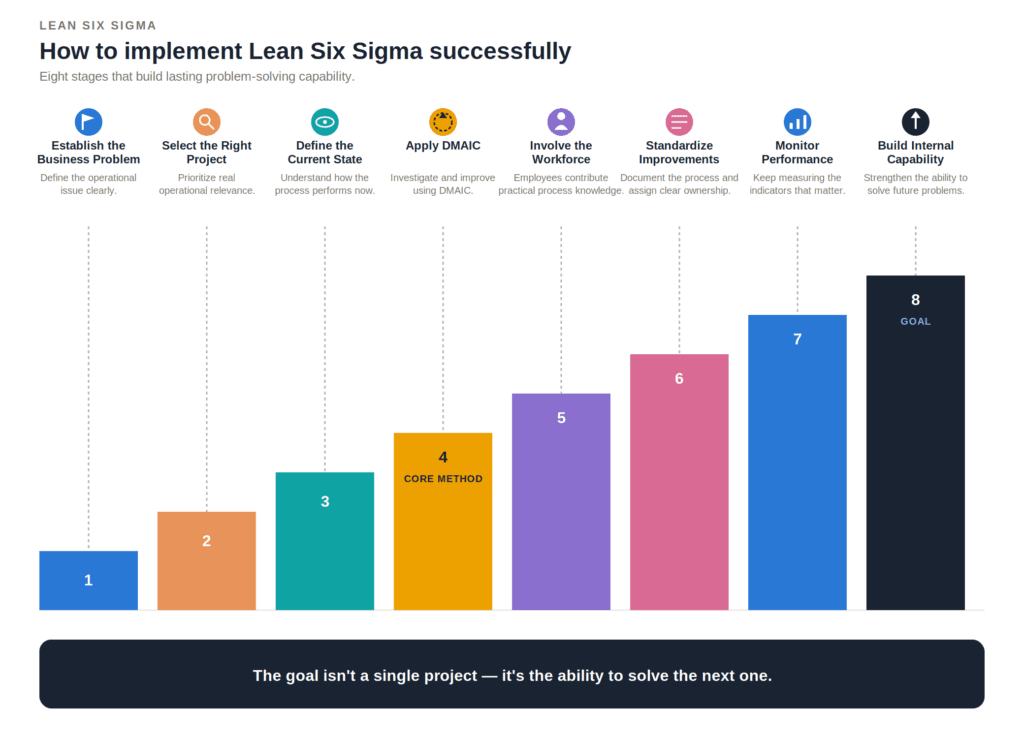
Organizations considering Lean Six Sigma consulting for KSA should therefore focus on practical problem solving, measurable improvement, workforce involvement, and sustainable capability rather than simply implementing a methodology.
Frequently Asked Questions
What is Lean Six Sigma and how does it help Saudi companies?
Lean Six Sigma combines Lean waste reduction with Six Sigma variation and defect reduction. It can help Saudi organizations improve processes, quality, productivity, flow, and operational consistency through structured problem solving.
How is Lean Six Sigma different from traditional quality management?
Traditional quality management often focuses on quality assurance, inspection, testing, compliance, and control. Lean Six Sigma adds a structured approach for identifying root causes and improving processes to prevent recurring problems.
How does DMAIC improve operational performance in KSA firms?
DMAIC provides five stages: Define, Measure, Analyze, Improve, and Control. It helps organizations structure problem solving, identify root causes, implement improvements, and establish controls to sustain results.
Can Lean Six Sigma and Industry 4.0 work together?
Yes. Lean Six Sigma can help organizations understand and improve processes, while Industry 4.0 technologies can support data collection, monitoring, analytics, automation, and connected processes.
How should organizations choose Lean Six Sigma consulting services in KSA?
Organizations should evaluate consultants based on relevant experience, practical methodology, measurable objectives, workforce capability building, sustainability, and transparency. The focus should be on solving meaningful operational problems rather than implementing Lean Six Sigma as an end in itself.