Inventory efficiency is influenced by much more than the quantity of stock held. It depends on inventory accuracy, material flow, replenishment practices, demand visibility, process stability, and the ability to make timely decisions.
Saudi companies looking to improve inventory performance can apply Lean principles, process standardization, better inventory controls, and appropriate digital solutions.
This article examines several illustrative scenarios showing how organizations could approach common inventory problems.
Key Takeaways
- Inventory efficiency improvement begins by identifying the operational causes behind inventory problems.
- Lean methods can help reduce unnecessary inventory by improving process flow and stability.
- Inventory accuracy is essential for reliable purchasing, planning, and replenishment decisions.
- Digital inventory solutions can improve visibility when they are connected to defined business requirements.
- Sustainable improvement requires standardization, measurement, workforce involvement, and continuous improvement.
What Does Inventory Efficiency Mean?
Inventory efficiency means managing inventory in a way that supports operational and customer requirements without creating unnecessary cost, waste, or complexity.
An efficient inventory system should provide sufficient availability while avoiding unnecessary accumulation.
This requires organizations to consider:
- Inventory levels
- Inventory accuracy
- Stock availability
- Material flow
- Replenishment
- Storage
- Demand
- Lead times
- Quality
- Equipment reliability
Improving one factor without considering the others can create unintended consequences.
For example, reducing inventory without improving replenishment reliability may increase stockouts.
Similarly, increasing inventory availability by continually adding stock may increase storage requirements and working capital pressure.
The objective is balance.
Why Are Inventory Improvements Difficult to Sustain?
Inventory problems often have multiple causes.
A stockout may be caused by inaccurate records rather than insufficient inventory. Excess inventory may be caused by long lead times. Work-in-Progress (WIP) may accumulate because of process bottlenecks. Additional stock may be held because equipment performance is unpredictable.
This is why sustainable inventory improvement requires root cause analysis.
Organizations should ask:
What process condition is creating this excess inventory requirement?
That question can lead to more effective solutions.
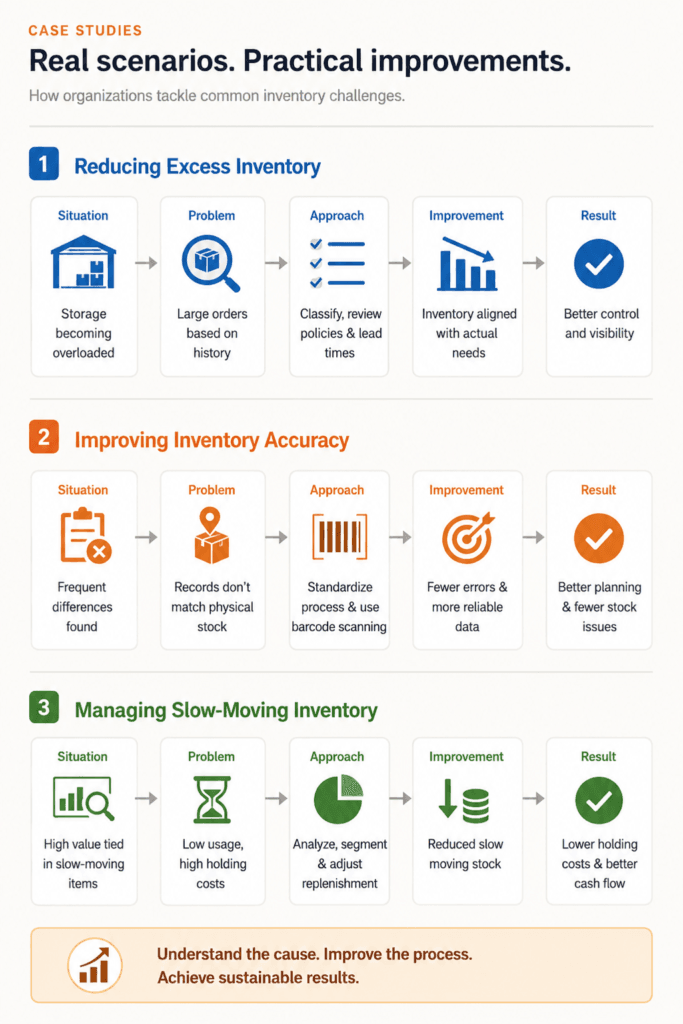
Illustrative Case Study 1: Reducing Excess Inventory
The Situation
Consider an illustrative Saudi manufacturing organization managing a broad range of materials.
The organization notices that storage areas are becoming increasingly difficult to manage. Some materials are frequently used, while others remain in storage for extended periods.
The Inventory Problem
An initial review shows that purchasing decisions are based heavily on historical ordering practices.
Large quantities are being purchased even when actual consumption does not consistently justify those quantities. The organization also has limited visibility into slow-moving inventory.
The Improvement Approach
The organization could begin by classifying inventory according to:
- Usage
- Criticality
- Demand
- Lead time
- Supply risk
It could then identify slow-moving materials and investigate why they are accumulating.
The organization could review:
- Ordering quantities
- Replenishment rules
- Purchasing frequency
- Demand information
- Supplier lead times
The objective would be to address the causes of excess inventory rather than simply reducing stock.
Expected Improvement
A better-controlled replenishment process could help the organization maintain inventory more closely aligned with actual operational requirements.
The organization could also improve visibility into materials requiring management attention.
Key Lesson
Excess inventory should be investigated as a process problem before it is treated as a stock reduction problem.
Illustrative Case Study 2: Improving Inventory Accuracy
The Situation
Consider an illustrative organization where employees frequently discover differences between physical inventory and system records.
These discrepancies make purchasing and production planning more difficult.
The Inventory Problem
Employees spend considerable effort checking inventory manually.
In some cases, materials appear available in the system but cannot be located physically. In other cases, materials are available physically but are not accurately reflected in system records.
The Improvement Approach
The organization could review the complete inventory transaction process. This could include:
- Receiving
- Put-away
- Storage
- Issuing
- Transfers
- Returns
- Counting
- Record updates
The organization could then standardize these activities and establish clear ownership.
Appropriate cycle counting could be introduced based on inventory characteristics.
Recurring discrepancies should also be investigated to identify their root causes.
Expected Improvement
More reliable inventory information can support better planning and purchasing decisions. It can also reduce unnecessary reconciliation work.
Key Lesson
Inventory optimization depends on trustworthy inventory information.
Illustrative Case Study 3: Reducing Work-in-Progress Inventory
The Situation
Consider a manufacturing organization where substantial work-in-progress accumulates between production stages.
Management initially believes that the additional inventory is necessary to protect production continuity.
The Inventory Problem
A Value Stream Mapping exercise reveals that the work-in-progress inventory is partly compensating for:
- Uneven process times
- Equipment interruptions
- Quality problems
- Waiting between processes
The inventory is functioning as a buffer.
The Improvement Approach
Instead of immediately removing the buffer, the organization could address the underlying causes.
Potential improvement activities could include:
- Process standardization
- Equipment reliability improvement
- Root cause analysis
- Quality improvement
- Better process synchronization
- Improved production planning
Once the processes become more predictable, inventory levels can be reassessed.
Expected Improvement
Improving process stability could reduce the organization’s dependence on large work-in-progress buffers.
The goal would be improved flow rather than simply lower inventory.
Key Lesson
Inventory can sometimes hide process instability.
Illustrative Case Study 4: Improving Material Flow
The Situation
Consider an organization where inventory is stored across multiple locations within a facility. Employees frequently move materials between storage areas and production processes.
The Inventory Problem
The organization discovers that employees spend significant time searching for and transporting materials.
Inventory levels may not be the primary issue. The problem is material flow.
The Improvement Approach
The organization could map material movement and review:
- Storage locations
- Material routes
- Frequently used items
- Picking patterns
- Handling activities
- Production delivery points
Frequently used materials could be positioned according to actual process requirements.
Storage and movement standards could also be established.
Expected Improvement
Improved material flow could reduce unnecessary movement and handling. It could also make inventory easier to locate and manage.
Key Lesson
Inventory efficiency includes how materials move, not only how much inventory exists.
Illustrative Case Study 5: Improving Inventory Visibility Through Digital Solutions
The Situation
Consider an illustrative organization managing inventory information through several systems and manual records. Management does not have a consistent view of inventory across the organization.
The Inventory Problem
Employees spend time collecting and reconciling information before making inventory decisions.
The organization wants better visibility but has not yet clearly defined the information requirements.
The Improvement Approach
The organization should first standardize inventory processes and determine which information is needed. It could then evaluate appropriate technologies such as:
- Inventory management systems
- Barcode-based tracking
- Automated data capture
- Warehouse management systems
- Inventory dashboards
- Inventory analytics
The technology should be selected according to the operational decisions it needs to support.
Expected Improvement
Better inventory visibility could support more timely and consistent inventory decisions. It could also reduce unnecessary manual information handling.
Key Lesson
Digital transformation should solve an inventory problem rather than become an inventory objective by itself.
Illustrative Case Study 6: Applying Just-in-Time Inventory
The Situation
Consider an illustrative manufacturer that maintains substantial material buffers because of concerns about replenishment reliability.
The Inventory Problem
The organization wants to explore Just-in-Time inventory principles but recognizes that simply reducing inventory could create shortages.
The Improvement Approach
The organization could first examine:
- Supplier lead times
- Replenishment reliability
- Inventory accuracy
- Production stability
- Quality performance
- Demand patterns
- Material criticality
It could then identify suitable materials for a controlled pull-based replenishment approach.
JIT should be introduced only where the operating conditions support it.
Expected Improvement
A more demand-driven replenishment system could reduce unnecessary inventory while maintaining required availability.
Key Lesson
Just-in-Time is a process discipline, not simply an instruction to hold less inventory.
What These Illustrative Cases Have in Common
Although each scenario involves a different inventory problem, the improvement logic is similar.
Start With the Problem
Do not begin with a technology or methodology. Begin by understanding what is going wrong.
Identify the Root Cause
Determine what process condition is creating the inventory problem.
Improve the Process
Address waste, variation, delays, quality issues, or information gaps.
Standardize the Improvement
Create clear processes and responsibilities.
Introduce Technology Where Appropriate
Use digital tools when they strengthen the improved process.
Measure the Outcome
Monitor relevant operational and inventory indicators.
Continue Improving
Inventory management should remain part of continuous improvement rather than a one-time project.
Lean Principles for Inventory Optimization in KSA
The illustrative examples demonstrate several Lean principles that can be applied to inventory optimization.
Eliminate Unnecessary Inventory
Identify stock that does not provide operational value.
Improve Flow
Reduce waiting, movement, and unnecessary handling.
Reduce Variation
Make processes more predictable.
Establish Pull
Replenish according to actual requirements where appropriate.
Standardize
Create consistent processes.
Solve Root Causes
Address the conditions creating inventory waste.
Involve Employees
Use practical knowledge from people working directly with the process.
These principles can support Lean inventory initiatives in Saudi Arabia when adapted to the organization’s actual operating conditions.
Inventory Management Digital Transformation Saudi Arabia
Digital transformation can support inventory efficiency when it addresses specific information or process challenges.
A practical approach can involve:
Current-State Assessment
Understand existing inventory systems, processes, and information.
Process Standardization
Establish consistent inventory processes.
Data Improvement
Address inaccurate or incomplete information.
Technology Selection
Identify tools appropriate to the organization’s requirements.
Implementation
Introduce the selected solution with appropriate workforce support.
Integration
Connect relevant information where necessary.
Performance Measurement
Evaluate the effect on inventory and operational performance.
This sequence helps ensure that technology supports inventory improvement rather than simply adding another system.
Smart Technologies in Inventory Management
Connected technologies can provide additional inventory information in suitable applications. Smart technologies in inventory management may support monitoring of inventory location, movement, or relevant environmental conditions. However, organizations should establish the business case before adopting connected technologies.
Questions should include:
- What information is needed?
- What problem will it solve?
- What decision will it improve?
- Who will use the information?
- How reliable is the existing data?
- Can the current process act on the information?
These questions help distinguish useful technology adoption from technology adoption for its own sake.
How Inventory Management Consultants Can Support Improvement
Organizations experiencing persistent inventory problems may require structured external support. Inventory management consultants in Saudi Arabia can potentially assist with:
- Inventory assessments
- Inventory optimization
- Lean inventory improvement
- Value Stream Mapping
- Material flow analysis
- Process standardization
- Inventory performance measurement
- Digital inventory improvement
Inventory management consulting in Saudi Arabia should be tailored to the organization’s specific inventory challenges. The objective should be to establish practical improvements that internal teams can understand, manage, measure, and sustain.
How to Measure Inventory Efficiency Improvement
Organizations should use multiple indicators to evaluate inventory performance.
Potential measures include:
- Inventory accuracy
- Inventory turnover
- Stock availability
- Stockout frequency
- Slow-moving inventory
- Obsolete inventory
- Replenishment performance
- Work-in-Progress
- Material lead time
- Order fulfillment
The right measures depend on the improvement objective.
For example, if the goal is inventory accuracy, accuracy should be a primary measure. If the goal is improving material flow, lead time and movement may be more relevant.
Measures should always be connected to the original problem.
Conclusion
The question of how Saudi companies improved inventory efficiency should not be answered with a single inventory method.
Different inventory problems require different solutions.
Organizations should first understand the inventory problem, identify its root causes, improve the underlying process, standardize the new approach, and then use appropriate technology where it can strengthen performance.
For businesses evaluating inventory management consulting in KSA, this approach provides a practical foundation for assessing where improvement opportunities exist and what type of intervention may be appropriate.
Inventory efficiency is ultimately about creating a reliable relationship between demand, supply, processes, information, and resources. When those elements work together, organizations can manage inventory more effectively while supporting broader Operational Excellence and continuous improvement.
Frequently Asked Questions
How can Saudi companies improve inventory efficiency?
Saudi companies can improve inventory efficiency by improving inventory accuracy, reducing unnecessary stock, optimizing material flow, standardizing replenishment, addressing process problems, and using appropriate digital inventory solutions.
What are the best inventory optimization techniques?
Inventory optimization techniques can include inventory classification, demand analysis, Value Stream Mapping, replenishment improvement, cycle counting, Lean principles, Just-in-Time practices, and inventory performance measurement.
How can Lean principles reduce inventory waste?
Lean principles can reduce inventory waste by identifying unnecessary stock and addressing the process problems that create inventory buffers, such as long lead times, poor quality, unreliable processes, and inefficient material flow.
Can digital transformation improve inventory efficiency?
Yes. Digital transformation can improve inventory visibility, data collection, analytics, and selected replenishment or warehouse processes. Its effectiveness depends on process readiness, data quality, and appropriate technology selection.
What are the benefits of smart inventory solutions in KSA?
Smart inventory solutions can provide better inventory visibility, more efficient data collection, improved tracking, and stronger decision support. The appropriate benefits depend on the organization’s specific inventory requirements and implementation approach.