
Inventory management can directly influence operational efficiency, working capital, customer service, and business continuity. Saudi businesses can face inventory challenges ranging from inaccurate stock records and excess inventory to stockouts, inefficient storage, weak demand visibility, and inconsistent replenishment practices. Solving these issues requires more than reducing stock levels.
Organizations need to understand the causes behind inventory problems and improve the processes that create them. Lean principles, better inventory visibility, standardized processes, and appropriate digital solutions can help organizations build more responsive and efficient inventory systems.
Key Takeaways
- Inventory challenges often originate from planning, process, information, and coordination issues.
- Excess inventory and stockouts can both indicate weaknesses in inventory management.
- Inventory accuracy and visibility are foundations for better inventory decisions.
- Lean methods can help reduce inventory waste by addressing underlying process problems.
- Digital inventory solutions can strengthen visibility when supported by standardized processes and reliable data.
What Are the Top Inventory Challenges for Saudi Businesses?
Inventory problems rarely exist in isolation.
A business may experience excess stock while also experiencing shortages of critical items. A warehouse may hold significant inventory while employees still struggle to locate the materials they need. A purchasing team may place frequent orders because inventory information is unreliable.
These situations demonstrate why inventory management requires a systems-level view.
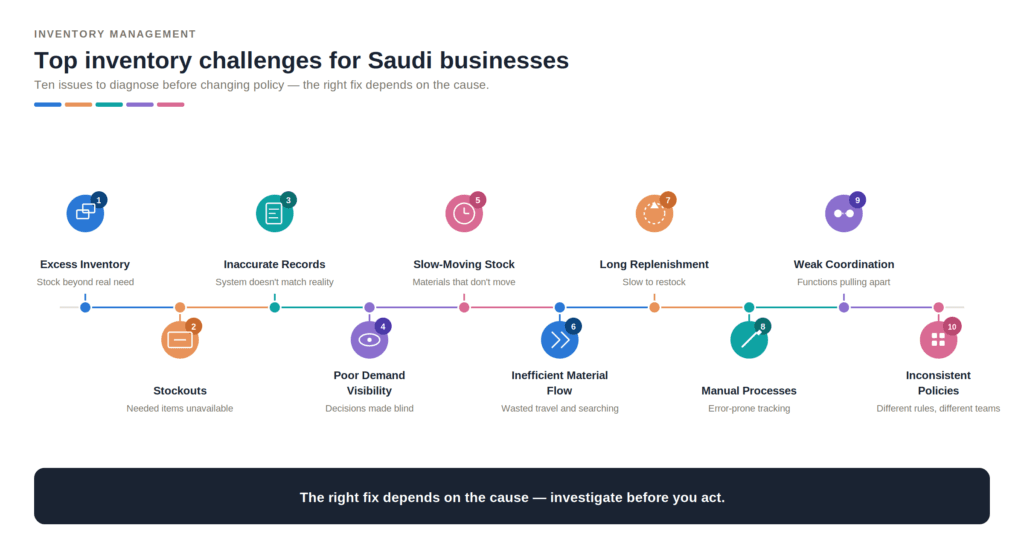
The most common inventory challenges include:
- Excess inventory
- Inventory shortages and stockouts
- Inaccurate inventory records
- Poor demand visibility
- Slow-moving and obsolete inventory
- Inefficient storage and material movement
- Long replenishment cycles
- Manual inventory processes
- Weak coordination between functions
- Inconsistent inventory policies
The appropriate solution depends on the underlying cause.
1. Excess Inventory
Excess inventory occurs when an organization holds more stock than required to support its operational or customer needs.
It can consume storage capacity and tie up working capital while increasing handling and inventory management requirements.
Excess inventory may result from:
- Inaccurate demand assumptions
- Large purchasing quantities
- Long replenishment cycles
- Poor inventory classification
- Unclear replenishment rules
- Limited visibility into existing stock
- Changes in customer requirements
- Weak coordination between functions
How to Solve Excess Inventory
Organizations should first identify why excess inventory exists.
Useful steps can include:
- Classifying inventory according to usage and importance
- Identifying slow-moving materials
- Reviewing ordering quantities
- Reviewing replenishment policies
- Improving demand information
- Investigating long lead times
- Establishing regular inventory reviews
The goal should not be to reduce inventory indiscriminately.
The objective is to determine what inventory is genuinely required and why.
2. Inventory Shortages and Stockouts
Stockouts occur when required inventory is unavailable when needed.
They can affect production, fulfillment, customer service, and operational continuity.
A stockout does not necessarily mean the organization has too little total inventory.
Inventory may exist elsewhere in the system but be unavailable at the required location or time.
Potential causes include:
- Poor demand visibility
- Inaccurate inventory records
- Unreliable replenishment
- Long lead times
- Poor inventory allocation
- Weak planning
- Supplier-related uncertainty
How to Solve Stockouts
Organizations can examine:
- Replenishment rules
- Lead times
- Inventory accuracy
- Demand patterns
- Critical inventory categories
- Supplier performance
- Stock availability by location
A useful principle is to investigate the reason for repeated shortages instead of simply increasing inventory.
Increasing stock may hide the problem rather than solve it.
3. Inaccurate Inventory Records
Inventory accuracy is one of the foundations of effective inventory management.
If physical inventory differs from system records, employees may make purchasing, planning, and operational decisions based on incorrect information.
This can lead to:
- Unnecessary purchasing
- Stockouts
- Duplicate orders
- Difficulties locating materials
- Excess inventory
- Additional reconciliation work
How to Improve Inventory Accuracy
Organizations can strengthen inventory accuracy by:
- Standardizing inventory transactions
- Defining inventory ownership
- Improving receiving and issuing procedures
- Using appropriate cycle counting
- Investigating recurring discrepancies
- Improving data discipline
- Applying automated data capture where appropriate
Digital systems can help, but accurate information ultimately depends on reliable processes.
4. Poor Demand Visibility
Inventory decisions depend heavily on understanding demand.
When demand information is incomplete, delayed, or inconsistent, organizations can struggle to determine how much inventory they actually require.
Poor demand visibility can contribute to both excess inventory and stockouts.
How to Improve Demand Visibility
Businesses can improve planning by:
- Reviewing historical consumption
- Understanding demand patterns
- Separating predictable and variable demand
- Improving communication between relevant functions
- Reviewing inventory assumptions regularly
- Using appropriate forecasting methods
The objective is not to eliminate uncertainty.
It is to make inventory decisions using the best available information.
5. Slow-Moving and Obsolete Inventory
Some inventory items move slowly or may eventually become obsolete.
This can create storage requirements and tie up resources that could otherwise be used more effectively.
Slow-moving inventory can result from:
- Changes in demand
- Product changes
- Large purchasing quantities
- Poor inventory classification
- Inaccurate planning
- Changes in operational requirements
How to Manage Slow-Moving Inventory
Organizations should regularly identify slow-moving items and investigate why they are not being consumed.
Possible actions include:
- Reviewing future requirements
- Adjusting replenishment policies
- Improving inventory classification
- Reviewing purchasing quantities
- Establishing clear management rules for aging stock
The appropriate action depends on the material and its operational importance.
6. Inefficient Storage and Material Movement
Inventory efficiency is also influenced by how materials move through a facility.
Poor storage arrangements can result in unnecessary:
- Travel
- Handling
- Searching
- Movement
- Waiting
These activities consume workforce capacity without directly increasing inventory value.
How to Improve Material Flow
Organizations can review:
- Storage locations
- Material movement
- Picking routes
- Frequently accessed inventory
- Storage layouts
- Handling procedures
Value Stream Mapping can help teams visualize material and information flows and identify unnecessary movement and waiting.
This connects inventory improvement with broader Lean and Operational Excellence practices.
7. Long Replenishment Cycles
Long replenishment cycles can make inventory planning more difficult.
When organizations cannot replenish materials quickly or predictably, they may maintain additional stock to protect against shortages.
This can create a relationship between lead time and inventory levels.
How to Solve Replenishment Problems
Organizations can examine:
- Procurement processes
- Approval requirements
- Supplier lead times
- Order quantities
- Replenishment frequency
- Internal material movement
- Information flow
Reducing replenishment time where practical can reduce the need for unnecessary inventory buffers.
8. Manual Inventory Processes
Manual processes can create unnecessary administrative work and increase the possibility of inconsistent information.
Examples include:
- Manual stock updates
- Spreadsheet-based tracking
- Repetitive reporting
- Manual reconciliation
- Paper-based transactions
Not every manual process requires automation.
Organizations should first identify which activities create significant inefficiency or information risk.
How Digital Solutions Can Help
Appropriate inventory management solutions that KSA organizations can consider may include:
- Inventory management systems
- Barcode-based tracking
- Automated data capture
- Warehouse management systems
- Inventory dashboards
- Inventory analytics
- Automated replenishment support
The technology should address a defined operational requirement.
9. Weak Coordination Between Functions
Inventory management often involves several functions. Procurement, planning, operations, warehousing, sales, finance, and logistics may all influence inventory levels.
When these functions work with different priorities or assumptions, inventory performance can suffer. For example, purchasing may prioritize large order quantities while operations prioritize availability and finance focuses on working capital.
How to Improve Coordination
Organizations can establish:
- Shared inventory objectives
- Clear responsibilities
- Standardized inventory policies
- Common performance measures
- Regular cross-functional reviews
Inventory should be managed as a connected business process rather than as the responsibility of one department.
10. Inconsistent Inventory Policies
Different teams may sometimes apply different rules when deciding:
- When to reorder
- How much to order
- Which items require greater attention
- How to classify inventory
- How often inventory should be reviewed
This can create inconsistent decisions.
How to Improve Inventory Policies
Organizations should establish clear, documented policies based on operational requirements.
Policies may cover:
- Inventory classification
- Replenishment
- Stock reviews
- Cycle counting
- Slow-moving inventory
- Critical inventory
- Ordering rules
Policies should also be reviewed when demand, processes, or supply conditions change.
How Lean Inventory Can Solve Common Challenges
Lean inventory approaches for Saudi Arabia focus on identifying and reducing waste while improving material flow.
Inventory itself can sometimes be a symptom of another operational problem.
For example, additional stock may exist because of:
- Unreliable processes
- Long lead times
- Quality problems
- Equipment interruptions
- Unpredictable demand
- Poor supplier coordination
Simply reducing inventory without addressing these causes can create new risks.
Lean inventory improvement therefore asks:
Why does this inventory exist?
The answer can reveal opportunities beyond inventory management itself.
Using Value Stream Mapping for Inventory Improvement
Value Stream Mapping (VSM) can help organizations visualize the movement of materials and information across a process.
A current-state analysis can identify:
- Inventory accumulation
- Waiting
- Unnecessary movement
- Process delays
- Information gaps
- Bottlenecks
- Repeated activities
Teams can then develop a future-state process that reduces unnecessary activity and improves flow.
This makes Value Stream Mapping a useful tool for inventory optimization techniques.
Just-in-Time Inventory in KSA
Just-in-Time inventory strategies aim to make materials available when they are required instead of maintaining unnecessarily high stock levels.
JIT can support inventory efficiency when the surrounding processes are sufficiently stable.
Relevant conditions can include:
- Reliable replenishment
- Accurate inventory information
- Appropriate planning
- Predictable processes
- Effective supplier coordination
- Consistent quality
JIT should therefore not be reduced to simply keeping less inventory.
A successful JIT approach requires the organization to improve the processes that determine how and when inventory is required.
Smart Inventory Solutions KSA Businesses Can Consider
Technology can improve inventory visibility and decision making when applied to the right processes.
Potential smart inventory solutions that KSA organizations may evaluate include:
- Automated inventory tracking
- Barcode systems
- Warehouse management systems
- Inventory dashboards
- Inventory analytics
- Automated data capture
- Replenishment systems
- Connected inventory information
The appropriate solution depends on the organization’s processes, information requirements, scale, and operational maturity.
Technology selection should follow process analysis rather than precede it.
Inventory Management Digital Transformation in Saudi Arabia
Inventory management digital transformation initiatives can help organizations in Saudi Arabia move from fragmented or manual inventory processes toward more connected information and improved visibility.
A practical transformation sequence can include:
Assess
Understand current inventory processes, systems, data, and challenges.
Standardize
Create consistent processes and definitions.
Improve
Remove unnecessary steps and address root causes.
Digitize
Introduce technology where it can improve a defined process.
Integrate
Connect relevant information across appropriate systems.
Measure
Monitor whether the changes are improving inventory performance.
Continuously Improve
Use performance information to identify further opportunities.
This approach helps prevent organizations from simply digitizing inefficient processes.
When Do Businesses Need Inventory Management Consultants?
Organizations may require structured external support when problems are persistent, cross-functional, or difficult to diagnose.
Inventory management consultants in Saudi Arabia can support organizations with structured approaches to areas such as:
- Inventory assessment
- Inventory optimization
- Process analysis
- Lean inventory improvement
- Material flow analysis
- Inventory performance measurement
- Process standardization
- Inventory-related digital transformation
Inventory management consulting for Saudi Arabia should be aligned with the organization’s actual operational requirements.
The objective should be to identify root causes, implement appropriate improvements, and establish methods for sustaining performance.
A Practical Framework for Solving Inventory Challenges
Organizations can use the following sequence to approach inventory improvement.
Step 1: Identify the Problem
Determine whether the primary issue is excess stock, shortages, accuracy, movement, replenishment, visibility, or another factor.
Step 2: Measure the Current State
Establish a reliable baseline using relevant inventory and operational information.
Step 3: Identify Root Causes
Investigate the processes creating the problem.
Step 4: Prioritize Improvements
Focus on issues that have meaningful operational consequences.
Step 5: Improve the Process
Use Lean principles, standardization, process improvement, or other appropriate methods.
Step 6: Evaluate Technology
Determine whether digital tools can strengthen the improved process.
Step 7: Standardize
Document successful methods and establish clear responsibilities.
Step 8: Monitor and Improve
Track performance and continue addressing emerging inventory problems.
How to Measure Inventory Improvement
Organizations should use measures that reflect both inventory efficiency and operational performance.
Potential indicators include:
- Inventory accuracy
- Stock availability
- Inventory turnover
- Stockout frequency
- Slow-moving inventory
- Obsolete inventory
- Replenishment performance
- Order fulfillment
- Inventory carrying requirements
No individual measure tells the complete story.
For example, reducing inventory levels while increasing stockouts would not necessarily represent successful inventory optimization.
A balanced measurement approach is therefore important.
Conclusion
The top inventory challenges for Saudi businesses can include excess inventory, stockouts, inaccurate records, poor demand visibility, slow-moving materials, inefficient storage, long replenishment cycles, manual processes, weak coordination, and inconsistent inventory policies.
Each challenge requires a different response. The most effective approach is not simply to reduce inventory. It is to understand why inventory exists, identify the processes influencing inventory performance, and improve those processes systematically.
For organizations considering inventory management consulting in KSA, the starting point should be a clear understanding of the current inventory situation and the operational problems that need to be solved.
Frequently Asked Questions
What are the top inventory challenges for Saudi businesses?
Common inventory challenges include excess inventory, stockouts, inaccurate inventory records, poor demand visibility, slow-moving inventory, inefficient storage, long replenishment cycles, manual processes, and inconsistent inventory policies.
How can businesses solve inventory challenges in Saudi Arabia?
Businesses can solve inventory challenges by identifying root causes, improving inventory accuracy, standardizing processes, optimizing replenishment, improving material flow, applying Lean principles, and using appropriate digital inventory solutions.
How can Lean inventory improve inventory management?
Lean inventory practices can reduce unnecessary stock, movement, waiting, and other forms of waste by addressing the process problems that create inventory requirements.
What are the benefits of JIT inventory systems for Saudi businesses?
JIT can help reduce unnecessary inventory and improve material flow when supported by reliable processes, accurate information, effective replenishment, appropriate planning, and suitable supplier coordination.
When should a business use Inventory Management Consultants?
Businesses may consider Inventory Management Consultants when inventory problems are persistent, cross-functional, or require structured assessment and improvement support across inventory processes, Lean practices, optimization, or digital transformation.