In Kenya, manufacturing competitiveness is increasingly defined by one factor: how effectively factories convert existing resources into output without unnecessary loss.
In practice, many manufacturing plants are not limited by demand or installed capacity; they are limited by internal inefficiencies that silently reduce productive output every day.
This is why waste reduction has become one of the most important drivers of operational performance improvement in the manufacturing industry.
Rather than being a cost-cutting initiative, waste reduction is a system-level approach that improves how production, maintenance, quality, and planning interact.
What Waste Reduction Means in Manufacturing Systems
In manufacturing terms, waste refers to any activity that consumes resources but does not create value for the customer.
In Kenyan manufacturing environments, waste typically exists in four interconnected layers:
- Process waste (inefficient workflows, unnecessary steps)
- Time waste (waiting, delays, machine idle time)
- Resource waste (materials, energy, labor underutilization)
- Flow waste (poor coordination between production stages)
What makes waste particularly damaging is that it rarely appears as a single issue; it accumulates across systems and compounds over time.
This is why building manufacturing efficiency through waste reduction must be approached as a system redesign project, not a localized improvement effort.
Core Benefits of Waste Reduction in Kenyan Manufacturing
The benefits of waste reduction are best understood as system-wide performance gains, not isolated improvements.
1. Recovery of Hidden Production Capacity (Not Just Efficiency Gains)
The most significant impact of waste reduction is the recovery of latent capacity already existing within the system.
This happens when factories:
- Remove bottlenecks in production flow
- Eliminate idle machine time
- Reduce waiting between processes
- Balance workloads across shifts
In many Kenyan factories, this results in capacity gains without new machinery investment because the constraint is not equipment; it is flow structure.
This is a core outcome of operational waste reduction in factories.
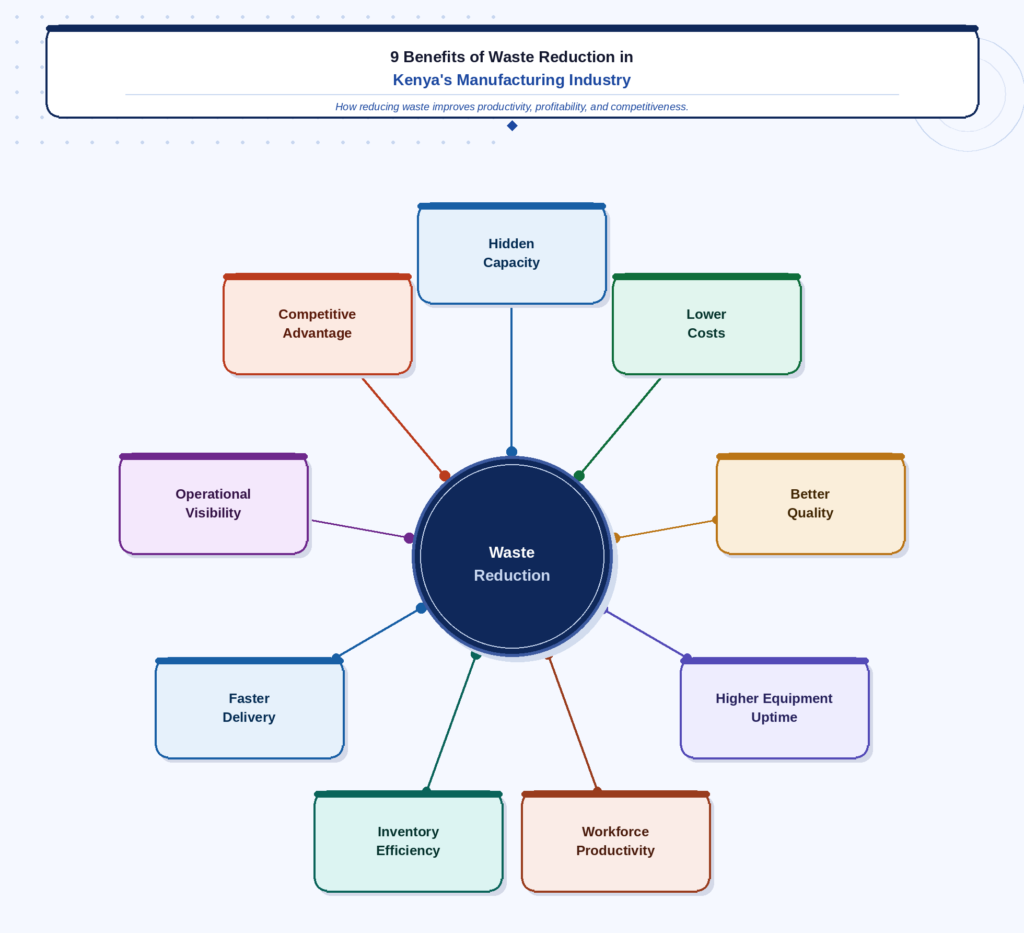
2. Structural Reduction in Cost per Unit (Not Marginal Savings)
Waste directly determines cost structure in manufacturing industries across Kenya.
When waste is reduced at the system level:
- Material losses decrease at source
- Energy consumption becomes more efficient per output unit
- Labor productivity increases per shift hour
- Maintenance costs shift from reactive to preventive models
This is why waste reduction methods for manufacturing processes often produce more impact on profitability than pricing strategies or sales expansion.
3. Quality Stability Through Process Control
In manufacturing systems, poor quality is rarely a standalone issue; it is usually a symptom of process variability.
Waste reduction improves quality by stabilizing:
- Work methods across shifts
- Machine operating conditions
- Material handling processes
- Inspection and feedback loops
As variability reduces, defect rates decline naturally.
This makes production waste control strategies essential for consistent product output in Kenya’s manufacturing industries.
4. Machine Uptime Improvement Through Loss Elimination
Machine downtime in Kenyan factories is often misclassified as “equipment failure” when in reality it is frequently caused by preventable operational losses.
Waste reduction improves uptime through:
- Preventive maintenance systems
- Early failure detection routines
- Operator-level machine care
- Planned maintenance scheduling
The result is not just fewer breakdowns, but more predictable production planning cycles. This is a key driver of productivity optimization strategies for manufacturing industries.
5. Workforce Productivity Improvement Through Process Clarity
Labor inefficiency is rarely about effort; it is usually about system design.
Waste reduction improves workforce productivity by:
- Eliminating unnecessary movement between tasks
- Standardizing operating procedures across shifts
- Reducing waiting time between operations
- Clarifying task ownership and workflow sequencing
When processes are stable, labor output becomes more predictable and scalable.
This is central to achieving manufacturing efficiency through waste reduction.
6. Inventory Efficiency and Working Capital Release
Inventory is one of the most overlooked forms of waste in manufacturing systems.
Excess inventory leads to:
- Capital being locked in raw materials and WIP
- Storage inefficiencies
- Material obsolescence risk
- Hidden production imbalances
Waste reduction improves financial performance by aligning inventory levels with actual production demand rather than historical ordering behavior.
This improves liquidity and operational flexibility simultaneously.
7. Faster Production Cycles and Improved Delivery Reliability
When waste is removed from production flow, cycle times naturally decrease.
This leads to:
- Faster order completion
- Reduced production lead times
- More stable delivery schedules
- Improved responsiveness to demand fluctuations
In competitive markets, delivery reliability often becomes as important as product quality.
8. Data-Driven Operational Control
In Kenya’s manufacturing sectors, consulting for modern industrial waste reduction relies heavily on production visibility systems.
These include:
- Overall Equipment Effectiveness (OEE) tracking
- Downtime categorization systems
- Real-time production dashboards
- KPI-based performance monitoring
This visibility shifts decision-making from reactive problem-solving to proactive system control.
9. Competitive Positioning in Regional and Export Markets
Manufacturers that successfully reduce waste also gain structural competitive advantages:
- Lower production costs enable pricing flexibility
- Higher consistency improves export readiness
- Improved efficiency increases scalability
- Better reliability strengthens customer relationships
In East African manufacturing markets, operational efficiency is increasingly a competitive differentiator, not just an internal metric.
Why Waste Reduction Is a Strategic Necessity in Kenya
Waste reduction is particularly critical in Kenya due to:
- Rising input and energy costs
- Strong import competition
- Demand variability in FMCG markets
- Pressure for faster fulfillment cycles
In Kenya’s manufacturing environment, waste reduction functions as both an efficiency strategy and a survival mechanism.
Role of Consulting in Achieving Measurable Results
Many factories understand waste reduction conceptually but struggle with execution.
This is where industrial waste reduction consulting becomes important, as it provides:
- Structured diagnostic assessments
- Root cause identification at system level
- Lean transformation design
- Implementation support on the shop floor
- KPI-driven performance tracking systems
The difference between theory and results is execution discipline, not knowledge.
Why These Benefits Are Consistently Achievable
These outcomes are consistent across manufacturing environments because they are based on established industrial systems:
- Lean manufacturing principles (flow efficiency)
- Industrial engineering (process optimization)
- Kaizen systems (continuous improvement)
- ISO-aligned operational standards (process control)
The reliability of results comes from the fact that these frameworks focus on measurable system variables such as:
- Output per hour
- Defect rates
- Equipment uptime
- Cycle time reduction
Conclusion
The benefits of waste reduction are not incremental; they are structural.
For Kenyan manufacturers, waste reduction is one of the most effective ways to unlock hidden capacity, reduce operational costs, and improve long-term competitiveness without major capital investment.
When waste is systematically removed from production systems, factories do not simply become faster; they become more stable, predictable, and scalable.
Ultimately, waste reduction is not an efficient initiative. It is a manufacturing performance redesign strategy.
FAQs
What is waste reduction in Kenyan manufacturing?
In Kenyan manufacturing, waste reduction is the systematic removal of non-value-adding activities such as downtime, defects, excess inventory, and inefficiencies in production processes to improve output, reduce costs, and increase overall efficiency.
How does waste reduction improve manufacturing efficiency?
Waste reduction improves efficiency by increasing production flow, reducing machine downtime, eliminating unnecessary movement, and stabilizing processes. This allows factories to produce more output using the same resources.
Why is waste reduction important for Kenyan manufacturers?
It is important because manufacturers in Kenya face rising input costs, energy expenses, and competitive pressure. Waste reduction helps improve profitability without requiring new capital investment or machinery.
How does waste reduction affect manufacturing costs?
Waste reduction lowers manufacturing costs by reducing material waste, improving labor productivity, minimizing machine downtime, and optimizing energy usage. This directly reduces cost per unit of production.
Can manufacturers improve output without buying new machines?
Yes. Many factories achieve 15–40% productivity gains through waste reduction alone by improving flow, reducing downtime, and eliminating inefficiencies in existing systems.