Manufacturers are under increasing pressure to improve profitability while navigating rising labor costs, supply chain volatility, energy price fluctuations, and growing customer expectations. As a result, many organizations are exploring Artificial Intelligence (AI) as a way to accelerate cost reduction in manufacturing industry operations.
The appeal is understandable. AI promises predictive maintenance, intelligent scheduling, automated quality control, and data-driven decision-making, all of which can contribute to significant savings.
However, there is a common misconception that AI alone can solve manufacturing cost challenges.
In reality, AI is most effective when it is built on a foundation of Operational Excellence. Manufacturers that achieve the greatest return on AI investments are typically those that first focus on process stability, equipment reliability, workforce alignment, and continuous improvement.
Understanding the relationship between AI and Operational Excellence is essential for organizations pursuing sustainable manufacturing cost optimization.
How Does AI Reduce Manufacturing Costs?
AI helps manufacturers identify patterns, predict outcomes, and optimize decisions using operational data. Unlike traditional systems that react to problems after they occur, AI enables organizations to anticipate issues before they affect production.
Some of the most common ways AI contributes to cost reduction include:
Predictive Maintenance
AI analyzes equipment performance data to identify early signs of failure. This allows maintenance teams to address issues before breakdowns occur.
Potential benefits include:
- Reduced unplanned downtime
- Lower emergency repair costs
- Improved equipment lifespan
- Better resource utilization
Predictive maintenance is often cited as one of the fastest ways to reduce production costs because equipment reliability directly impacts productivity and operating expenses.
Automated Quality Control Systems
Quality-related costs can quickly erode profitability through scrap, rework, warranty claims, and customer complaints.
AI-powered automated quality control systems use machine vision and analytics to detect defects earlier and more consistently than traditional inspection methods.
Benefits include:
- Reduced waste
- Lower rework costs
- Improved product consistency
- Faster inspection processes
Supply Chain Cost Management
AI can improve forecasting accuracy, inventory planning, and procurement decisions.
Organizations often use AI to:
- Optimize inventory levels
- Anticipate demand fluctuations
- Improve supplier performance visibility
- Reduce excess stock
These improvements support more effective supply chain cost management while helping manufacturers maintain service levels.
Factory Energy Saving Techniques
Energy consumption remains a major operating expense across many industries.
AI can support factory energy saving techniques by identifying inefficient equipment usage, optimizing production schedules, and monitoring consumption patterns.
Potential outcomes include:
- Reduced utility costs
- Improved sustainability performance
- Better energy utilization across operations
Production Planning and Resource Optimization
AI-powered planning tools can help manufacturers improve production flow and resource allocation.
Benefits may include:
- Reduced bottlenecks
- Improved throughput
- Better workforce utilization
- Increased production efficiency
These capabilities make AI an attractive option for manufacturers pursuing Operational Excellence in manufacturing environments.
Why Many AI Initiatives Fail to Deliver Expected Results
Despite the potential benefits, many manufacturing organizations struggle to achieve meaningful returns from AI investments.
The issue is rarely the technology itself.
More often, the challenge lies in the operational environment where the technology is deployed.
During improvement engagements, organizations frequently encounter issues such as:
- Inconsistent production processes
- Unreliable equipment performance
- Poor data quality
- Lack of standardized work procedures
- Limited cross-functional visibility
- Reactive maintenance practices
When these foundational issues exist, AI often highlights operational problems rather than solving them.
Technology can accelerate improvement, but it cannot replace operational discipline.
This is why successful AI adoption typically begins with Operational Excellence.
Operational Excellence: The Foundation of AI-Driven Cost Reduction
Operational Excellence in manufacturing focuses on continuously improving performance through disciplined processes, reliable systems, and effective management practices.
Rather than pursuing technology as the starting point, leading manufacturers focus on eliminating inefficiencies that drive unnecessary costs.
Organizations that establish strong operational foundations are often better positioned to realize value from AI initiatives.
Lean Manufacturing Waste Reduction
Reducing waste through lean manufacturing remains one of the most effective approaches to lowering operating costs.
Waste often exists in the form of:
- Overproduction
- Excess inventory
- Waiting time
- Unnecessary movement
- Rework and defects
- Inefficient workflows
Addressing these issues creates immediate savings while improving process visibility.
When AI is introduced into lean operations, it can amplify gains that have already been achieved through continuous improvement efforts.
Industrial Process Improvement
Many manufacturing costs originate from inefficient workflows rather than major operational failures.
Industrial process improvement focuses on identifying bottlenecks, reducing variation, and improving process consistency.
Common improvement opportunities include:
- Reducing changeover times
- Improving production flow
- Standardizing work methods
- Optimizing resource allocation
- Enhancing communication between departments
Organizations that improve process performance create more reliable operational data, which is essential for successful AI applications.
Preventive Maintenance Strategies
Equipment reliability is a critical component of manufacturing cost optimization.
Without stable equipment performance, AI-driven maintenance initiatives often struggle to produce accurate recommendations.
Strong preventive maintenance strategies typically include:
- Scheduled inspections
- Condition monitoring
- Reliability analysis
- Maintenance planning
- Root cause problem solving
These practices reduce downtime while creating the operational stability necessary for predictive technologies to perform effectively.
Manufacturing Overhead Reduction
Many organizations focus on direct production costs while overlooking the impact of overhead expenses.
Manufacturing overhead reduction often requires improvements in:
- Resource utilization
- Scheduling efficiency
- Process standardization
- Maintenance effectiveness
- Inventory management
Addressing these areas creates a stronger operational foundation that supports both cost reduction and future technology adoption.
A Practical Roadmap for Sustainable Cost Reduction
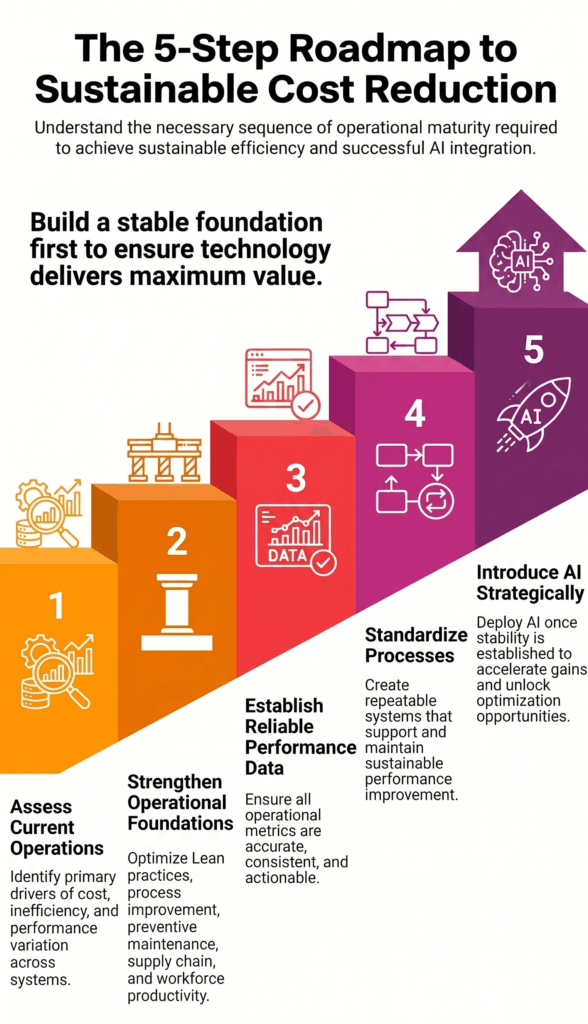
Manufacturers seeking long-term performance improvement should consider a structured approach.
Step 1: Assess Current Operations
Identify the primary drivers of cost, inefficiency, and performance variation across production systems.
Step 2: Strengthen Operational Foundations
Focus on:
- Lean manufacturing waste reduction
- Industrial process improvement
- Preventive maintenance strategies
- Supply chain cost management
- Workforce productivity enhancement
Step 3: Establish Reliable Performance Data
Ensure operational metrics are accurate, consistent, and actionable.
Step 4: Standardize Processes
Create repeatable systems that support sustainable improvement.
Step 5: Introduce AI Where It Delivers Clear Value
Once operational stability has been established, AI can help accelerate performance gains and unlock additional optimization opportunities.
This approach often produces more sustainable results than implementing technology before operational issues have been addressed.
The Role of Manufacturing Consulting in AI Readiness
Many manufacturers understand the potential of AI but struggle to determine where to begin.
The challenge is not selecting technology, it is preparing the organization to use technology effectively.
Manufacturing consulting helps organizations evaluate operational maturity, identify performance gaps, and establish the systems required for sustainable improvement.
Areas of focus often include:
- Operational Excellence programs
- Lean manufacturing implementation
- Process improvement initiatives
- Maintenance system optimization
- Supply chain performance enhancement
- Manufacturing transformation strategies
By strengthening operational fundamentals first, organizations improve both immediate performance and long-term readiness for digital transformation.
Conclusion
AI has the potential to drive significant cost reduction in manufacturing industry operations through predictive maintenance, automated quality control systems, supply chain optimization, and energy management.
However, technology alone is rarely the answer.
The manufacturers that achieve the greatest results are those that first build strong operational foundations through lean manufacturing waste reduction, industrial process improvement, preventive maintenance strategies, and Operational Excellence in manufacturing.
When operational systems are stable, measurable, and continuously improving, AI becomes a powerful accelerator rather than an expensive experiment.
For organizations pursuing sustainable manufacturing cost optimization, Operational Excellence should not be viewed as separate from AI strategy, it should be considered the foundation that makes AI successful.
Frequently Asked Questions (FAQs)
How to implement cost reduction in the manufacturing industry?
Cost reduction in the manufacturing industry is most effective when organizations combine operational excellence in manufacturing, industrial process improvement, preventive maintenance strategies, and targeted AI adoption to improve efficiency and eliminate waste.
What are the best practices for cost reduction in the manufacturing industry?
Best practices for cost reduction in the manufacturing industry include Lean manufacturing waste reduction, manufacturing cost optimization, supply chain cost management, factory energy saving techniques, and automated quality control systems.
Why is Operational Excellence important for manufacturing cost optimization?
Operational Excellence in manufacturing creates stable processes, reliable data, and continuous improvement systems that enable sustainable manufacturing cost optimization and successful AI implementation.
What are the future trends of cost reduction in the manufacturing industry?
Future trends of cost reduction in the manufacturing industry include greater use of AI, predictive analytics, automated quality control systems, smart energy management, and data-driven manufacturing cost optimization.