Manufacturers face constant pressure to reduce costs and improve profitability. However, not all cost-reduction initiatives deliver equal financial impact.
Some initiatives reduce expenses but also reduce production capacity, efficiency, or quality, ultimately lowering profitability instead of improving it.
This is why modern manufacturers are shifting from simple cost cutting to Return on Investment (ROI)-driven manufacturing cost optimization.
The real objective is not just to reduce costs, but to ensure that every improvement increases profitability per unit of output.
What ROI Means in Manufacturing Cost Reduction
ROI in manufacturing cost reduction refers to the measurable financial benefit gained from efficiency improvements compared to implementation cost.
It answers a critical question:
Is the improvement increasing profitability or only reducing spending?
Key ROI indicators include:
- Cost per unit produced
- Output per machine hour
- Downtime cost impact
- Labor efficiency per shift
- Energy cost per production cycle
Manufacturing Cost Reduction vs Manufacturing Cost Optimization
Many organizations use the terms manufacturing cost reduction and manufacturing cost optimization interchangeably, but they are not the same.
Manufacturing cost reduction focuses on lowering expenses. Manufacturing cost optimization focuses on improving profitability while maintaining or improving production performance.
For example, reducing maintenance budgets may lower short-term expenses but increase equipment failures and downtime. In contrast, optimizing maintenance through preventive maintenance programs can reduce total operating costs while improving production reliability.
This distinction is important because sustainable manufacturing cost reduction requires balancing cost, quality, throughput, and customer service levels.
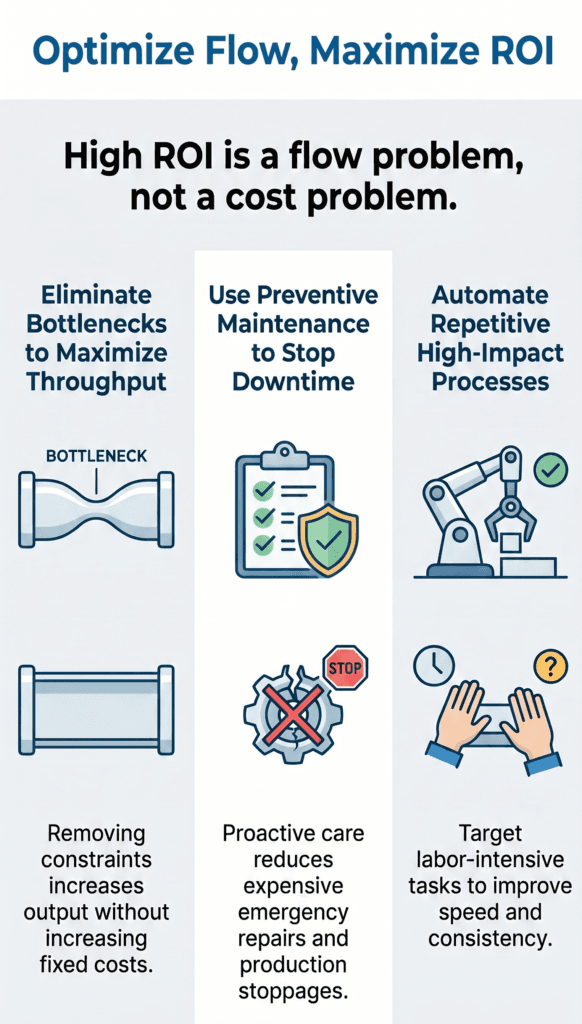
ROI Is a Flow Problem, Not a Cost Problem
A critical principle in manufacturing economics is:
ROI is determined by how efficiently value flows through a system, not just how much cost is removed.
This means:
- Improving flow increases output without increasing cost
- Reducing cost without improving flow may reduce ROI
- The highest ROI comes from removing constraints, not expenses
The Role of Throughput in Manufacturing ROI
Throughput is one of the most important drivers of manufacturing profitability.
When manufacturers increase throughput without significantly increasing operating costs, profitability improves naturally. This is why many operational excellence programs focus first on identifying and removing constraints within production systems.
A production line producing 15% more output using the same assets often delivers greater ROI than a project that reduces costs by 5% but limits production capacity.
This principle is reflected in widely adopted manufacturing improvement approaches such as Lean Manufacturing and the Theory of Constraints, which prioritize throughput improvement, bottleneck reduction, and production flow optimization as key drivers of profitability.
ROI Priority Model in Manufacturing
Not all cost reduction initiatives deliver equal value.
Tier 1 (Highest ROI)
- Bottleneck elimination
- Preventive and predictive maintenance systems
- Automation of repetitive processes
Tier 2 (Medium ROI)
- Energy optimization
- Supply chain improvements
- Workforce productivity systems
Tier 3 (Low or Risky ROI)
- Workforce reduction
- Raw material cost cutting
- Budget cuts without process redesign
Key insight:
High ROI comes from improving system flow, not reducing inputs.
Why Cost Reduction Alone Does Not Guarantee ROI
Lower costs do not always improve profitability.
Examples:
- Reducing labor may increase bottlenecks
- Cheaper materials may increase defects
- Cutting maintenance may increase downtime
This is why manufacturing cost optimization must always be evaluated through financial impact, not just expense reduction.
High-ROI Strategy 1: Bottleneck Elimination
Bottlenecks limit total system output.
ROI impact:
- Increases throughput without increasing fixed cost
- Improves machine utilization
- Reduces idle time
Bottleneck removal often delivers the highest ROI in manufacturing systems.
Why Bottlenecks Create Hidden Manufacturing Costs
Bottlenecks impact more than production output.
When constraints exist within a manufacturing system, they often create additional hidden costs such as:
- Excess work-in-progress (WIP) inventory
- Increased overtime expenses
- Longer lead times
- Delayed customer deliveries
- Poor equipment utilization
By addressing bottlenecks, manufacturers can improve flow across the entire value stream while reducing these indirect costs. This is why bottleneck elimination is frequently considered one of the highest ROI manufacturing improvement initiatives.
High-ROI Strategy 2: Preventive Maintenance Systems
Unplanned downtime is one of the largest hidden costs in manufacturing.
Preventive maintenance improves ROI by:
- Reducing emergency repair costs
- Preventing production stoppages
- Extending equipment lifespan
- Improving reliability
Equipment Reliability as a Cost-Reduction Lever
Many manufacturers underestimate the financial impact of equipment reliability.
Unexpected equipment failures can create multiple layers of cost including production losses, emergency maintenance expenses, quality issues, and missed customer commitments.
Implementing preventive and predictive maintenance programs improves Overall Equipment Effectiveness (OEE) by increasing equipment availability and reducing unplanned downtime.
As a result, manufacturers can lower total operating costs while improving production performance simultaneously.
High-ROI Strategy 3: Production Automation
Automation improves ROI when applied to the right processes.
High-impact areas include:
- Repetitive assembly tasks
- Material handling
- Inspection and quality control
Automation improves:
- Speed
- Consistency
- Scalability
How to Evaluate Automation ROI in Manufacturing
Not every automation project generates strong returns.
The highest ROI automation initiatives typically target repetitive, labor-intensive, or bottleneck processes where productivity improvements can be measured directly.
Before investing in automation, manufacturers should evaluate:
- Current process cycle times
- Labor utilization levels
- Production constraints
- Quality losses
- Payback period expectations
When aligned with operational objectives, automation can improve throughput, consistency, and cost efficiency without compromising flexibility.
Supply Chain Optimization and ROI Impact
Supply chain inefficiencies reduce ROI through:
- Excess inventory
- Delayed production cycles
- Increased logistics costs
ROI-driven improvements include:
- Demand forecasting systems
- Supplier optimization
- Inventory balancing
Supply Chain Cost Reduction Beyond Procurement
Many organizations focus exclusively on procurement savings when attempting supply chain cost reduction.
However, significant opportunities often exist within inventory management, production planning, transportation optimization, supplier performance management, and demand forecasting.
An optimized supply chain reduces inventory carrying costs, minimizes production disruptions, and improves cash flow while supporting higher service levels.
For manufacturers, supply chain performance directly influences overall operational efficiency and ROI.
Energy Efficiency and ROI Contribution
Energy optimization contributes to ROI when aligned with production efficiency.
High-impact actions include:
- Optimizing machine cycles
- Reducing idle energy usage
- Upgrading inefficient systems
Reducing Energy Costs Through Process Efficiency
Energy cost reduction is most effective when linked to process improvement initiatives.
Rather than focusing only on utility consumption, manufacturers should examine how production flow, machine utilization, setup times, and idle operating periods contribute to energy waste.
Improving process efficiency often reduces both production costs and energy consumption simultaneously, creating a stronger ROI than isolated energy-saving projects.
How Manufacturers Should Prioritize Investments
Every initiative should answer:
- Does it improve production flow?
- Does it increase output efficiency?
- Does it reduce cost without lowering capacity?
If not, ROI impact is likely limited.
How Manufacturing Consulting Supports ROI Optimization
Manufacturing consulting helps organizations evaluate improvement opportunities based on both operational and financial impact.
At Faber Infinite, improvement initiatives are prioritized based on system efficiency, throughput improvement, and long-term profitability, not just cost reduction.
This ensures organizations invest in initiatives that deliver measurable and sustainable returns.
Common Manufacturing Cost Reduction Mistakes
Even well-intentioned cost reduction programs can produce negative outcomes when implemented without a system-wide perspective.
Common mistakes include:
Cutting Maintenance Budgets
Reducing maintenance spending may create short-term savings but often increases downtime and equipment failures.
Choosing Lower-Cost Materials Without Evaluation
Material substitutions can introduce quality issues, rework, and customer complaints that outweigh initial savings.
Reducing Workforce Capacity Without Process Improvement
Labor reductions that are not supported by process redesign may create bottlenecks and reduce production output.
Focusing on Departmental Costs Instead of System Performance
Optimizing individual departments without improving overall production flow can limit financial benefits.
Successful manufacturing cost reduction programs evaluate both operational and financial impacts before implementation.
Conclusion
Maximizing ROI in manufacturing cost reduction requires a shift from cost-cutting thinking to flow optimization thinking.
The most successful manufacturers prioritize initiatives that improve throughput, efficiency, and system performance simultaneously.
In modern manufacturing environments, ROI is not driven by how much cost is removed, but by how effectively value moves through the production system.
FAQs
What is ROI in manufacturing cost reduction?
It is the financial return generated from efficiency improvements relative to implementation cost.
What gives the highest ROI in manufacturing?
Bottleneck elimination, preventive maintenance, and targeted automation.
Why does cost cutting sometimes reduce ROI?
Because it can reduce output or increase inefficiencies.
What is ROI-driven manufacturing?
A system that prioritizes financial impact over expense reduction.
How is ROI measured in manufacturing?
Through cost per unit, throughput, and downtime reduction metrics.