Organizational change in manufacturing is only meaningful when its impact can be measured in a structured and consistent way.
In many Kenyan manufacturing companies, change initiatives are launched with clear objectives, but performance tracking during and after implementation is often inconsistent. Without reliable measurement systems, organizations struggle to determine whether change is actually improving operational performance or simply creating temporary disruption.
In practice, this is one of the areas where structured external support becomes important. Many manufacturing organizations require help translating operational goals into measurable systems that are practical, consistent, and embedded into daily execution.
This article explains how organizational change can be measured in manufacturing environments and what indicators help determine whether change is delivering real operational improvement.
Why Measuring Organizational Change Matters
Measurement is what connects organizational change to actual business performance outcomes.
Without measurement, organizations risk:
- Assuming change is working when it is not
- Failing to detect execution gaps early
- Losing visibility of operational performance trends
- Making decisions based on perception rather than data
In manufacturing environments, where output, efficiency, and quality are tightly linked, the absence of measurement creates blind spots that affect both short-term performance and long-term competitiveness.
Measurement ensures that organizational change is not treated as a one-time initiative but as a controlled, trackable process that can be continuously improved based on real operational data.
From a consulting and execution perspective, measurement systems are often one of the first components assessed in manufacturing transformation work. This is because they determine whether organizations can actually see what is happening on the shop floor in real time, and whether improvement efforts are producing measurable results.
What Should Be Measured in Organizational Change
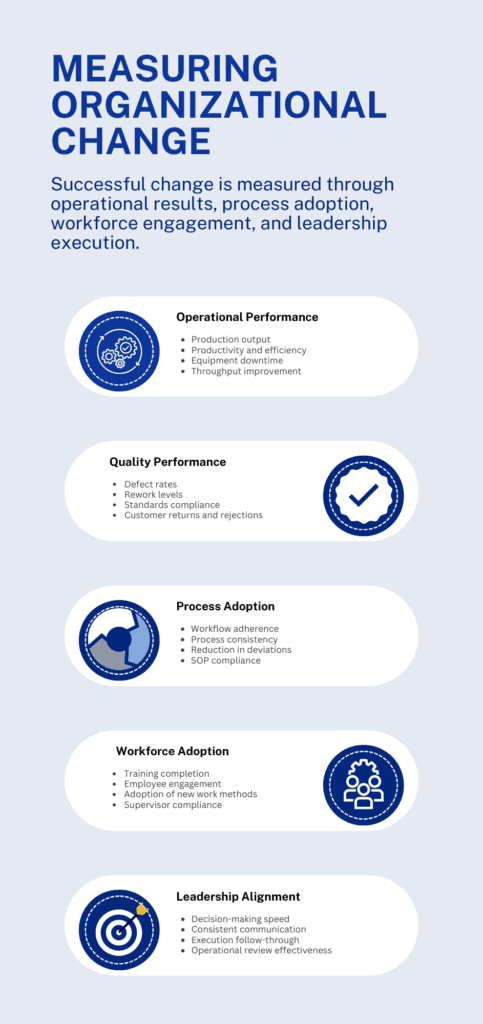
Measuring organizational change in manufacturing requires a balanced view across operational, behavioral, and process performance indicators.
Operational Performance Metrics
These indicators show how production systems are performing after change has been introduced.
Common metrics include:
- Production output levels
- Efficiency and productivity rates
- Equipment downtime reduction
- Throughput improvement
These metrics help determine whether operational flow has improved or whether bottlenecks still exist after implementation.
Quality Performance Indicators
Quality metrics indicate whether operational stability is improving or being disrupted by change.
Examples include:
- Defect rates
- Rework levels
- Compliance with production standards
- Customer rejection or return rates
In many manufacturing environments, quality trends are one of the earliest signals of whether organizational change is stabilizing or creating operational inconsistency.
Process Adoption Metrics
These measure whether new systems and workflows are actually being followed in daily operations.
Key indicators include:
- Adherence to updated workflows
- Consistency in process execution
- Reduction in process deviations
- Compliance with standard operating procedures
Without process adoption, even well-designed change programs fail to deliver sustainable outcomes.
Workforce Adoption Indicators
Organizational change ultimately depends on how people behave on the shop floor.
Relevant indicators include:
- Training completion rates
- Supervisor adherence to new systems
- Employee feedback on clarity of change expectations
- Consistency in application of new work methods
Workforce adoption is often the strongest predictor of whether change will be sustained or gradually eroded.
Leadership and Execution Alignment
Leadership behavior must also be measured because it directly influences execution consistency.
Key indicators of this include:
- Decision-making turnaround time
- Consistency of messaging across departments
- Execution follow-through rates
- Frequency and quality of operational reviews
When leadership alignment is weak, measurement systems tend to break down at the implementation level.
How Measurement Systems Should Be Structured
Effective measurement in manufacturing requires structure, consistency, and visibility across all levels of the organization.
Most manufacturing organizations need:
- Baseline performance data established before change begins
- Clearly defined KPIs linked directly to change objectives
- Structured reporting intervals (daily, weekly, monthly)
- Visible dashboards or reporting systems across departments
A common challenge is fragmented measurement, where different departments track performance in different ways. This makes it difficult to build a unified view of operational performance.
In structured transformation environments, measurement systems are designed alongside implementation planning. This ensures that tracking is not an afterthought but part of how work is executed daily.
Role of Consulting in Measurement Design
In many manufacturing organizations, consulting support is used to design and structure these measurement systems.
This typically involves:
- Defining meaningful operational KPIs linked to change goals
- Aligning metrics across departments (operations, quality, supply chain, HR, etc.)
- Designing practical reporting structures that fit shop-floor realities
- Ensuring measurement is embedded into daily execution routines
- Building visibility systems so leadership can track performance in real time
The value of this support lies in converting abstract operational goals into measurable systems that can be consistently tracked and acted upon.
Common Challenges in Measuring Organizational Change
Despite its importance, measurement is often one of the weakest areas in organizational change execution.
Lack of Baseline Data
Without pre-change benchmarks, it becomes difficult to determine whether improvements are real or perceived.
Over-Reliance on Financial Metrics
Financial outcomes alone do not reflect operational or behavioral change within manufacturing systems.
Inconsistent Reporting Structures
Different departments may track performance differently, leading to fragmented visibility.
Delayed Measurement Cycles
When data is reviewed too late, organizations lose the ability to correct issues during execution.
These challenges are often not purely technical. They usually reflect gaps in system design, alignment, and execution discipline; areas where structured consulting input is commonly applied.
How Measurement Improves Change Outcomes
When measurement is properly structured, it strengthens organizational change in several ways.
It enables:
- Early identification of execution gaps
- Faster corrective action during rollout
- Improved accountability across teams
- Stronger alignment between strategy and operations
- Sustained performance improvements over time
Measurement ensures that organizational change remains visible, controlled, and continuously adjustable throughout execution.
This is also why manufacturing organizations often rely on structured support during transformation; not only to implement change but to ensure performance systems are capable of tracking whether that change is actually working.
How Consulting Supports Measurement System Design in Manufacturing
In manufacturing environments, measurement systems are most effective when they are designed as part of the operational structure rather than treated as standalone reporting tools.
Many organizations struggle with inconsistent or fragmented measurement because performance indicators are either too generic, not aligned across departments, or not embedded into daily execution routines.
This is where structured consulting support becomes relevant in manufacturing change environments.
Instead of only defining metrics, consulting support helps organizations translate operational and change objectives into a functional measurement system that reflects how work actually happens on the shop floor.
This typically involves ensuring that measurement is not isolated within reporting functions but is directly linked to production workflows, quality systems, workforce behavior, and leadership decision-making processes.
A well-designed measurement system in manufacturing must also balance practicality with accuracy. If KPIs are too complex or disconnected from daily operations, they are often ignored or inconsistently applied. If they are too simple, they fail to capture meaningful change performance.
Consulting support helps organizations strike this balance by aligning measurement design with operational realities, ensuring that:
- KPIs reflect actual production and process performance
- Reporting structures are consistent across departments
- Data collection is feasible within daily operations
- Performance visibility supports real-time decision-making
In this way, consulting plays a supporting role in ensuring that measurement systems are not only defined, but also usable, sustainable, and embedded into execution.
Conclusion
Measuring organizational change in manufacturing is essential for ensuring that transformation efforts translate into real operational improvements.
Organizations that establish clear performance indicators, structured tracking systems, and consistent review processes are more likely to sustain gains and improve long-term operational stability.
In many manufacturing environments, consulting support plays a critical role in building these systems by ensuring that measurement frameworks are practical, aligned with operations, and embedded into daily execution routines.
Frequently Asked Questions
Why is measuring organizational change important in manufacturing?
Because it ensures that change delivers real operational improvements and not just structural adjustments.
What should be measured during organizational change?
Operational performance, quality outcomes, process adoption, workforce behavior, and leadership alignment.
What happens if organizational change is not measured?
Organizations lose visibility of progress and cannot identify execution gaps in time.
How often should change be measured?
Measurement should be continuous, with daily, weekly, and monthly tracking depending on the metric.
Why is consulting used in organizational change measurement?
Because it helps design structured, practical measurement systems that align with manufacturing operations and ensure consistent performance tracking.