Manufacturing in Kenya is undergoing a structural shift driven by rising operational costs, increasing customer expectations, and stronger regional competition.
As industries evolve, manufacturers are under pressure not only to produce more, but to produce better; using fewer resources, less time, and more consistent processes.
This shift has made manufacturing efficiency and productivity central to industrial competitiveness in Kenya.
However, these outcomes are not achieved through isolated improvements. They depend on structured systems that govern how work is designed, executed, and managed across the factory.
This article provides a foundational understanding of manufacturing efficiency and productivity improvement, focusing on the systems thinking required to build long-term operational capability.
Understanding Manufacturing Efficiency and Productivity
To improve manufacturing performance, it is essential to clearly distinguish between efficiency and productivity, as they address different dimensions of factory performance.
Manufacturing Efficiency
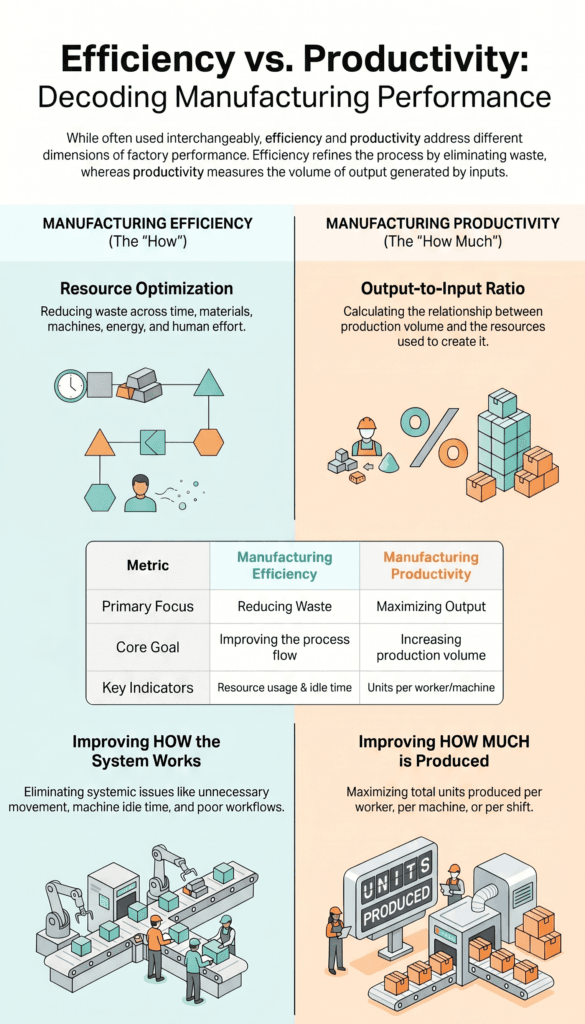
Efficiency refers to how effectively a factory uses its available resources during production.
These resources include:
- Time
- Materials
- Machines
- Energy
- Human effort
A factory becomes more efficient when it reduces waste across these areas while maintaining stable output levels.
Waste can appear in many forms, such as unnecessary movement, machine idle time, or poorly structured workflows. While these issues may seem operational, they are actually systemic in nature.
Manufacturing Productivity
Productivity refers to the relationship between output and input within a production system.
It is commonly expressed as:
- Units produced per worker
- Output per machine per shift
- Total production volume over time
Unlike efficiency, which focuses on reducing waste, productivity focuses on maximizing output from the same set of inputs.
A factory may appear active, but if outputs are low relative to inputs, productivity remains weak.
Why the Distinction Matters
Efficiency and productivity are often confused, but they solve different problems.
- Efficiency improves how the system works
- Productivity improves how much the system produces
When both are aligned, manufacturing performance becomes stable, predictable, and scalable.
Without this clarity, factories often attempt improvements that do not address the root structure of performance.
Why Manufacturing Performance Matters in Kenya
Manufacturing performance plays a critical role in determining the competitiveness and resilience of Kenya’s industrial sector.
Several structural factors make efficiency and productivity especially important in this context.
Rising Operational Costs
Manufacturers in Kenya face increasing costs in energy, logistics, and raw materials.
When systems are inefficient, these costs compound quickly, reducing profitability and limiting reinvestment capacity.
Efficiency becomes essential not only for savings but for long-term operational sustainability.
Competitive Regional Manufacturing Environment
Kenyan manufacturers operate in a regional and global market where competitors often benefit from highly optimized production systems.
This creates pressure to improve internal performance in order to remain competitive in pricing, quality, and delivery timelines.
Supply Chain and Infrastructure Variability
Manufacturing performance is often affected by external factors such as:
- Delayed raw materials
- Transport inefficiencies
- Unpredictable supply schedules
Strong internal systems help factories absorb these disruptions more effectively by maintaining stable production flows.
Workforce and Process Variation
Differences in skill levels, experience, and training often lead to inconsistencies in output.
Without standardized processes, performance varies significantly between shifts and operators, reducing overall productivity stability.
This makes process standardization a key foundation of manufacturing performance.
A Systems Perspective on Manufacturing Efficiency
Manufacturing efficiency cannot be understood or improved in isolation. It emerges from the interaction of multiple interconnected systems within the factory.
Most performance challenges are not caused by a single failure point but by misalignment between systems.
A systems-based approach provides a clearer way to understand how manufacturing performance is actually created.
Process Systems (How Work Is Defined)
Process systems determine how work is structured and executed across the factory.
They include:
- Standard operating procedures
- Defined workflows
- Task sequencing
- Production standards
When process systems are weak or inconsistent, factories experience variability in output and quality.
Strong process systems create predictability and reduce dependency on individual operator behavior.
Flow Systems (How Work Moves)
Flow systems determine how materials and tasks move through production stages.
Inefficiencies in flow typically appear as:
- Bottlenecks between processes
- Idle time between production stages
- Excess handling of materials
- Disconnected production steps
Improving flow means ensuring that work moves smoothly from one stage to another without unnecessary interruption.
Flow efficiency is often one of the most visible indicators of overall factory performance.
Resource Systems (How Capacity Is Utilized)
Resource systems refer to the use of machines, labor, and production capacity.
Common inefficiencies include:
- Machine downtime
- Underutilized shifts
- Slow cycle times
- Idle labor capacity
Improving resource systems focuses on ensuring that available capacity is consistently converted into productive output.
This is not about adding resources but about optimizing existing ones.
Management Systems (How Performance Is Controlled)
Management systems provide visibility, control, and feedback across all factory operations.
They typically include:
- Performance tracking metrics
- Production reporting structures
- Shift-level performance reviews
- Operational dashboards
Without these systems, factories operate reactively rather than proactively.
Effective management systems ensure that performance issues are identified early and addressed systematically.
The Role of Operational Excellence
Operational Excellence provides the structured framework that aligns processes, resources, flow, and management systems into a cohesive performance model.
It is not a single initiative but a continuous discipline focused on:
- Reducing variability
- Improving consistency
- Eliminating systemic waste
- Strengthening operational discipline
In manufacturing environments, Operational Excellence acts as the foundation for sustainable performance improvement.
Manufacturing Outlook (2026 and Beyond)
As manufacturing continues to evolve, factories in Kenya are expected to increasingly adopt structured and data-informed operational models.
Key trends include:
- Greater use of production data for decision-making
- Standardized operational frameworks
- Increased focus on process stability
- Wider adoption of continuous improvement systems
These shifts are redefining how efficiency and productivity are understood and measured.
Factories that develop strong internal systems will be better positioned to adapt to these changes and maintain long-term competitiveness.
Where Faber Infinite Fits
Faber Infinite supports organizations in strengthening operational thinking and building structured performance systems that enable long-term manufacturing capability development.
Conclusion
Manufacturing efficiency and productivity are not outcomes of isolated improvements but the result of well-aligned systems operating together.
By focusing on process stability, flow efficiency, resource utilization, and management systems, factories can build a foundation for consistent and scalable performance.
In Kenya’s evolving industrial landscape, organizations that invest in structured operational systems will be better positioned for sustainable growth and long-term competitiveness.
FAQs
What is manufacturing efficiency?
Manufacturing efficiency is the ability of a factory to use resources such as time, materials, and machines with minimal waste.
What is manufacturing productivity?
Manufacturing productivity measures the amount of output produced relative to inputs such as labor, machines, and time.
Why are efficiency and productivity important in manufacturing?
They determine production costs, operational stability, and competitiveness in both local and regional markets.
What is Operational Excellence in manufacturing?
It is a structured approach that aligns processes, systems, and people to achieve consistent and continuous performance improvement.
How do systems improve manufacturing performance?
Well-designed systems reduce variability, improve coordination, and ensure that resources are used effectively across production processes.