
Manufacturing organizations looking to improve productivity often face a practical question: should they focus on Lean, Six Sigma, digital transformation, or broader process improvement?
In practice, these approaches can complement one another.
Lean focuses heavily on flow and waste reduction. Six Sigma focuses on reducing variation and improving consistency. Together, they can provide a structured approach to productivity improvement consulting for KSA organizations pursuing stronger operational performance.
For companies evaluating productivity consultants in Saudi Arabia, the important consideration is not simply which methodology is used. It is whether the approach addresses the organization’s actual productivity challenges and produces measurable, sustainable process improvements.
What Is Productivity Consulting?
Productivity consulting involves helping organizations understand how effectively their processes, resources, and systems are performing and identifying opportunities for improvement.
The focus can include process efficiency, workforce productivity, equipment utilization, quality, waste, operating costs, and continuous improvement.
A structured productivity improvement effort generally begins with understanding the current state. Instead of assuming that low productivity requires more resources, an organization can examine where time, capacity, materials, and effort are being lost. This creates a stronger foundation for improvement.
Lean vs Six Sigma: What Is the Difference?
Lean and Six Sigma have different primary areas of emphasis.
Lean Manufacturing
Lean focuses on improving flow and eliminating activities that do not create value.
Common areas of focus include:
- Waiting
- Excess inventory
- Unnecessary movement
- Overprocessing
- Transportation
- Overproduction
- Defects
Lean asks a fundamental question:
Where is waste interrupting the flow of value?
Six Sigma
Six Sigma focuses on reducing process variation and improving consistency. It uses data and structured problem-solving to understand why processes produce inconsistent results.
Six Sigma asks:
Why does this process vary, and how can the variation be reduced?
Why Combine Them?
Many productivity problems involve both waste and variation. A process may have unnecessary steps while also producing inconsistent quality.
Lean can help simplify the process, while Six Sigma can help investigate and control variation.
This is the basis of how Lean Six Sigma improves productivity in Saudi companies.
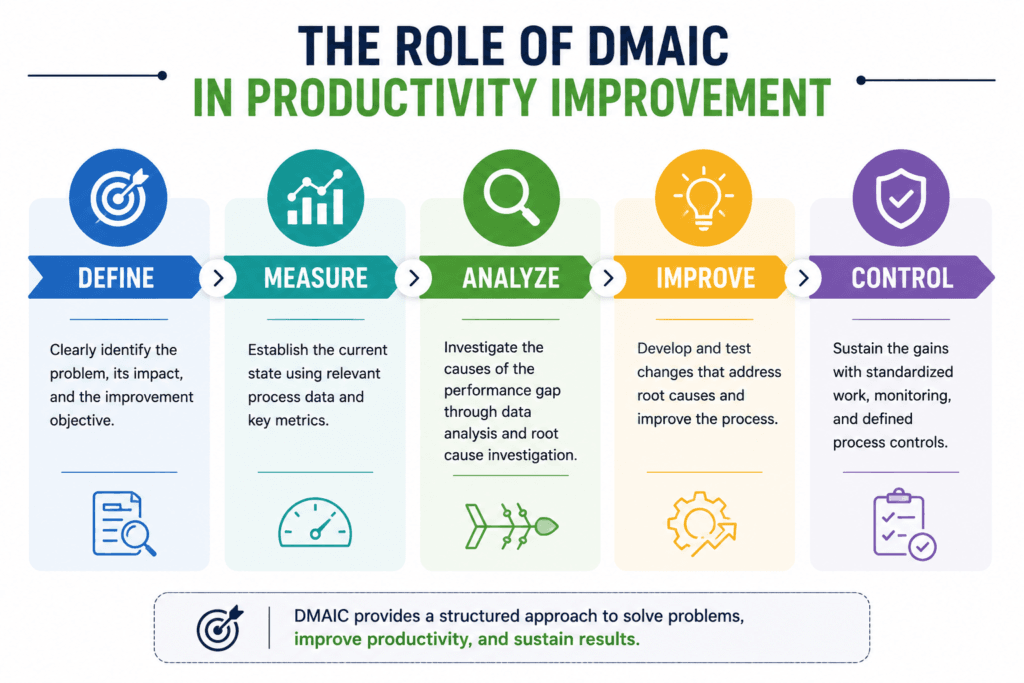
The Role of DMAIC in Productivity Improvement
DMAIC is one of the best-known Six Sigma problem-solving frameworks.
It stands for:
Define → Measure → Analyze → Improve → Control
Define
The organization clearly identifies the problem, its impact, and the intended improvement objective.
A vague goal such as “increase productivity” is difficult to manage.
A more useful objective identifies the specific process problem that needs attention.
Measure
The current state is established using relevant process information.
Measurements might include cycle time, defects, waiting, downtime, throughput, or other indicators relevant to the problem.
Analyze
The team investigates the causes of the performance gap. This is where data analysis and root cause investigation become important.
Improve
The organization develops and tests changes that address the identified causes.
Improvements might involve process redesign, standardization, equipment changes, workflow improvements, or other appropriate interventions.
Control
The improved process needs to remain stable.
Standardized work, monitoring, visual management, and defined process controls can help sustain the improvement.
How Lean Six Sigma Supports Productivity
Saudi Arabia organizations considering Lean productivity consulting may combine Lean’s focus on waste with Six Sigma’s focus on variation. This combination can support productivity in several ways.
Improving Process Flow
Lean techniques can identify bottlenecks, unnecessary movement, waiting, and other interruptions to flow.
Improving flow can reduce the time required to move work through a process.
Reducing Defects
Six Sigma methods can help identify the causes of recurring defects and variation.
Reducing defects can improve productivity by lowering rework, scrap, inspection, and additional processing.
Improving Process Stability
A process that performs inconsistently can be difficult to manage. Variation can create scheduling problems, quality issues, and additional work.
Six Sigma provides analytical tools for understanding and reducing this variation.
Reducing Waste
Lean helps organizations identify activities that consume resources without creating sufficient value.
Removing unnecessary activity can improve resource utilization and reduce operating costs.
Lean Six Sigma and Cost Efficiency
Productivity and cost efficiency are closely connected. When organizations spend less time reworking products, waiting for materials, or recovering from equipment problems, they can reduce unnecessary resource consumption.
However, cost efficiency should not mean cutting essential resources.
Reducing maintenance, training, quality controls, or workforce capability without understanding the consequences can create additional costs later.
Lean Six Sigma focuses on improving the process first. The financial benefit should follow from eliminating waste, reducing variation, and improving resource utilization.
How to Overcome Productivity Improvement Barriers in KSA
Productivity improvement initiatives can encounter several practical challenges.
Lack of a Clear Baseline
Organizations cannot determine whether an improvement has worked without understanding the starting point.
A baseline should therefore be established before major changes are introduced.
Treating Symptoms Instead of Causes
Adding resources may temporarily hide a productivity problem without resolving its underlying cause.
Root cause analysis helps teams determine why the problem exists.
Limited Employee Involvement
Employees who perform the process regularly often understand its practical challenges.
Excluding them from improvement efforts can result in solutions that are difficult to implement or sustain.
Too Many Improvement Projects
Organizations can dilute their efforts by launching numerous projects simultaneously.
A focused improvement program with clear objectives can make implementation more manageable.
Failure to Sustain Improvements
An improvement can disappear if new methods are not standardized and monitored.
Control mechanisms are therefore essential.
The Role of Productivity Consultants
Productivity consultants that Saudi Arabian organizations engage should provide more than recommendations. A strong productivity improvement approach should connect analysis with implementation.
Depending on the organizational need, a consultant may support:
- Current-state assessment
- Process analysis
- Waste identification
- Productivity measurement
- Lean implementation
- Six Sigma problem-solving
- Process standardization
- Performance measurement
- Continuous improvement
The exact scope should depend on the organization’s challenges.
Organizations considering productivity improvement consulting in KSA should evaluate whether the approach is practical, measurable, and aligned with operational priorities.
Conclusion
For organizations seeking productivity consulting in KSA, Lean and Six Sigma can provide complementary approaches to operational improvement.
Together, Lean Six Sigma can support productivity improvement by reducing waiting, defects, unnecessary work, process variation, and resource losses.
Whether improvement is managed internally or supported by productivity consultants in Saudi Arabia, the fundamental objective remains the same: create processes that consistently deliver the required results with less unnecessary time, effort, material, and capacity.
Frequently Asked Questions
What are the benefits of productivity consulting services in Saudi Arabia?
Productivity consulting can help organizations identify operational losses, analyze processes, implement structured improvement methods, establish performance measures, and develop continuous improvement practices.
How does Lean Six Sigma improve productivity?
Lean Six Sigma combines waste reduction with process variation reduction. Lean improves flow and removes unnecessary activities, while Six Sigma uses structured analysis to improve consistency and reduce defects.
What is DMAIC in productivity improvement?
DMAIC stands for Define, Measure, Analyze, Improve, and Control. It provides a structured framework for solving process problems and sustaining improvements.
When should a company use Lean Six Sigma?
Lean Six Sigma can be useful when an organization is experiencing problems involving waste, process variation, defects, inconsistent performance, or inefficient workflows and needs a structured approach to improvement.
Can Lean Six Sigma be combined with automation?
Yes. Lean Six Sigma can identify and improve the process first, while automation can then be applied to suitable activities. This helps prevent organizations from simply automating inefficient processes.