
Productivity improvement in manufacturing across Saudi Arabia is not simply about producing more in less time. Sustainable productivity comes from improving how effectively an organization uses its people, equipment, materials, time, and processes while maintaining quality and operational reliability.
For companies looking at manufacturing productivity in Saudi Arabia, the most effective improvements often begin with existing operations. Before investing in additional capacity or technology, organizations can examine where time is being lost, where processes create unnecessary work, and where resources are not being used effectively.
This is where Lean manufacturing, process improvement, workforce involvement, data analysis, and continuous improvement can provide a structured foundation.
What Is Productivity Improvement in Manufacturing?
Manufacturing productivity refers to how effectively inputs are converted into useful output. Inputs can include workforce time, equipment capacity, materials, energy, production space, and information.
Improving productivity means increasing the value generated from these inputs without compromising required quality or performance.
For example, reducing unnecessary movement can allow employees to spend more time on productive activities. Reducing equipment downtime can make more capacity available. Preventing defects can reduce rework and material consumption.
This makes productivity improvement closely connected with operational efficiency, waste reduction, and operational performance.
Why Productivity Improvement Requires a Systematic Approach
Productivity problems are rarely caused by one factor. A production delay might appear to be an equipment problem but could actually result from material availability, scheduling, process imbalance, or information delays.
Similarly, low workforce productivity may actually be caused by employees waiting for materials or correcting problems created earlier in the process.
This is why organizations should first understand the current state before selecting an improvement solution.
A structured assessment can examine:
- Process flow
- Cycle times
- Waiting
- Equipment performance
- Quality and rework
- Material movement
- Inventory
- Workforce utilization
- Information flow
The objective is to identify where productivity is being lost and understand why.
Key Productivity Improvement Strategies
1. Optimize Processes Before Adding Capacity
Process optimization should be one of the first areas organizations examine.
A process may contain unnecessary approvals, repeated activities, excessive movement, inefficient handoffs, or waiting between stages.
Value Stream Mapping (VSM) can help teams visualize how materials and information move through an operation.
Once these sources of waste are visible, teams can determine which activities can be eliminated, simplified, standardized, or redesigned.
This approach can improve capacity without immediately requiring additional resources.
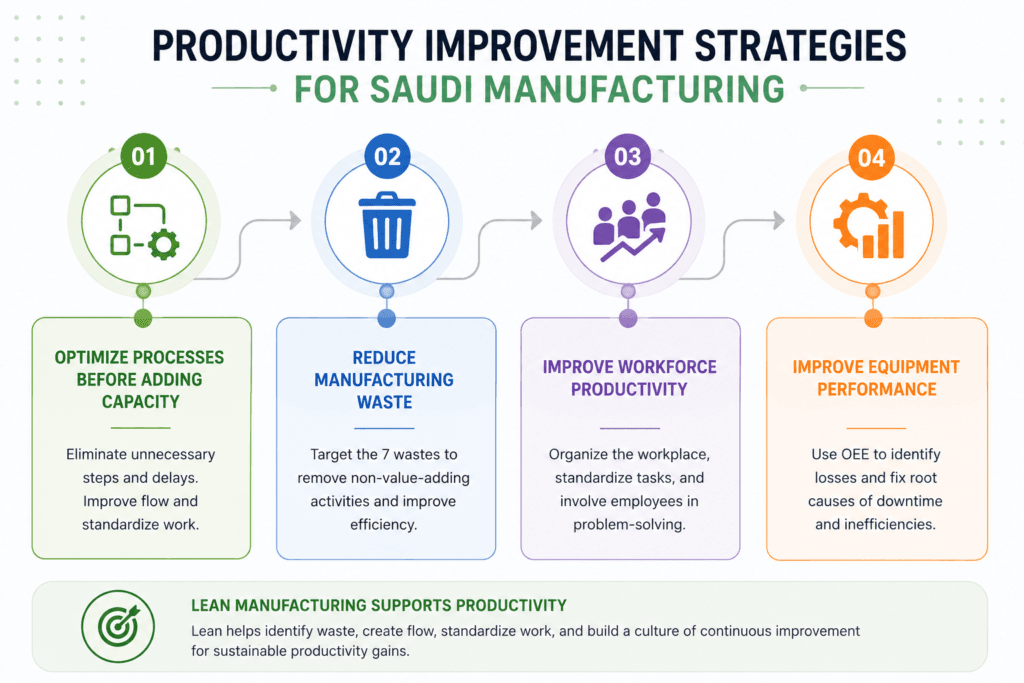
2. Reduce Manufacturing Waste
Waste reduction is central to productivity improvement.
Common forms of waste include:
- Waiting
- Overproduction
- Excess inventory
- Unnecessary transportation
- Unnecessary motion
- Overprocessing
- Defects and rework
The objective is not simply to remove activities. Each activity should be assessed against its purpose and required outcome.
For example, an inspection that protects an important quality requirement should not be removed simply because it consumes time. Instead, organizations should determine whether quality can be built into the process more effectively.
3. Improve Workforce Productivity
Workforce productivity should be considered in the context of the process. Employees cannot perform efficiently if they regularly wait for materials, search for tools, resolve unclear instructions, or repeat work because of defects.
Improving workplace organization, standardizing tasks, providing clear information, and involving employees in problem-solving can remove many of these barriers.
Employee knowledge is also an important improvement resource. People who work directly with a process often understand its practical problems better than performance reports alone can reveal.
4. Improve Equipment Performance
Equipment availability and performance can have a direct impact on manufacturing productivity.
Overall Equipment Effectiveness, or OEE, provides a structured way to examine equipment performance through availability, performance, and quality.
The purpose is not simply to improve an OEE score. Organizations should investigate the causes behind equipment losses, including recurring interruptions, reduced operating speed, changeover losses, and quality problems.
This creates a more targeted approach to equipment productivity improvement.
How Lean Manufacturing Supports Productivity
Lean manufacturing provides a practical framework for identifying and reducing activities that do not create sufficient value.
Several Lean techniques can support productivity improvement consulting initiatives in KSA.
Standardized Work
Standardized work establishes a consistent method for performing a process. It provides a baseline for identifying variation and evaluating improvements.
5S
5S workplace organization can reduce searching, unnecessary movement, and workplace confusion. It also makes abnormal conditions easier to identify.
Value Stream Mapping
VSM helps teams understand the complete flow of materials and information. It can reveal bottlenecks, waiting, excess inventory, and unnecessary process steps.
Root Cause Analysis
Root cause analysis helps organizations address the causes of productivity problems rather than repeatedly treating their symptoms.
Continuous Improvement
Continuous improvement creates a structured mechanism for identifying, testing, measuring, and sustaining improvements.
Using Data and Automation to Improve Productivity
Digital technologies can strengthen productivity improvement when they address a clearly defined operational need.
Automated data collection can reduce manual reporting and provide more consistent information about production performance.
Analytics can help organizations identify recurring patterns in downtime, quality, cycle time, or process variation.
Automation can also reduce repetitive manual activities where appropriate.
This supports the long-tail search intent around how automation increases productivity in KSA companies.
However, automation should not be treated as a substitute for process improvement. Automating an inefficient process can simply make the inefficient process faster.
A better sequence is:
Understand the process → remove unnecessary work → standardize → identify digital opportunities → automate where appropriate → measure.
How to Overcome Productivity Improvement Barriers in KSA
Organizations can encounter several barriers when implementing productivity improvement initiatives. One common barrier is focusing on symptoms instead of causes. Another is treating productivity as an individual employee issue rather than examining the process surrounding the employee.
Resistance to change can also affect improvement initiatives, particularly when employees do not understand why a process is changing or how the change will affect their work.
Clear communication and employee involvement can help address this.
Organizations should also avoid launching too many improvement initiatives simultaneously. A focused improvement project with a clearly defined problem, measurable objective, and responsible team can be easier to implement and sustain.
When Productivity Consulting Can Add Value
Organizations across Saudi Arabia may consider productivity consultants when they need structured support to assess operational performance, identify improvement opportunities, or implement a defined improvement methodology.
A productivity consultant can bring an external perspective to processes that internal teams may have become accustomed to.
The value of consulting should ultimately come from the quality of the problem-solving approach, not from adopting a particular methodology for its own sake.
Organizations evaluating productivity consulting for KSA should consider whether the approach:
- Begins with understanding the current process
- Uses measurable objectives
- Identifies root causes
- Involves relevant employees
- Provides practical implementation support
- Includes mechanisms for sustaining improvements
The specific approach should depend on the organization’s operational challenges.
Conclusion
For Saudi manufacturing companies, productivity improvement is best approached as a process and operational challenge rather than simply an output target.
Organizations can improve productivity by reducing waste, improving process flow, strengthening workforce effectiveness, optimizing equipment performance, preventing defects, and applying automation or digital tools where they provide clear value.
Lean manufacturing provides a strong foundation, while data, automation, and continuous improvement can extend these capabilities.
Whether improvement is managed internally or supported through productivity consulting in KSA, the underlying principle remains the same: understand how work is performed, identify where productivity is being lost, address the root causes, measure the results, and sustain the improvement.
This creates a practical foundation for stronger operational efficiency and long-term manufacturing productivity.
Frequently Asked Questions
How can manufacturing companies improve productivity?
Companies can improve productivity by reducing process waste, improving material flow, preventing defects, reducing equipment downtime, standardizing work, involving employees, and continuously measuring operational performance.
What are effective productivity improvement strategies?
Effective strategies include Lean manufacturing, Value Stream Mapping, standardized work, root cause analysis, OEE improvement, workplace organization, process optimization, and continuous improvement.
How does Lean manufacturing improve productivity?
Lean improves productivity by identifying and reducing non-value-adding activities such as waiting, unnecessary movement, defects, excess inventory, and overprocessing while improving process flow.
How can automation increase productivity in KSA companies?
Automation can increase productivity by reducing repetitive work, improving process consistency, supporting faster information collection, and reducing avoidable manual activities. It should be applied after the process has been understood and optimized.
When should a company consider productivity consulting?
A company may consider productivity consulting when it needs structured external support to assess operational performance, identify productivity losses, implement improvement methods, or establish a sustainable continuous improvement approach.