Operational Excellence is more than a collection of Lean tools or a program for reducing costs. It is a structured approach to making processes more reliable, efficient, and capable of delivering consistent results while creating a culture of continuous improvement.
For organizations pursuing Operational Excellence in manufacturing Saudi Arabia, this distinction matters. Productivity improvement may solve a particular performance problem, while Operational Excellence creates a broader management system for continuously identifying and addressing operational losses.
What Is Operational Excellence?
Operational Excellence can be understood as the ability of an organization to consistently deliver the required value through effective processes, capable people, disciplined execution, and continuous improvement.
It is not simply about making a process faster.
A process that operates quickly but produces defects, creates excessive inventory, or depends heavily on rework is not necessarily excellent. Instead, Operational Excellence considers how different elements of an operation work together:
- Process efficiency
- Quality
- Productivity
- Workforce capability
- Equipment performance
- Waste reduction
- Standardization
- Problem-solving
- Continuous improvement
This makes Operational Excellence broader than individual improvement projects.
Operational Excellence vs Operational Efficiency
The two concepts are closely related, but they are not identical.
Operational efficiency generally focuses on using resources effectively. It may involve reducing cycle time, minimizing waste, improving productivity, or lowering unnecessary operating costs.
Operational Excellence takes a broader view. It asks whether the organization has the processes, management practices, people, performance systems, and improvement culture required to sustain strong performance over time.
For example, reducing production waiting time is an efficiency improvement.
Creating a management system that continually identifies, investigates, and prevents the causes of waiting is closer to Operational Excellence.
This distinction is particularly important when developing an Operational Excellence transformation strategy.
Core Principles of Operational Excellence
1. Focus on Customer Value
Operational improvement should ultimately support the value expected by the customer. Not every activity within a process creates equal value.
Teams should understand which activities are necessary to deliver quality, reliability, and service requirements and which activities create avoidable effort. This provides the foundation for identifying waste without removing activities that are genuinely necessary.
2. Standardize Before Improving
It is difficult to improve a process consistently when there is no defined way of performing it. Standardized work creates a baseline.
Once a process is reasonably stable, teams can identify variation and test improvements against an established method.
Standardization should not prevent improvement. Instead, it provides a reference point for identifying whether a change actually makes the process better.
3. Make Problems Visible
Operational Excellence depends on identifying problems rather than allowing them to become normal. Visual performance management, process measures, structured reviews, and direct observation can help teams recognize abnormal conditions.
The objective is not to create more reporting. It is to make important operational problems visible early enough to address them.
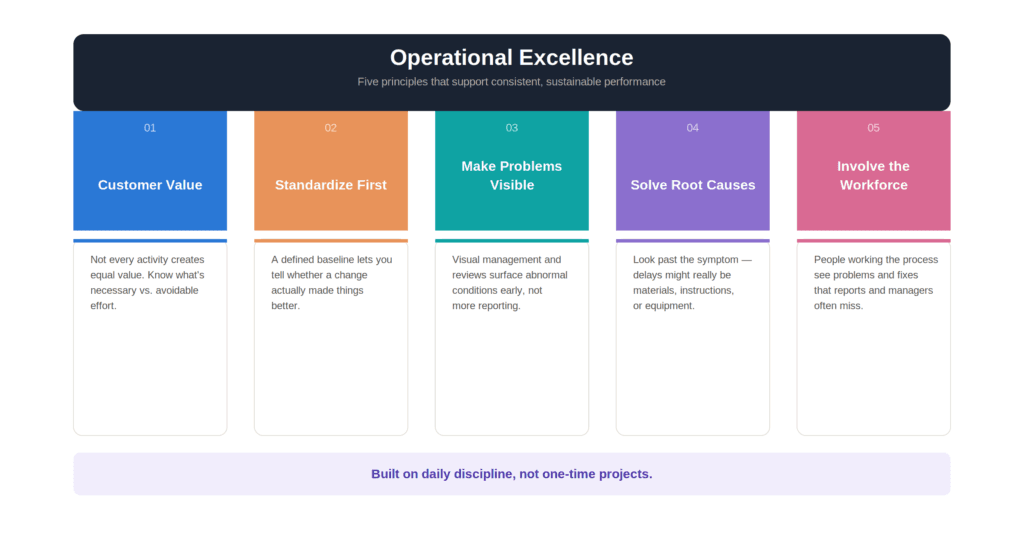
4. Solve Root Causes
Repeatedly correcting the same problem is not continuous improvement.
Root cause analysis helps teams move beyond symptoms and investigate why a problem occurs.
For example, recurring delays might initially appear to be a workforce issue. Further investigation could reveal material shortages, unclear instructions, equipment interruptions, or poor process sequencing.
Addressing the cause creates a more sustainable improvement.
5. Involve the Workforce
Operational Excellence cannot depend entirely on management or external specialists. Employees who work directly within processes often have valuable knowledge about recurring problems, unnecessary steps, and practical improvement opportunities.
A strong continuous improvement culture gives employees structured ways to identify and solve these problems.
The Role of TPM and Six Sigma
Operational Excellence does not require one methodology to solve every problem. Different operational challenges can require different approaches.
Total Productive Maintenance
TPM focuses on improving equipment reliability and involving operations and maintenance teams in equipment performance. The objective is to reduce avoidable equipment losses and support stable production.
Six Sigma
Six Sigma focuses on process variation, defects, and data-driven problem-solving. It can be particularly useful when inconsistent process performance is creating quality or productivity problems.
Lean
Lean focuses strongly on flow and waste elimination.
Together, these approaches can contribute to Lean Operational Excellence initiatives in KSA when applied according to the actual operational problem.
Measuring Operational Excellence
Operational Excellence should be measurable, but no single metric can represent it completely.
Organizations aiming for manufacturing transformation in Saudi Arabia can use a combination of operational indicators depending on their objectives.
These may include:
- Productivity
- Cycle time
- Throughput
- OEE
- Downtime
- Defects
- Rework
- Scrap
- Inventory
- On-time performance
- Process lead time
The most useful measures are those that help teams understand performance and make decisions. A large collection of metrics can create reporting activity without improving operations. The focus should remain on actionable information.
Best Operational Excellence Frameworks for Saudi Manufacturing
There is no single framework that is automatically appropriate for every organization.
A practical Operational Excellence approach may combine elements of:
- Lean management
- Six Sigma
- Kaizen and continuous improvement
- TPM
- Standardized work
- Performance management
- Structured problem-solving
The appropriate combination depends on the organization’s maturity and operational priorities.
For example, an organization struggling with excessive process waste may benefit from Lean-focused improvement. An organization dealing with significant process variation may require stronger Six Sigma methods. An organization experiencing recurring equipment losses may need greater attention to TPM principles.
The framework should follow the problem rather than the other way around.
When Operational Excellence Consulting Can Add Value
Organizations may consider Operational Excellence consulting in Saudi Arabia when they need structured support to assess current performance, identify improvement opportunities, establish improvement systems, or develop internal capabilities.
Similarly, Operational Excellence consultants for KSA organizations should be able to connect recommendations with practical implementation.
When evaluating Operational Excellence support, organizations should look for an approach that:
- Begins with the current state
- Defines measurable objectives
- Identifies root causes
- Involves employees
- Uses appropriate improvement methods
- Establishes performance measures
- Addresses sustainability
The objective should be capability building and measurable operational improvement, rather than simply implementing a collection of tools.
Conclusion
In KSA, Operational Excellence initiatives are best understood as a long-term approach to improving how an organization operates.
It combines effective processes, workforce involvement, performance management, structured problem-solving, waste reduction, quality, and continuous improvement.
For organizations pursuing Operational Excellence in the Saudi Arabian manufacturing industry, Lean manufacturing, Six Sigma, TPM, and appropriate digital technologies can all contribute, but none should be treated as a standalone solution.
Operational Excellence is not a destination or a single project. It is the organizational capability to keep improving how work is performed and how value is delivered.
Frequently Asked Questions
What does Operational Excellence mean in manufacturing?
Operational Excellence means creating reliable, efficient, and continuously improving processes that consistently deliver the required value, quality, and performance.
How does Lean manufacturing drive Operational Excellence?
Lean supports Operational Excellence by improving process flow, reducing waste, standardizing work, and creating structured methods for continuous improvement.
What are the best Operational Excellence frameworks for Saudi manufacturing?
Common approaches include Lean, Six Sigma, TPM, Kaizen, standardized work, and structured performance management. The appropriate combination depends on the organization’s operational challenges and improvement maturity.
How does Industry 4.0 enable Operational Excellence?
Industry 4.0 technologies can improve operational visibility through automated data collection, connected production systems, advanced analytics, and AI-enabled analysis. These capabilities can support faster identification and investigation of operational problems.
What is the role of Operational Excellence consultants?
Operational Excellence consultants can provide structured support for assessing processes, identifying improvement opportunities, implementing improvement methodologies, establishing performance measures, and developing continuous improvement capabilities.