
Productivity improvement is often easier to understand through practical examples. Organizations may know that they need better efficiency, lower waste, stronger operational performance, or improved workforce productivity, but the challenge is determining where to begin.
For Saudi Arabian organizations exploring productivity improvement in manufacturing, case-based thinking can help connect improvement methods with specific operational problems.
The examples in this article are illustrative case studies. They demonstrate realistic ways organizations can approach common productivity challenges using Lean manufacturing, process improvement, Six Sigma, automation, and continuous improvement.
What Does a Productivity Improvement Case Study Show?
A useful productivity case study should explain more than the improvement method.
It should show:
- What problem existed
- How the problem was investigated
- What caused the performance gap
- What improvement was introduced
- How performance was measured
- How the improvement was sustained
This structure is more useful than simply stating that a company implemented Lean or automation.
For manufacturing productivity in Saudi Arabia, the key lesson is that the right solution depends on the specific source of lost productivity.
Illustrative Case Study 1: Reducing Production Delays
A manufacturing organization experiences inconsistent production flow. Some process stages complete work quickly, while downstream stages regularly develop queues. Employees also spend time waiting for materials and instructions.
Management initially believes that additional equipment is required.
Before making the investment, an improvement team maps the process and observes the actual workflow. The analysis identifies several sources of lost productivity:
- Uneven work distribution
- Material delays
- Unnecessary movement
- Waiting between process stages
- Inconsistent work methods
The organization introduces standardized work, improves material presentation, and reviews how work is distributed between process stages.
The focus is not on asking employees to work faster. Instead, the organization removes barriers that prevent employees from working efficiently.
The Productivity Lesson
This scenario demonstrates how Lean productivity improvement initiatives in KSA can improve output by improving flow and reducing process waste.
A capacity problem may sometimes be a process problem in disguise.
Illustrative Case Study 2: Improving Equipment Productivity
An organization has adequate production equipment but consistently achieves less productive output than expected.
The improvement team begins by examining equipment performance through OEE. The analysis separates losses into availability, performance, and quality.Rather than focusing on the overall number alone, the team examines the underlying losses. It discovers that several recurring short interruptions are affecting availability.
The organization begins classifying interruptions consistently and investigating recurring causes. Some issues are addressed through maintenance improvements, while others are linked to operating conditions and process practices.
The team continues monitoring the losses after the changes are introduced.
The Productivity Lesson
Overall Equipment Effectiveness (OEE) improvement strategies for Saudi factories can help organizations understand where equipment capacity is being lost.
The value of OEE is not the metric itself. Its value comes from using the information to identify and solve specific problems.
Illustrative Case Study 3: Reducing Rework With Six Sigma
A manufacturing organization experiences recurring quality problems. Final inspection identifies defects, but similar defects continue to appear.
The improvement team applies a structured Six Sigma approach. The team first defines the problem and establishes a baseline. It then collects process information and analyzes variation.
The investigation identifies several process conditions associated with inconsistent results.
The organization introduces changes to the process method, improves standardized work, and establishes appropriate monitoring. Instead of relying only on final inspection, the organization moves toward preventing defects at their source.
The Productivity Lesson
Six Sigma productivity improvement initiatives in KSA can improve productivity when variation and defects are consuming production capacity.
Reducing rework can free workforce time, materials, and equipment capacity for productive activities.
Illustrative Case Study 4: Improving Material Flow
A manufacturing organization frequently experiences interruptions because materials are unavailable when required. The initial response is to increase inventory. However, material shortages continue.
The organization maps the movement of materials and discovers that replenishment information is inconsistent and materials are stored across multiple locations. Employees also spend time searching for components.
The improvement team redesigns material presentation, establishes clearer replenishment rules, and improves the connection between production requirements and material availability.
The Productivity Lesson
This illustrates how supply chain optimization improves productivity in Saudi manufacturing.
The objective is not necessarily to increase or decrease inventory. The objective is to create a reliable material flow that supports production without unnecessary handling or interruptions.
Illustrative Case Study 5: Using Automation to Improve Productivity
An organization relies on manual data collection for production reporting. Employees record information periodically and consolidate it for management review. Because information is delayed, recurring production losses are difficult to identify quickly.
The organization introduces automated data collection for selected production measures. The improvement team can now access more consistent information about production activity, downtime, and process performance.
The technology does not automatically improve productivity. Instead, it makes operational losses easier to identify.
The organization then uses the information to investigate recurring problems and prioritize improvement activities.
The Productivity Lesson
This demonstrates how automation increases productivity in KSA companies when technology is connected to a specific operational problem.
Automation should strengthen an improvement process rather than replace one.
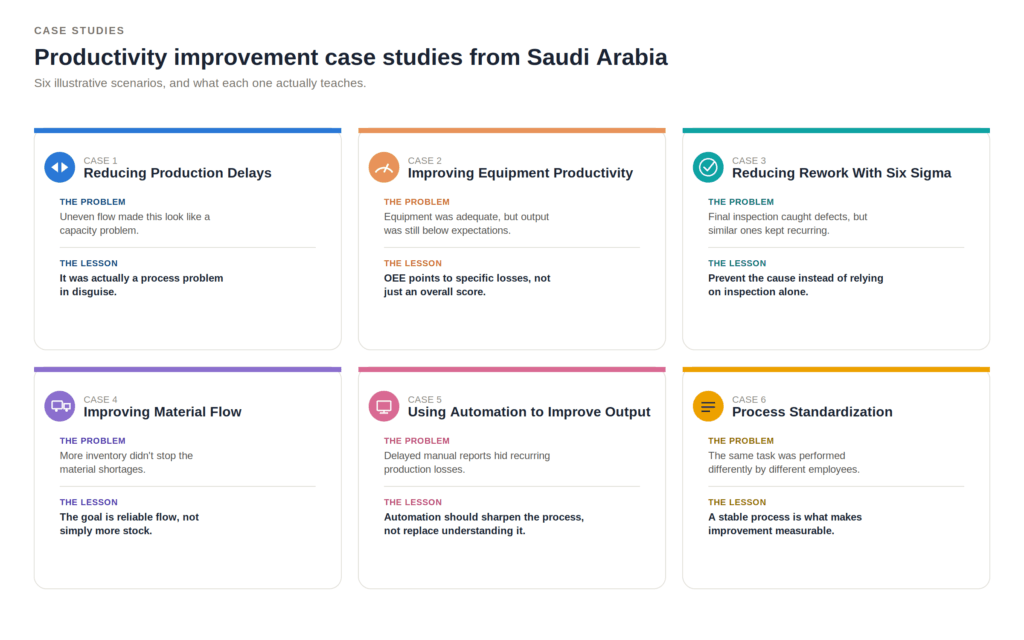
Illustrative Case Study 6: Improving Productivity Through Process Standardization
A manufacturing organization has significant variation in how employees perform the same process. Different work methods produce different cycle times and inconsistent outcomes.
The organization documents the most effective known method and introduces standardized work.
Training is provided around the standard, while employees are encouraged to identify practical issues that could require further improvement.
Performance is monitored to determine whether the new method improves consistency.
The Productivity Lesson
Standardized work creates a baseline for improvement. Without a reasonably stable process, it can be difficult to determine whether changes actually improve productivity.
What These Productivity Cases Have in Common
Although the scenarios involve different problems, they follow a common improvement logic.
Start With the Problem
Organizations should define the productivity issue clearly.
“Productivity is low” is too broad to guide improvement.
“Production is regularly delayed because of material shortages” provides a more useful starting point.
Understand the Current State
Process observation, data, employee input, and process mapping can help establish what is actually happening. This prevents improvement teams from designing solutions based only on assumptions.
Identify the Root Cause
The visible problem may not be the real cause. Waiting may be caused by poor scheduling. Rework may result from process variation. Low equipment utilization may result from recurring minor interruptions.
Root cause analysis helps teams determine where intervention is needed.
Implement a Targeted Improvement
The improvement should directly address the identified cause.
Possible approaches include Lean methods, standardized work, process redesign, maintenance improvements, Six Sigma analysis, or automation.
Measure the Result
Relevant measures should be established before and after the improvement. Depending on the problem, these may include:
- Cycle time
- Throughput
- OEE
- Downtime
- Defects
- Rework
- Scrap
- Waiting time
- Inventory
- Resource utilization
Sustain the Improvement
Improvements can disappear when new practices are not standardized. Documentation, training, visual controls, monitoring, and continuous improvement routines can help maintain the new process.
The Role of Productivity Consultants
Organizations may consider productivity consultants in Saudi Arabia when they need structured external support for process assessment, improvement planning, Lean implementation, productivity measurement, or continuous improvement.
When evaluating productivity improvement consulting for KSA, organizations should look beyond methodology names.
A useful improvement approach should be able to:
- Understand the current state
- Identify measurable productivity losses
- Investigate root causes
- Involve relevant employees
- Recommend practical improvements
- Establish appropriate performance measures
- Support sustainability
The objective should be measurable operational improvement rather than simply completing a consulting exercise.
Conclusion
Productivity improvement case studies demonstrate an important principle: there is no single solution for every manufacturing productivity problem.
For organizations pursuing manufacturing productivity in Saudi Arabia, Lean manufacturing, Six Sigma, process improvement, automation, and continuous improvement can each provide useful capabilities when applied to the right problem.
The strongest approach is to understand the current state, identify the root cause, implement a focused improvement, measure the outcome, and sustain the new process.
Frequently Asked Questions
How can Saudi manufacturers improve productivity?
Manufacturers can improve productivity by reducing waste, improving process flow, preventing defects, reducing equipment downtime, standardizing work, improving material availability, and using appropriate digital technologies.
What are common productivity improvement methods?
Common methods include Lean manufacturing, Value Stream Mapping, standardized work, root cause analysis, Six Sigma, OEE analysis, workplace organization, process optimization, and continuous improvement.
How can automation improve manufacturing productivity?
Automation can reduce repetitive activities, improve process consistency, and provide faster access to operational information. Its effectiveness depends on selecting suitable processes and clearly defining the productivity problem.
How does Lean Six Sigma improve productivity?
Lean Six Sigma combines Lean’s focus on waste and process flow with Six Sigma’s focus on variation and quality. Together, they can help reduce waiting, defects, rework, unnecessary activities, and process inconsistency.