Kenyan organizations are increasingly focused on improving operational efficiency, reducing waste, and delivering consistent customer value. As competition intensifies across the sectors, many businesses are turning to Lean Six Sigma as a structured approach to improve performance through data-driven decision-making and continuous improvement.
One of the most common challenges organizations face when working with a Six Sigma consultant in Kenya is understanding whether to apply DMAIC or DMADV. While both methodologies belong to the Lean Six Sigma framework, they are designed for very different types of business problems. Selecting the appropriate methodology can significantly improve efficiency, quality outcomes, and cost performance when correctly applied within a structured improvement framework.
DMAIC vs. DMADV: Quick Answer
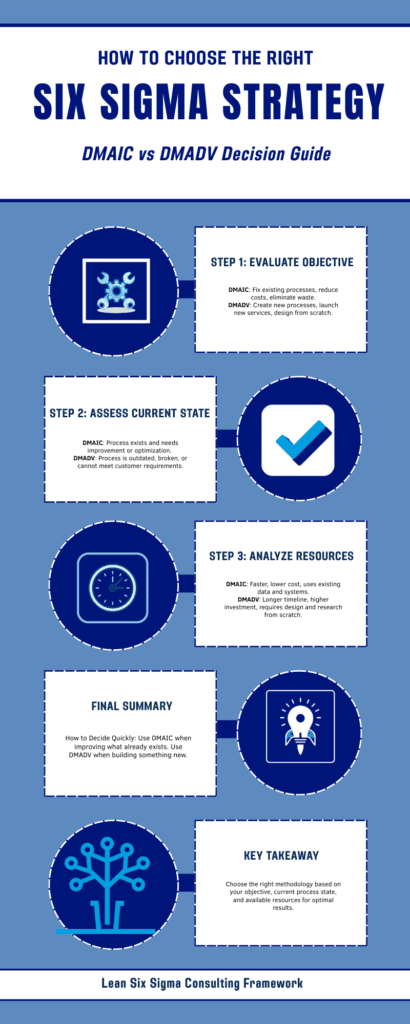
DMAIC is used to improve an existing process that is not performing well. DMADV is used to design a new process, product, or service that does not yet exist.
Simple rule:
- DMAIC = Improve what already exists
- DMADV = Design something new
Key Takeaways
- DMAIC focuses on improving existing processes
- DMADV focuses on designing new processes or systems
- DMAIC is reactive (problem-solving approach)
- DMADV is proactive (design-first approach)
- Both support Lean Six Sigma consulting and operational excellence
- Choosing the right method improves efficiency, quality, and cost outcomes
DMAIC vs. DMADV at a Glance
| Area | DMAIC | DMADV |
| Purpose | Improve existing processes | Design new processes |
| Starting Point | Existing process | No existing process |
| Focus | Problem-solving and optimization | Process design and validation |
| Approach | Reactive improvement | Proactive design |
| Goal | Reduce defects and inefficiencies | Build quality into design |
| Outcome | Improved performance | New optimized system |
Why This Distinction Matters: A Practical Perspective
In Lean Six Sigma consulting, selecting the wrong methodology can lead to wasted effort, limited impact, or ineffective solutions. DMAIC and DMADV are not interchangeable because they operate on two entirely different premises: DMAIC assumes a process already exists and needs fixing, whereas DMADV assumes a process does not exist or must be completely redesigned from scratch.
Making this distinction during the initial project assessment ensures that resources are focused on the right goals.
DMAIC in Action: Fixing a Broken Process
Imagine a company where customers frequently complain that their invoices are late or filled with errors. The invoicing process exists, but it is underperforming, causing delays and hurting cash flow.
A consultant would use DMAIC here. The team wouldn’t throw out the whole billing system; instead, they would measure the current delays, analyze the root causes of the errors (such as manual data entry bottlenecks), improve the workflow, and put controls in place to keep it running smoothly.
DMADV in Action: Designing a New Solution
Now imagine that same company decides to launch a brand-new subscription service. There is currently no mechanism to handle recurring monthly billing, automated renewals, or tier upgrades.
Because no process exists, you cannot use DMAIC to fix it. Instead, the team applies DMADV to define the new service requirements, measure customer expectations, analyze the best technical frameworks, design the entire billing workflow from scratch, and verify that it works perfectly before launch.
What Is DMAIC?
DMAIC is a structured Six Sigma methodology used to improve existing processes by reducing defects, variation, and inefficiencies. It follows five structured phases: Define, Measure, Analyze, Improve, and Control.
When DMAIC Is the Right Choice
DMAIC is used when organizations are dealing with active, daily operational challenges such as:
- Inconsistent product or service quality
- High defect, mistake, or error rates
- Process delays, long waiting times, or bottlenecks
- Excessive or rising operational costs
- Customer complaints or service failures
In these cases, the goal is not to reinvent the wheel, but to repair and optimize it systematically using data.
What Is DMADV?
DMADV is a Design for Six Sigma (DFSS) methodology used to create new processes, products, or services that meet customer requirements from the very beginning. It follows five structured phases: Define, Measure, Analyze, Design, and Verify.
When DMADV Is the Right Choice
DMADV is applied in scenarios when organizations are expanding or transforming their operations, such as:
- Developing and launching entirely new services or products
- Designing an entirely new customer experience or journey
- Implementing new business models
- Building new infrastructure, software systems, or workflows from scratch
- Replacing an old process that has reached its absolute limit and cannot be saved by incremental improvements
The focus here is proactive: building quality into the design stage so that inefficiencies never have a chance to develop.
Industry Standards Supporting DMAIC and DMADV
DMAIC and DMADV are core methodologies within the Lean Six Sigma framework, which is widely aligned with quality management principles such as ISO 9001 standards for process consistency and continuous improvement. These methodologies are also used across industries by certified Six Sigma practitioners, process engineers, and operational excellence consultants to ensure structured and measurable improvements.
DMAIC vs. DMADV in Real Business Contexts
Although both methodologies are part of Lean Six Sigma, their application depends on the nature of the operational challenge.
Manufacturing Context
In manufacturing environments, organizations often deal with process variation, equipment issues, and production inefficiencies.
- DMAIC is used to improve existing production lines by reducing defects, downtime, and waste
- DMADV is used when designing new production systems, launching new products, or setting up new facilities
Supply Chain Context
In supply chain operations, challenges are usually related to coordination, flow efficiency, and planning accuracy.
- DMAIC is used to improve existing logistics issues such as delays, inventory mismatches, and procurement inefficiencies
- DMADV is used to design new supply chain structures, distribution models, or operating frameworks
In practice, many organizations in Kenya misuse these methodologies by applying DMAIC to processes that are not yet well-defined. This often leads to incomplete solutions and repeated redesign work later in the project lifecycle.
How Lean Six Sigma Supports Operational Performance
Lean Six Sigma is widely used because it connects process improvement directly to measurable business outcomes.
Organizations typically use it to:
- Improve operational efficiency
- Reduce process waste
- Enhance quality control systems
- Increase productivity
- Strengthen customer satisfaction
- Support continuous improvement culture
By combining Lean (waste reduction) and Six Sigma (variation reduction), organizations are able to improve both speed and quality simultaneously.
Why This Matters for Continuous Improvement Culture
Selecting the correct approach between DMAIC and DMADV helps organizations apply structured problem-solving more effectively and supports a consistent approach to improving operational performance over time. When applied correctly, these methodologies help ensure that existing processes are improved where possible and new processes are designed properly where needed. This structured approach supports more consistent decision-making and strengthens long-term operational improvement efforts within organizations.
How to Measure Six Sigma Project Success
A key part of any Lean Six Sigma initiative is measuring whether improvements are actually delivering value.
Organizations evaluating Six Sigma project success typically track:
Operational Metrics
- Cycle time reduction
- Process efficiency improvements
- Workflow optimization
Quality Metrics
- Defect reduction
- Error rate reduction
- Process consistency improvements
Financial Metrics
- Cost savings
- ROI from improvements
- Reduction in operational waste
Customer Metrics
- Customer satisfaction improvements
- Service reliability
- Reduction in complaints
Successful Lean Six Sigma projects always link process improvements to measurable business outcomes.
Frequently Asked Questions
What is the main difference between DMAIC and DMADV?
DMAIC improves existing processes, while DMADV is used to design new processes or systems.
When should DMAIC be used?
DMAIC should be used when an existing process has performance issues such as defects, delays, or inefficiencies.
When should DMADV be used?
DMADV should be used when designing a new process, product, or service.
Can DMAIC and DMADV be used together?
Yes. Many organizations use DMAIC for improvement initiatives and DMADV for new process design within a broader continuous improvement strategy.
Which Six Sigma approach is better?
Neither is better. The correct choice depends on whether the goal is improvement (DMAIC) or design (DMADV).
Conclusion
DMAIC and DMADV are two foundational Lean Six Sigma methodologies that serve different but complementary purposes. DMAIC improves existing processes by reducing inefficiencies and variation, while DMADV is used to design new processes that meet customer and business requirements from the start.
For organizations seeking Lean Six Sigma consulting in Kenya, understanding when to apply each methodology is essential for achieving sustainable improvements in operational efficiency, quality, and cost performance.
At Faber Infinite, Lean Six Sigma consulting approaches are used to help organizations improve processes, reduce waste, and build structured systems that support long-term operational excellence and continuous improvement.
Contact us