Operational stability is the foundation of manufacturing excellence. Yet many organizations struggle with recurring production issues, missed targets, quality deviations, communication gaps, and firefighting culture. While improvement projects often deliver gains, sustaining those gains remains a challenge.
This is where the Daily Work Management (DWM) framework becomes essential.
A well-designed DWM framework creates the discipline, visibility, and accountability required to maintain stable operations while driving continuous improvement. Rather than relying on periodic reviews or reactive problem-solving, DWM embeds Operational Excellence into everyday work.
For manufacturers, across emerging markets such as Kenya, DWM provides a practical way to align teams, monitor performance, identify abnormalities early, and sustain improvements over time.
In this article, we explore how Daily Work Management supports operational stability, the key elements of a Lean Daily Work Management system, and the steps organizations can take to build an effective DWM culture.
What Is Daily Work Management?
Daily Work Management is a structured management approach that enables organizations to monitor, control, and improve operational performance on a day-to-day basis.
At its core, DWM focuses on:
- Standardizing daily activities
- Tracking key operational metrics
- Identifying deviations from standards
- Escalating issues quickly
- Driving accountability across teams
- Sustaining continuous improvement efforts
Unlike large transformation initiatives that occur periodically, DWM operates continuously. It creates a rhythm that helps leaders and frontline teams stay aligned with operational goals every day.
Many organizations use DWM as part of broader Operational Excellence and continuous improvement journeys because it helps sustain gains achieved through Lean, Total Productive Maintenance (TPM), Six Sigma, and other improvement methodologies.
Why Operational Stability Matters
Operational stability means processes consistently deliver expected outcomes in terms of:
- Safety
- Quality
- Delivery
- Cost
- Productivity
- Customer satisfaction
Without stability, organizations often experience:
- Frequent production disruptions
- Unplanned downtime
- Variable product quality
- Excessive firefighting
- Poor communication between departments
- Difficulty sustaining improvement initiatives
A stable operation provides the platform for continuous improvement and long-term growth.
Daily Work Management helps create this stability by ensuring that operational issues become visible and actionable before they grow into larger problems.
The Daily Work Management Framework
An effective Daily Work Management framework typically consists of several interconnected elements.
1. Standardized Daily Work
Consistency begins with clear standards.
Teams should understand:
- Daily responsibilities
- Standard operating procedures
- Escalation processes
- Performance expectations
Standardizing Daily Work Management ensures that activities are performed consistently regardless of shift, department, or individual.
When standards are clearly defined, abnormalities become easier to identify and address.
2. Visual Performance Management
One of the most important components of a Lean Daily Work Management system is visibility.
Teams need real-time awareness of performance.
This is often achieved through:
- Key performance indicator (KPI) dashboards
- Production boards
- Safety metrics
- Quality indicators
- Delivery performance tracking
Visual Daily Work Management boards help teams quickly identify whether operations are on target or off target.
Rather than waiting for monthly reports, employees can see issues as they occur and respond immediately.
3. Daily Accountability Meetings
Regular communication creates alignment.
Many organizations establish tiered Daily Work Management meetings that connect frontline teams, supervisors, managers, and leadership.
These meetings help:
- Review previous performance
- Discuss abnormalities
- Assign corrective actions
- Escalate unresolved issues
- Align priorities
When conducted effectively, tiered meetings improve responsiveness and reduce communication delays across organizational levels.
4. Problem Escalation Process
Not all issues can be resolved at the point of occurrence.
An effective Daily Work Management framework establishes clear escalation pathways so that unresolved problems receive timely support.
The objective is not to assign blame but to ensure rapid problem resolution and prevent recurring issues.
5. Continuous Improvement Integration
Daily Work Management is not simply about tracking performance.
It should also encourage continuous improvement by:
- Capturing improvement opportunities
- Monitoring corrective actions
- Reviewing root causes
- Standardizing successful solutions
This connection between operational control and improvement creates long-term sustainability.
Daily Work Management Routines That Drive Stability
Successful organizations establish consistent Daily Work Management routines.
Examples include:
Start-of-Shift Reviews
Teams review:
- Safety concerns
- Production targets
- Staffing availability
- Equipment status
- Quality alerts
This ensures everyone begins the shift with shared priorities.
Gemba Walks
Leaders observe operations directly at the workplace to understand actual conditions rather than relying solely on reports.
Regular Gemba walks help identify emerging issues before they impact performance.
KPI Reviews
Teams review operational indicators such as:
- Output
- Quality defects
- Downtime
- Overall Equipment Effectiveness (OEE)
- Delivery performance
Frequent KPI reviews create accountability and faster corrective action.
End-of-Day Reflection
A brief review of:
- Targets achieved
- Problems encountered
- Actions completed
- Outstanding concerns
This supports learning and preparation for the next shift.
The Role of the Standardize–Do–Check–Act (SDCA) Cycle in Daily Work Management
Many organizations are familiar with Plan-Do-Check-Act (PDCA).
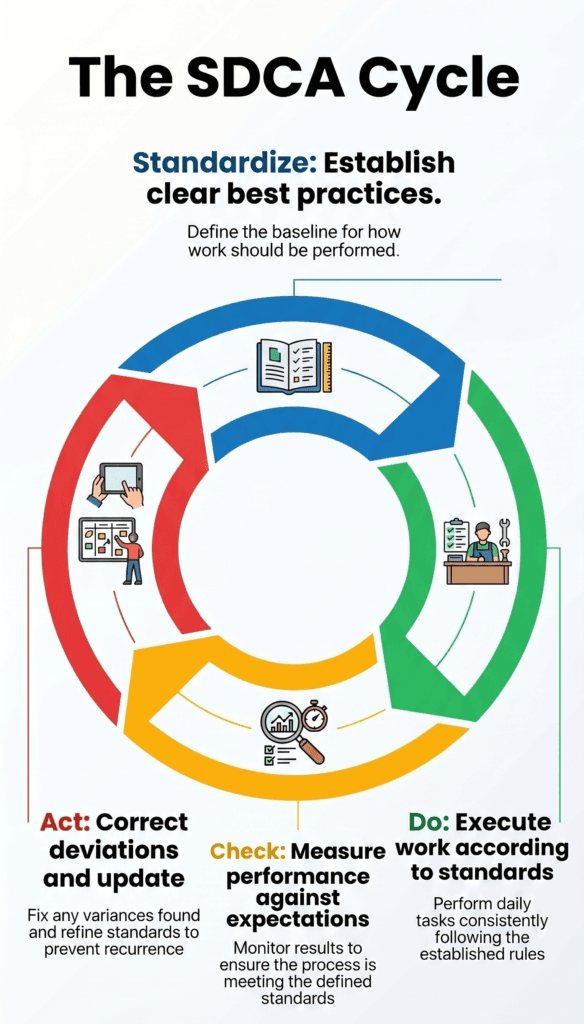
However, operational stability in Daily Work Management often depends on the SDCA cycle. It involves:
Standardize
Establish clear standards and best practices.
Do
Execute work according to defined standards.
Check
Measure actual performance against expectations.
Act
Correct deviations and update standards when necessary.
The SDCA cycle focuses on maintaining process stability before pursuing larger improvement initiatives.
Without stable processes, continuous improvement efforts often fail to sustain results.
DWM in Manufacturing Excellence
DWM in manufacturing excellence goes beyond daily reporting.
It creates a management system that connects strategic objectives to frontline execution.
Benefits include:
Improved Visibility
Teams gain immediate awareness of operational performance.
Faster Problem Resolution
Issues are identified and addressed before they escalate.
Stronger Accountability
Clear ownership improves follow-through on actions.
Better Cross-Functional Alignment
Operations, maintenance, quality, and supply chain teams work toward common goals.
Sustained Improvements
Organizations are more likely to maintain gains from Operational Excellence initiatives.
These benefits make DWM a critical component of long-term manufacturing excellence.
Step-by-Step Daily Work Management Implementation Guide
Organizations looking to implement DWM can follow these practical steps:
Step 1: Define Critical KPIs
Identify measures that reflect operational performance.
Examples include:
- Safety incidents
- Productivity
- Quality defects
- Delivery performance
- Equipment uptime
Step 2: Establish Standard Work
Document key processes and responsibilities.
Step 3: Create Visual Management Boards
Display performance information where work occurs.
Step 4: Launch Daily Huddles
Implement a structured Daily Work Management huddle agenda focused on performance, issues, and actions.
Step 5: Build Tiered Escalation
Connect operational reviews across different management levels.
Step 6: Use the SDCA Cycle
Monitor adherence to standards and address deviations promptly.
Step 7: Sustain and Improve
Regularly review the effectiveness of the DWM system and refine it based on organizational needs.
Common Challenges in Daily Work Management
Organizations often encounter obstacles such as:
- Inconsistent meeting discipline
- Too many KPIs
- Lack of ownership
- Poor follow-up on actions
- Limited frontline engagement
Addressing these challenges requires leadership commitment, clear expectations, and ongoing reinforcement.
Daily Work Management should become part of the organizational culture rather than an additional reporting exercise.
Conclusion
Operational stability is not achieved through isolated improvement projects alone. It requires a disciplined management system that creates visibility, accountability, and consistency every day.
A robust Daily Work Management framework enables organizations to standardize processes, identify problems early, improve communication, and sustain performance improvements over time. It provides the foundation needed to support Operational Excellence and continuous improvement.
Organizations that embed effective Daily Work Management routines, visual management practices, tiered meetings, and the SDCA cycle are better positioned to achieve stable operations and long-term success.
FAQs
What is a Daily Work Management framework?
A Daily Work Management framework is a structured system that helps organizations monitor daily performance, manage abnormalities, improve accountability, and sustain Operational Excellence through standard work, visual management, and regular reviews.
How does a Lean Daily Work Management system improve manufacturing performance?
A Lean Daily Work Management system improves visibility, accelerates problem-solving, reduces waste, strengthens accountability, and supports continuous improvement across manufacturing operations.
What should be included in a Daily Work Management huddle agenda?
A Daily Work Management huddle agenda typically includes safety updates, KPI review, production performance, quality concerns, maintenance issues, action status updates, and escalation requirements.
What is the difference between Daily Work Management and PDCA?
PDCA focuses on continuous improvement initiatives, while Daily Work Management often relies on the SDCA cycle to maintain stability, sustain standards, and control daily operations.
Contact us