Manufacturing organizations often achieve performance improvements through Lean initiatives, process optimization, and continuous improvement programs. However, a common challenge emerges over time; initial gains begin to fade, processes drift, and performance becomes inconsistent again.
This challenge is not usually caused by a lack of improvement effort, but by the absence of a strong sustainment system.
This is where Daily Work Management (DWM) plays a critical role.
A well-designed Daily Work Management framework ensures that operational performance is not only improved but also sustained through structured routines, visibility systems, and disciplined execution. It acts as the control layer that keeps operations stable while enabling continuous improvement.
Daily Work Management as a Stability System
Daily Work Management is often misunderstood as a reporting or tracking mechanism. In reality, it is a daily execution and control system.
In a mature operational environment, DWM ensures that:
- Standards are consistently followed
- Performance is monitored in real time
- Abnormalities are quickly identified
- Corrective actions are assigned and tracked
- Operational discipline is maintained across shifts
This makes DWM the backbone of operational stability.
Without it, even well-designed improvement initiatives struggle to sustain results.
How DWM Sustains Operational Excellence
Operational Excellence depends on consistency in execution. Daily Work Management in manufacturing excellence enables this consistency through several interconnected mechanisms.
Standard Work Discipline
Standard work ensures that processes are executed in the most effective and repeatable way. Within DWM, standard work becomes the baseline for daily control.
It reduces variation, improves predictability, and ensures that operational performance is not dependent on individual interpretation.
Visual Management Systems
Visual Daily Work Management boards provide real-time visibility into operational performance.
These boards typically display:
- Production output
- Quality performance
- Downtime and losses
- Safety indicators
- Overall Equipment Effectiveness (OEE)
Visual management ensures that performance gaps are immediately visible, enabling faster response and decision-making.
KPI Governance and Daily Performance Control
Key performance indicators (KPIs) form the measurement backbone of DWM.
Unlike traditional reporting systems where KPIs are reviewed periodically, DWM integrates KPIs into daily management routines.
This enables organizations to:
- Detect deviations early
- Respond to performance gaps immediately
- Maintain alignment with operational targets
KPI discipline is what transforms DWM from a passive system into an active control mechanism.
SDCA Cycle for Process Stability
The Standardize–Do–Check–Act (SDCA) cycle is central to sustaining operational stability.
- Standardize: Define the best known method
- Do: Execute consistently
- Check: Monitor performance against standards
- Act: Correct deviations and update standards when required
SDCA ensures that improvements are stabilized before new changes are introduced, preventing process drift.
Tiered Communication and Escalation Systems
Daily Work Management tiered meetings create a structured communication flow across operational levels.
This system ensures:
- Issues are escalated to the right level
- Decision-making is timely and structured
- Operational problems are not delayed or overlooked
- Leadership remains connected to execution reality
This tiered structure strengthens accountability and reduces response delays in complex operations.
Leadership Gemba and Operational Engagement
Sustaining excellence requires leadership presence at the point of work.
Gemba, the practice of observing actual operations, enables leaders to:
- Understand real operational conditions
- Validate performance data
- Identify systemic issues
- Reinforce accountability and discipline
When leadership actively engages with the operational environment, DWM becomes embedded in organizational culture rather than remaining a reporting activity.
Why Daily Work Management Systems Fail
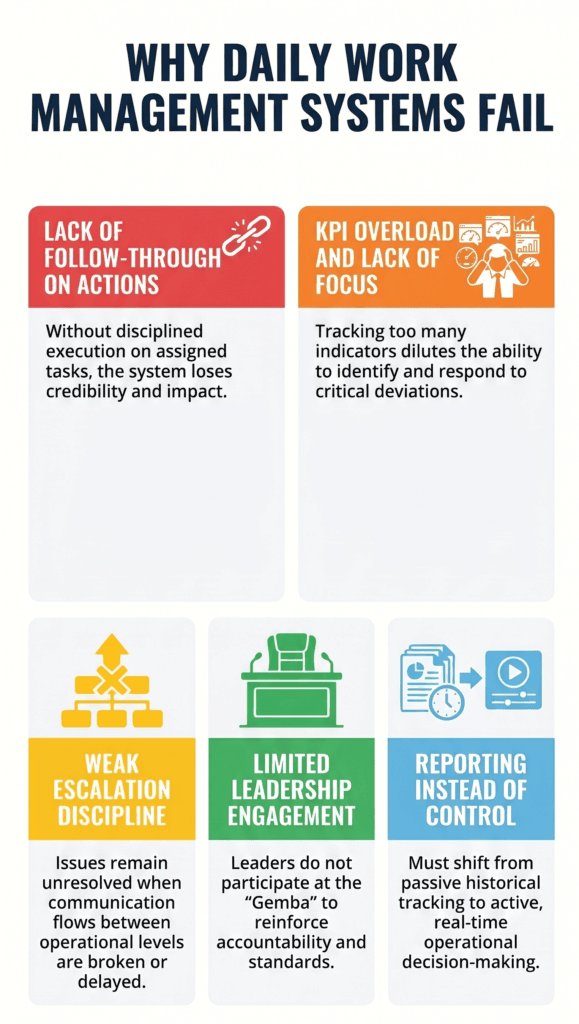
Despite strong design, many DWM systems fail to sustain impact due to structural weaknesses such as:
- Lack of consistent follow-through on actions
- Overloading of KPIs without clear focus
- Weak escalation discipline
- Limited leadership engagement
- Treating DWM as reporting instead of control
These issues reduce DWM effectiveness and eventually lead to erosion of operational discipline.
The Shift: From Reporting to Control
A critical mindset shift is required for DWM to deliver sustained value.
| Reporting System | Daily Work Management System |
| Focus on historical data | Focus on real-time control |
| Periodic reviews | Daily execution rhythm |
| Passive tracking | Active problem solving |
| Information sharing | Operational decision-making |
This shift transforms DWM from a passive monitoring tool into an operational control system that drives stability and performance.
Role of Daily Work Management in Organizational Alignment
Daily Work Management (DWM) plays a critical role in aligning organizational strategy with execution. It ensures that business priorities are translated into structured daily actions through standardized routines and consistent operational discipline.
This alignment is strengthened through visual performance tracking, standard work, and clearly defined accountability mechanisms. By linking daily activities directly to strategic objectives, DWM reduces ambiguity and improves execution clarity across teams.
DWM also integrates key performance indicators (KPIs), escalation pathways, and standard work into a unified operating system. This creates a direct connection between leadership expectations and frontline execution, enabling faster response to deviations and better decision-making.
The approach also aligns with Lean principles such as standardization and visual management, which support structured work organization and continuous improvement. These principles are reflected in work organization frameworks discussed by the International Labour Organization, emphasizing structured processes, clarity in roles, and improved operational efficiency.
Conclusion
Daily Work Management (DWM) is not simply a set of routines or visual tools. It is a structured management system that enables organizations to sustain Operational Excellence over time.
By integrating standard work, visual management, KPI discipline, SDCA cycles, tiered communication, and leadership engagement, DWM creates a stable operational environment where performance is continuously monitored and maintained.
When implemented effectively, Daily Work Management becomes the foundation that ensures improvements are not temporary, but sustained as part of everyday execution.
FAQs
What is Daily Work Management in manufacturing excellence?
Daily Work Management is a structured system that ensures operational performance is monitored, controlled, and sustained through daily routines, KPIs, and standard work.
How does DWM support Operational Excellence?
It ensures stability, improves visibility, strengthens accountability, and enables faster response to operational issues.
What is the role of SDCA in Daily Work Management?
SDCA helps maintain process stability by standardizing work, monitoring execution, and correcting deviations when required.
How do tiered meetings support DWM?
They create structured escalation pathways that ensure issues are communicated and resolved at the appropriate organizational level.
Why do Daily Work Management systems fail?
Common reasons include weak follow-through, poor escalation discipline, KPI overload, and lack of leadership engagement.
Contact us