
The importance of organizational change is rapidly increasing in Egypt as businesses face evolving customer expectations, technological advancements, economic pressures, and growing competition. Organizations that can adapt effectively are better positioned to improve performance, respond to market changes, and create sustainable growth.
However, successful organizational change is not achieved by introducing new systems or restructuring teams alone. It requires organizations to align their people, processes, leadership practices, and culture around clear business objectives.
For Egyptian companies, developing the ability to manage change has become an important capability for improving productivity, strengthening operational performance, and building long-term organizational resilience.
This article explains why organizational change is critical for Egyptian businesses, the factors driving transformation, the benefits organizations can achieve, and practical approaches for creating sustainable improvement.
Key Takeaways
- Organizational change helps Egyptian companies adapt to changing market conditions and business requirements.
- Sustainable transformation requires alignment between people, processes, leadership, and organizational culture.
- Digital transformation and operational improvement succeed when supported by effective organizational change.
- Strong leadership and employee involvement are essential for successful change adoption.
- Organizations that develop continuous improvement capabilities are better prepared for future challenges.
What Is Organizational Change?
Organizational change is the structured process of improving how an organization operates to achieve strategic objectives, respond to changing conditions, and develop stronger capabilities.
Unlike short-term improvement projects, organizational change focuses on creating lasting improvements in the way people work, decisions are made, and processes are managed.
Organizational change may involve:
- Improving business processes
- Developing leadership capabilities
- Redefining roles and responsibilities
- Strengthening collaboration between teams
- Introducing new technologies
- Improving performance management systems
- Building a culture of continuous improvement
Effective organizational change considers both operational and human factors. While processes and technologies may create opportunities, people determine whether improvements are successfully adopted and sustained.
Why Is Organizational Change Important for Egyptian Companies?
Organizational change is important for Egyptian companies because it enables businesses to adapt, improve performance, and remain competitive in an evolving environment.
Organizations across Egypt are navigating several challenges, including:
- Changing customer expectations
- Increased competition
- Technology adoption
- Need for higher productivity
- Workforce capability development
- Pressure to improve efficiency
These challenges require more than isolated improvement initiatives. Businesses need the ability to continuously evaluate how they operate, identify opportunities for improvement, and adapt their ways of working.
Companies that treat change as an ongoing capability are better positioned to:
- Respond to new market requirements
- Improve operational effectiveness
- Strengthen decision-making
- Develop employee capabilities
- Sustain long-term improvements
Organizational change creates a connection between strategic goals and everyday execution by ensuring employees, processes, and leadership practices support the same objectives.
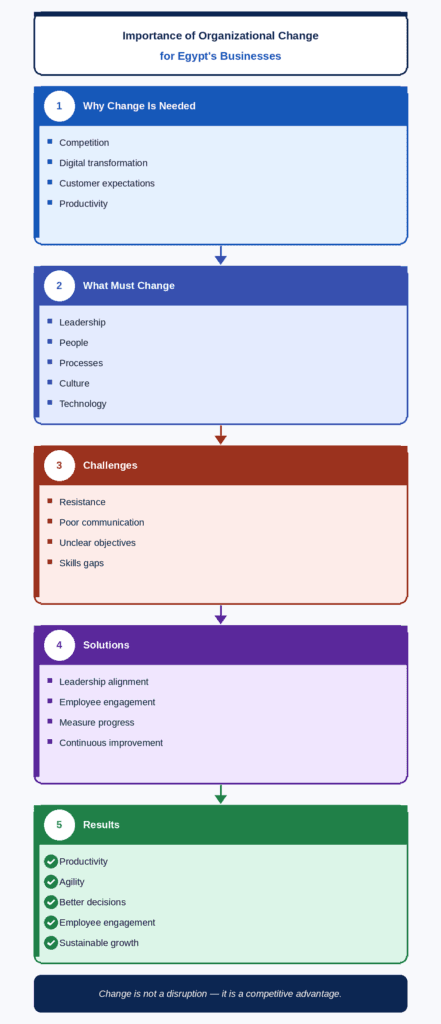
What Are the Main Drivers of Business Change in Egypt?
Several factors are encouraging organizations in Egypt to rethink traditional ways of working and invest in business transformation.
Economic Competitiveness and Market Changes
Organizations operate in increasingly competitive environments where efficiency, quality, and customer value influence business success.
To remain competitive, companies need to continuously improve how they allocate resources, manage operations, and deliver value.
Organizational change helps businesses evaluate existing practices, remove unnecessary complexity, and create more effective ways of working.
Digital Transformation
Digital transformation is changing how organizations collect information, manage processes, and make decisions.
However, technology alone does not guarantee successful transformation.
Organizations must also address:
- Process alignment
- Employee capabilities
- Leadership readiness
- New ways of working
- Performance management practices
Without organizational change, digital investments may not deliver their expected value because employees and processes may not be prepared to adopt new approaches effectively.
Changing Workforce Expectations
Employees increasingly value clear communication, professional development, collaboration, and meaningful involvement in organizational decisions.
Organizations that invest in leadership development and employee capabilities can create stronger engagement and improve their ability to implement change successfully.
Building workforce capability is therefore an important part of organizational development.
The Need for Operational Excellence
Operational Excellence requires organizations to continuously improve how work is performed.
It is not only about increasing efficiency or reducing waste. It involves creating systems where employees understand performance expectations, problems are identified early, and improvements become part of daily operations.
Organizational change supports Operational Excellence by helping businesses develop:
- Consistent processes
- Better problem-solving capabilities
- Stronger accountability
- Continuous improvement behaviors
What Are the Benefits of Organizational Change?
When managed effectively, organizational change creates improvements across multiple areas of the business.
Improved Productivity
One of the key benefits of organizational change is productivity improvement.
By improving processes, clarifying responsibilities, and reducing inefficiencies, organizations can help employees focus on activities that create greater value.
Effective change does not simply require employees to work harder. It enables them to work more effectively through better systems and clearer ways of working.
Better Decision-Making
Organizations make stronger decisions when they have clear responsibilities, reliable information, and effective performance measurement systems.
Organizational change can improve decision-making by strengthening:
- Management systems
- Communication channels
- Accountability structures
- Performance visibility
This allows leaders to respond more effectively to challenges and opportunities.
Greater Organizational Agility
Business environments continue to change. Organizations with strong change capabilities can adapt more effectively to:
- Customer needs
- Market conditions
- Technology developments
- Operational challenges
Agility allows businesses to respond while maintaining stability and performance.
Stronger Employee Engagement
Employees are more likely to support change when they understand:
- Why change is needed
- How it affects their work
- How they contribute to success
Organizations that involve employees, communicate clearly, and provide necessary support can improve ownership and adoption of new ways of working.
What Role Does Leadership Play in Organizational Change?
Leadership is one of the most important factors influencing successful organizational change.
Leaders are responsible for creating direction, building alignment, and reinforcing the behaviors required for transformation.
Effective leaders:
- Communicate the purpose of change
- Align teams around common objectives
- Support employees during transition periods
- Remove barriers to implementation
- Reinforce improvement behaviors
Change initiatives often struggle when leaders view transformation as a temporary project rather than an ongoing organizational capability.
Strong leadership ensures that change becomes integrated into everyday decision-making and organizational culture.
What Are the Common Challenges of Organizational Change in Egypt?
Although organizational change creates significant opportunities, businesses often face several challenges during adoption.
Resistance to Change
Employees may hesitate to adopt new approaches because they are unfamiliar or because they are uncertain about how changes affect their responsibilities.
Organizations can address resistance by:
- Communicating clearly
- Involving employees early
- Providing training and support
- Creating feedback opportunities
Lack of Clear Objectives
Change initiatives are more difficult to implement when organizations do not clearly define:
- Why change is needed
- What outcomes are expected
- How success will be measured
Clear objectives create alignment and help teams understand the purpose behind transformation.
Communication Gaps
Poor communication can create confusion and reduce employee engagement.
Effective communication should explain:
- What is changing
- Why change is necessary
- How employees are involved
- What progress is being achieved
Limited Capability Development
Organizations cannot sustain new ways of working without developing the required skills and capabilities.
Training, coaching, and continuous learning help employees adapt and support long-term improvement.
What Are Effective Organizational Change Solutions for Egyptian Businesses?
Organizations can strengthen their ability to manage change by focusing on several practical approaches.
Align Change With Business Strategy
Change initiatives should directly support organizational objectives rather than operate separately from business priorities.
Build Leadership Alignment
Leaders should share a common understanding of transformation goals and consistently reinforce priorities.
Engage Employees Throughout the Process
Employees should be involved in identifying improvement opportunities and developing practical solutions.
Measure Progress
Performance indicators help organizations evaluate whether changes are producing the intended results.
Examples include:
| Area | Possible Measures |
| Productivity | Process efficiency, cycle time |
| Operations | Quality performance, improvement progress |
| People | Training completion, employee involvement |
| Business | Achievement of strategic objectives |
Develop a Continuous Improvement Culture
Organizations that encourage ongoing improvement are better prepared to adapt and respond to future challenges.
Conclusion
The importance of organizational change in Egypt continues to grow as businesses navigate evolving markets, technological developments, and increasing expectations for better performance.
Successful transformation requires more than implementing new systems or processes. Organizations must align people, leadership, processes, and culture to create sustainable improvement capabilities.
Businesses that develop strong organizational change capabilities can improve productivity, strengthen operational performance, and build greater resilience in an increasingly dynamic environment.
By treating change as an ongoing capability rather than a one-time initiative, Egyptian organizations can create the foundation needed for long-term growth and continuous improvement.
Frequently Asked Questions
Why is organizational change important for Egyptian companies?
Organizational change is important for Egyptian companies because it helps businesses adapt to market changes, improve productivity, strengthen operational performance, and develop the capabilities needed for sustainable growth.
What drives organizational change in Egypt?
Key drivers include changing customer expectations, digital transformation, increased competition, workforce development needs, and the need for stronger operational performance.
How does organizational change improve productivity?
Organizational change improves productivity by creating better processes, clarifying responsibilities, improving collaboration, and enabling employees to focus on higher-value activities.
What are the biggest challenges of organizational change?
Common challenges include employee resistance, unclear objectives, communication gaps, leadership misalignment, and insufficient capability development.
How can organizations create sustainable change?
Organizations can create sustainable change by aligning leadership, involving employees, measuring progress, developing capabilities, and embedding continuous improvement into daily operations.
Contact us