Operational efficiency in Egypt is often mistaken for a capital problem: in a fluctuating macroeconomic landscape, many Egyptian business leaders believe that driving operational growth requires substantial capital injection. However, purchasing expensive machinery or expanding real estate often masks deep-rooted process inefficiencies rather than fixing them.
The most sustainable way to protect margins and scale output across Egypt is to focus entirely on organic growth. Learning how to improve efficiency and productivity without increasing capital expenditure (CapEx) allows organizations to convert hidden waste into active profitability using their current resources.
Uncovering Hidden Capital Leaks on the Shop Floor
When a production line or an office team lags behind targets, the traditional corporate reaction is to hire more personnel or purchase more equipment. In reality, significant capacity already sits dormant inside your existing layout.
Operational friction generally surfaces through three distinct types of internal resource leaks:
- Underutilized Assets: Equipment sitting idle due to disorganized changeover processes, slow material delivery, or poor scheduling.
- Process Bottlenecks: A lack of balance across production lines where one overly slow station forces surrounding teams into unproductivity.
- Hidden Motion Waste: Personnel wasting valuable minutes searching for misaligned tools, wandering across layout floors for components, or waiting for administrative sign-offs.
By identifying and correcting these friction points, enterprises realize substantial productivity improvement in Egypt without adding a single line item to their operational budget.
Zero-Cost Strategies for Operational Efficiency Improvement in Egypt
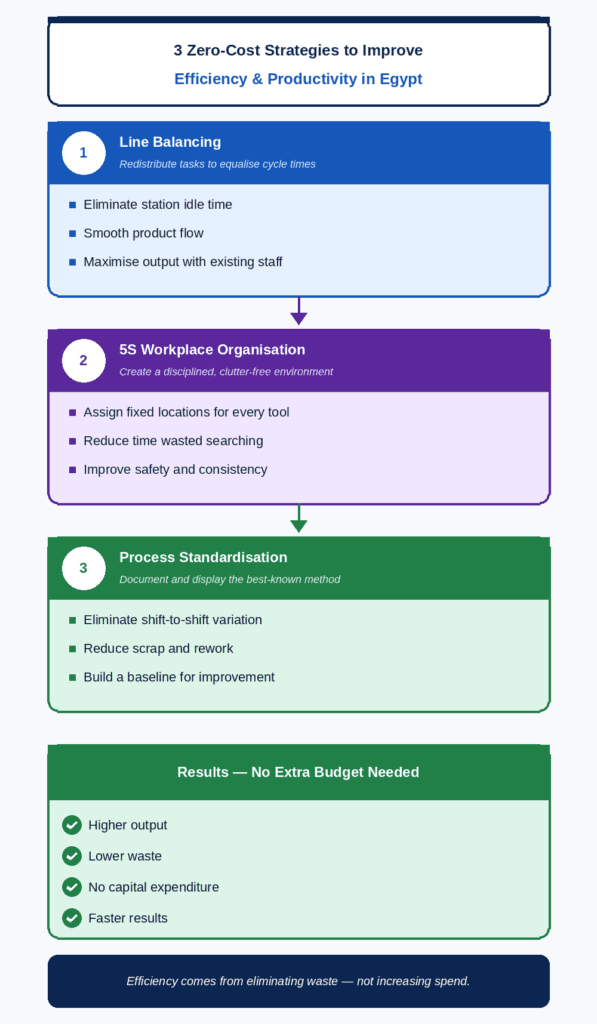
1. Optimize Resource Flows via Line Balancing
A major cause of unproductivity in Egyptian manufacturing plants is an unbalanced line layout. For instance, if Station A takes 40 seconds to complete a task, Station B takes 90 seconds, and Station C takes 30 seconds, Station C will constantly sit idle while inventory piles up awkwardly in front of Station B.
Line balancing involves breaking down operations and redistributing tasks evenly across the available workforce. By equalizing cycle times, you smooth out product movement, eliminate waiting periods, and maximize output without altering your current staff count or purchasing additional assets.
2. Implement the 5S Workplace Organization Framework
The 5S framework (Sort, Set in order, Shine, Standardize, Sustain) is a completely low-cost, high-impact methodology focused on environmental discipline.
When applied to a warehouse or assembly floor, it ensures every tool, gauge, and raw component has a designated, visually marked location. Removing unnecessary clutter and ensuring immediate accessibility reduces worker fatigue and eliminates the non-value-added time typically spent searching for items.
3. Capture Best Practices with Process Standardization
Without clear, visual standard work instructions, individual operators run the exact same process using wildly different methods. This inconsistency causes highly volatile cycle times and unpredictable scrap rates.
To drive sustainable process standardization for operational efficiency in Egypt, work directly with your top-performing operators to document the safest, fastest, and least wasteful way to complete a task. Display these standards visually at the workstation to ensure all shifts execute work with matching precision, establishing a solid baseline for continuous improvement.
Real-World Insight: An operational evaluation of a packaging facility revealed that wide quality variations across different work shifts were caused by unstandardized machine adjustments. By documenting a single, clear setup standard on a visual card at the machine, the facility slashed raw material scrap rates by 14% overnight, without spending any capital on new machinery or software.
Boosting Workforce Yield Through Smart Daily Governance
True Operational Excellence is built on human capital management, not capital investments. Improving output requires replacing hands-off management styles with highly engaged, visual daily governance frameworks.
Deploying Daily Work Management (DWM)
To learn how to improve workforce productivity in Egypt with zero added budget, transition your teams to structured Daily Work Management:
- Frontline Visual Boards: Set up low-cost whiteboards directly on the floor showing hourly production targets versus actual performance.
- Short Shift-Start Briefings: Gather teams for a 10-minute stand-up meeting at the start of each shift. Use this time to review yesterday’s variations, align on the day’s targets, and proactively flag any material or maintenance roadblocks.
Making targets visible directly to operators builds a strong culture of personal accountability and shifts middle management from reactive policing to active problem-solving.
Comparing the Financial Impact of Optimization vs. CapEx
| Operational Parameter | The High-Cost Approach (CapEx Expansion) | The Zero-Cost Approach (Lean & Optimization) |
| Financial Outlay | Large capital expenditure with long amortization timelines. | Low to zero capital investment; self-funded by internal waste elimination. |
| Implementation Speed | Months or years spent waiting for equipment shipping and installation. | Rapid turnaround; operational adjustments yield results within weeks. |
| Floor Space Required | Requires additional physical layout space or facility expansion. | Reclaims underutilized floor space by optimizing current workflows. |
| Cultural Impact | Staff relies on machinery to solve deep-rooted human and process errors. | Empowers teams to actively hunt for waste and build permanent problem-solving skills. |
For businesses looking to maximize their current asset utilization, collaborating with specialized productivity consulting for Egyptian industrial zones helps expose hidden capacity traps and drives a focused strategy for manufacturing efficiency.
Maximizing Existing Assets for Resilient Operations
Achieving sustainable operational efficiency in Egypt does not require an expansive corporate budget. True efficiency comes down to a relentless focus on waste reduction and maximizing the resources you already control.
By balancing your production lines, standardizing daily operational tasks, and introducing transparent, visual floor governance, your enterprise can rapidly increase output, decrease operational friction, and fuel long-term corporate growth completely from within.
Frequently Asked Questions (FAQs)
How can we find hidden bottlenecks on our production floor without using expensive monitoring software?
You can identify bottlenecks manually by spending time at the Gemba (the actual place where work happens) and mapping your workflows. Look for areas where large amounts of work-in-progress (WIP) inventory pile up or where operators are frequently waiting for materials. These visual cues clearly indicate an unbalanced process or a bottleneck station.
Will process standardization restrict our team’s flexibility or creativity?
Not at all. Process standardization simply defines the current best-known method to execute an operation safely and efficiently. By establishing a reliable baseline, it removes guesswork and errors. Operators can still suggest creative improvements, but those ideas are tested systematically and integrated into the new standard, ensuring continuous progress.
How does workplace clutter directly impact our bottom-line profitability?
Workplace clutter creates hidden operational costs. When tools or components are unorganized, operators waste time searching for them, which extends cycle times and lowers hourly output. Clutter also increases safety risks, misplaces inventory, and causes unnecessary material damage, all of which chip away at your profit margins.
What is the most effective way to motivate middle managers to support efficiency changes?
The best way to engage middle managers is to shift them away from manual paperwork and constant firefighting. By providing them with visual tracking boards and structured daily stand-up routines, you give them the tools to spot and resolve process variations quickly. Showing them how these changes eliminate daily operational chaos helps build long-term commitment.
Contact us