The industrial landscape across Egypt is undergoing a major technological evolution. In alignment with the government’s National Industrial Strategy, major manufacturing hubs and industrial zones are rapidly upgrading their infrastructure. For ambitious enterprises, the core objective is clear: leverage advanced technology to expand production capacity, reduce operational friction, and secure a place within global supply chains.
However, true digital transformation is not simply about buying expensive software or adding digital layers to legacy machinery. To successfully improve efficiency and productivity, modern businesses must merge physical operational discipline with digital intelligence. Deploying Industry 4.0 tools strategically allows Egyptian organizations to accelerate waste reduction and build resilient, highly adaptable operations.
The True ROI of Industry 4.0 in Egypt’s Industrial Sectors
Many executive teams look at digital upgrades through a purely defensive lens, seeing them merely as a tool for basic administrative tracking. In reality, connecting shop floor machinery to smart digital frameworks uncovers deep operational insights that traditional spreadsheets miss entirely.
When implemented effectively, an Industry 4.0 strategy helps improve efficiency and productivity by targeting major profitability leaks:
- Eliminating Blind Spots: Transitioning from subjective, manual shift logs to automated, real-time data collection.
- Preventing Unexpected Downtime: Moving away from reactive repairs and using early machine performance data to schedule maintenance proactively.
- Maximizing Asset Potential: Pinpointing the exact root causes behind micro-stoppages and short speed drops on processing lines.
By converting raw operational data into clear, actionable management strategies, companies can achieve a sustainable operational efficiency improvement in Egypt without adding excessive overhead.
A Pragmatic Blueprint to Improve Efficiency and Productivity in Egyptian Factories
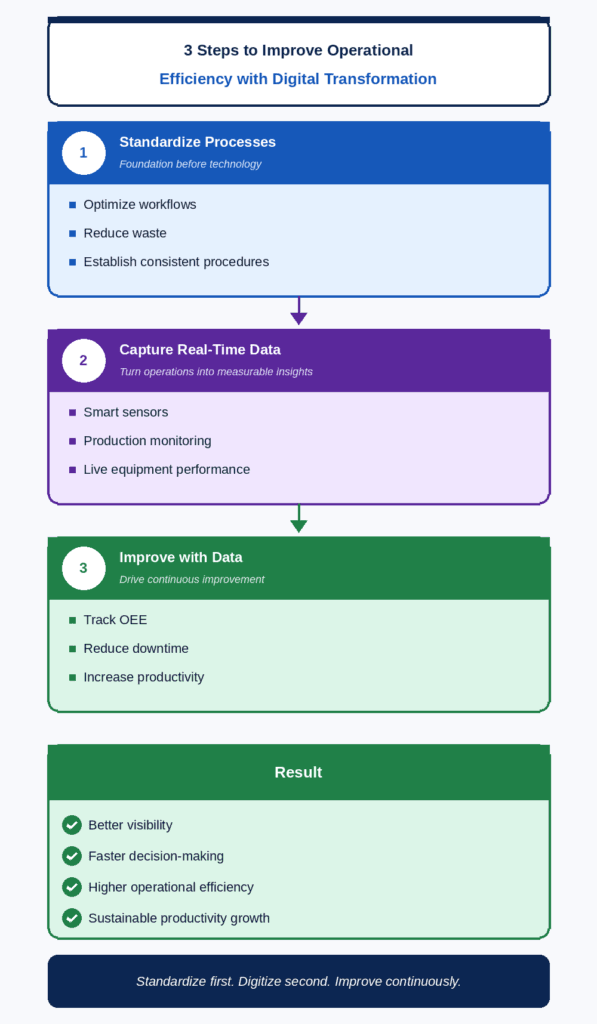
1. Stabilize with Lean Principles Before Automating
The most critical rule of technology adoption is simple: never automate an unstable or unstandardized process. If you apply digital tracking to an unoptimized, chaotic workflow, you only succeed in generating digital errors faster.
Before investing in advanced equipment sensors, factories must first execute rigorous process optimization and establish clear, manual baseline standards.Once your physical flows are lean and stable, technology acts as a powerful multiplier that helps improve efficiency and productivity at scale.
2. Implement Smart Automation and Real-Time Production Monitoring
Modern automation solutions improve efficiency and productivity by bridging the gap between production operations and business decision-making through continuous visibility into equipment performance. By equipping critical production assets with smart sensors and connected monitoring systems, manufacturers can automatically collect operational data from the shop floor.
These systems capture key performance metrics; including machine temperatures, vibration patterns, equipment utilization, and cycle times; without relying on manual operator input. The result is accurate, real-time production data that enables managers to identify inefficiencies, respond quickly to issues, and make informed operational decisions based on actual performance.
3. Track Performance with Automated OEE Dashboards
Relying on end-of-week paper updates prevents operations managers from addressing issues when they matter most. Industry 4.0 helps improve efficiency and productivity by replacing reactive reporting with real-time analytics dashboards that calculate Overall Equipment Effectiveness (OEE) instantly.
When a machine’s output drops or a bottleneck forms, the visual dashboard immediately flags the deviation. This enables supervisors to step in and fix the issue during the shift, preserving the day’s production targets.
Real-World Insight: An industrial enterprise struggling with frequent, unexplained conveyor stoppages integrated basic data-capture modules onto its main assembly line. The live tracking revealed that micro-stoppages, lasting less than two minutes each, were accumulating into over 90 minutes of lost production per shift. Having clear, real-time data allowed maintenance teams to locate the specific mechanical tracking issue, a fix that helped improve efficiency and productivity by 11% within the first month.
Elevating Workforce Capabilities Through Connected Technology
A successful digital shift involves redefining human roles, not replacing them. In Egypt’s manufacturing environment, true Operational Excellence works to improve efficiency and productivity by empowering front-line personnel.
Shifting to Digital Daily Work Management (DWM)
To learn how to improve workforce productivity in Egypt using tech, replace paper floor logs with localized digital interfaces:
- Interactive Visual Displays: Position touchscreens or monitors at key workstations so operators can see their live output versus shift targets in real time.
- Data-Driven Stand-up Briefings: Use accurate, system-generated data to guide your 10-minute daily team meetings, focusing discussions on actual facts rather than personal assumptions.
Providing teams with immediate visibility over their performance builds a strong culture of personal accountability and shifts supervisors from administrative tracking to active, on-the-floor coaching.
Traditional Automation vs. Intelligent Industry 4.0 Transformation
| Operational Parameter | Traditional Automation Approach | Intelligent Industry 4.0 Approach |
| Data Utilization | Data stays isolated within individual machines or siloed systems. | Centralized data streams integrate smoothly across your entire operation. |
| Maintenance Model | Reactive or schedule-based, leading to unexpected equipment breakdowns. | Predictive maintenance based on live sensor data and usage tracking. |
| Process Control | Rigid systems that require manual reconfiguration for product changes. | Flexible, connected setups that adjust rapidly to varying production batches. |
| Decision Speed | Management reacts to lagging historical reports at the end of the week. | Teams make proactive adjustments based on live, real-time analytics. |
For organizations looking to build an adaptable digital roadmap, utilizing specialized productivity consulting for Egyptian industrial zones ensures that software and hardware deployments are closely aligned with local supply chain realities.
Building a Future-Ready Enterprise
Adopting Industry 4.0 is no longer a luxury for forward-thinking brands, it is a vital requirement for long-term competitiveness. By enforcing strict process standardization for operational efficiency in Egypt before layering on digital tools, businesses protect their technology investments from day one.
Combining structured Lean discipline with real-time data visibility allows Egyptian enterprises to eliminate hidden waste, maximize asset performance, and build resilient organizations primed for regional and international growth.
Frequently Asked Questions (FAQs)
Do we need to replace our old factory machinery to start our digital transformation journey?
No, you do not need to replace legacy assets. Modern Industry 4.0 strategies focus on retrofitting existing machinery using external smart sensors and smart gateways. This allows you to extract real-time performance data and monitor OEE from older equipment without requiring massive capital investments in new assets.
How does predictive maintenance differ from traditional preventive maintenance?
Traditional preventive maintenance relies on fixed schedules or time intervals (e.g., servicing a machine every 90 days), regardless of its actual condition. Predictive maintenance uses live sensor data, such as operational temperatures and vibrations, to monitor real-time machine health. This allows teams to fix equipment only when early wear indicators appear, preventing unexpected breakdowns while avoiding unnecessary maintenance costs.
What is the biggest challenge when deploying Industry 4.0 in an Egyptian business?
The primary challenge is rarely the technology itself; it is organizational culture and data readiness. If you attempt to digitize an unstandardized, chaotic process, you will only accelerate operational errors. True success requires stabilizing workflows with Lean principles first, combined with thorough upskilling to ensure floor teams confidently use digital dashboards.
How do you measure the success of a digital transformation initiative?
Success should be measured through operational and business KPIs rather than technology adoption alone. Manufacturers should establish baseline performance before implementation and track metrics such as Overall Equipment Effectiveness (OEE), equipment downtime, production cycle times, first-pass quality, maintenance costs, and on-time delivery. Comparing these results over time helps organizations quantify productivity improvements, evaluate operational efficiency gains, and identify new opportunities for continuous improvement.
Contact us