Operating a manufacturing plant today requires extreme agility. With shifting macroeconomic pressures, fluctuating material costs, and intensifying regional competition, relying on traditional production habits is a fast track to margin erosion. To build a resilient business, progressive operators are shifting their focus toward Lean Manufacturing frameworks tailored specifically to local challenges.
When properly executed, Lean is not just a cost-cutting exercise; it is the most reliable strategy for factory efficiency in Egypt. By identifying and eliminating non-value-adding activities, facilities can scale output, stabilize supply chains, and dramatically lower operational costs.
Why Generic Lean Frameworks Fail on the Shop Floor
Many industrial operations attempt to copy-paste Western or Japanese production models directly onto their lines, only to watch them collapse within a few months. Sustainable operational improvement requires acknowledging and adapting to specific operational variables:
- High Fluctuations in Supply Chains: Reliance on imported raw materials means lead times vary wildly, making strict “Just-in-Time” systems risky without strategic buffers.
- Variable Labor Standardization: A large workforce offers scaling advantages, but without robust visual management, standard operating procedures (SOPs) are rarely followed consistently.
- Underutilized Asset Lifespans: Legacy machinery is often pushed to its limits without the standardized setup routines required to keep quality consistent.
To bypass these hurdles, successful execution depends on a deliberate, localized deployment of core Lean tools.
4 High-Impact Lean Techniques for Egyptian Factories
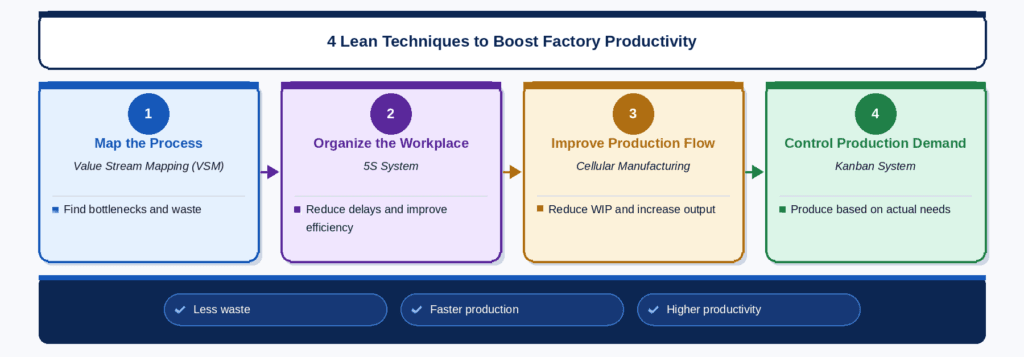
1. Value Stream Mapping (VSM): Exposing Hidden Bottlenecks
You cannot fix what you cannot see. Value Stream Mapping is the foundational pillar of any serious manufacturing productivity improvement initiative in Egypt. A VSM visualizes the entire flow of materials and information from the moment raw stock enters the facility until the finished product leaves the loading dock.
| Production Stage | Operational Issue |
| Supplier Raw Materials | Incoming materials ready for production |
| WIP Staging | Excess inventory waiting between processes |
| Processing Stage | Bottlenecks causing delays and reduced throughput |
| Finished Goods | Completed products ready for delivery |
In typical non-lean facilities, a product spends only 5% of its total lead time in actual processing; the remaining 95% is wasted sitting in queues, moving between departments, or waiting for quality approvals. Mapping out this timeline allows operations management to pinpoint exactly where material stalls, shifting the plant from localized fixes to true process optimization.
2. The 5S System: Building a Foundation for Operational Excellence
It is impossible to build a highly productive environment on a chaotic shop floor. The 5S framework; Sort, Set in Order, Shine, Standardize, and Sustain; is often misunderstood as mere housekeeping. In reality, it is a strict method to improve production efficiency and safety.
| Phase | Action | Local Manufacturing Impact |
| 1. Sort (Seiri) | Remove unneeded tools, scrap, and broken dies from the zone. | Frees up premium floor space; reduces search times. |
| 2. Set in Order (Seiton) | Assign a permanent, clearly marked home for every tool and fixture. | Eliminates micro-stoppages; streamlines changeovers. |
| 3. Shine (Seiso) | Clean equipment daily while checking for leaks, cracks, or wear. | Acts as an early warning system for preventative maintenance. |
| 4. Standardize (Seiketsu) | Create highly visual, color-coded checklists for every workstation. | Ensures consistency across different shifts and experience levels. |
| 5. Sustain (Shitsuke) | Establish weekly, peer-led audits backed by performance metrics. | Prevents the shop floor from slipping back into old habits. |
3. Cellular Manufacturing and Line Balancing
Traditional batch-and-queue production creates massive waves of work-in-progress (WIP) inventory that tie up valuable working capital. By grouping machinery and manual stations into U-shaped cellular layouts, products move continuously from one station to the next without sitting in storage bins.
Combined with a meticulous Time and Motion Study to increase productivity in Egypt, management can balance the work content evenly across all operators. This eliminates the common scenario where one operator is overwhelmed while the next station sits idle waiting for parts, driving a direct surge in overall factory productivity improvement in Egypt.
4. Kanban Systems: Pull vs. Push Production
To mitigate the risk of supply chain shocks, plants often overproduce, filling warehouses with costly buffer stock. Lean solves this via Kanban, a visual pull system where production is triggered only by actual down-line demand.
Using physical cards or digital signals, preceding work cells only produce a component when the subsequent station signals that they have consumed the previous batch. This keeps WIP low, exposes quality issues immediately, and ensures that the factory floor responds dynamically to real-time sales signals rather than rigid, inaccurate monthly forecasts.
Cultivating a Sustainable Culture of Continuous Improvement
Tools alone will not transform an organization. The ultimate engine behind Lean productivity improvement for Egyptian factories is a cultural shift toward Kaizen (continuous improvement).
First-Hand Insight: The most profitable ideas rarely come from the boardroom; they originate from the operators who run the machines for eight hours a day. Establishing a structured Kaizen suggestion system; where small, daily improvements are tested, standardized, and celebrated; transforms the workforce from passive labor into active problem solvers.
When this cultural foundation is secured, layering on advanced digital solutions for manufacturing productivity in Egypt (such as real-time OEE tracking or digital standard work displays) becomes significantly more effective. The technology enhances an already optimized process, accelerating your journey toward sustainable Operational Excellence.
Frequently Asked Questions (FAQs)
What is the first step to implement Lean productivity improvement for Egyptian factories?
The journey should always begin with a comprehensive Value Stream Mapping (VSM) exercise. Mapping the current state allows management to identify systemic wastes and bottlenecks objectively, ensuring that subsequent Lean projects target areas that will deliver the highest return on investment.
How does the 5S system directly increase productivity in manufacturing?
5S drives productivity by eliminating non-value-adding movement and search times. When operators have exactly what they need within arm’s reach in a clean, organized workstation, cycle times drop, safety incidents decrease, and minor machine defects are caught before causing major breakdowns.
Can Lean manufacturing work alongside Industry 4.0 manufacturing in Egypt?
Absolutely. In fact, Lean is a prerequisite for successful digital transformation. Implementing Industry 4.0 manufacturing in Egypt without first cleaning up processes via Lean principles simply automates waste. Lean optimizes the workflow, while digital tools provide the precise data needed to sustain it.
How does a Kanban system help manage volatile raw material availability?
Instead of pushing production based on unpredictable schedules, a Kanban system regulates the flow based on actual consumption. It aligns your current production directly with capacity and component availability, preventing the accumulation of half-finished products that clog the floor.
Contact us