The manufacturing sector in Egypt is experiencing a significant operational shift. As domestic and international markets expand, local industrial hubs face both massive market potential and complex shop floor bottlenecks. Facility leaders navigating competitive headwinds must balance rising input expenses, fluctuating material supply chains, and evolving consumer demands.
Under these dynamic conditions, achieving sustainable operational growth requires systematic productivity improvement in manufacturing across production operations. Managing physical bottlenecks, unscheduled equipment stoppages, floor space congestion, line imbalances, and operational waste is crucial to protecting margins and unlocking continuous growth.
This operational guide explores practical manufacturing productivity optimization strategies designed for industrial plants in Egypt to increase overall output, lower unit costs, streamline workflow, and maximize workforce efficiency without inflating fixed overhead.
What Drives Productivity Improvement Across Manufacturing in Egypt?
Understanding what drives productivity improvement across manufacturing in Egypt begins with a careful evaluation of daily plant floor realities. Industrial facilities often struggle with compounding friction points that silently erode operating margins. Driving long-term performance gains requires addressing three central operational pillars:
- Elimination of Non-Value-Added Activities (Waste): Across continuous and discrete operations, a substantial portion of shop floor time goes toward non-value-added activities. Waiting for materials, unnecessary handling, tool searching, and rework consume precious shift hours without adding value to the final product.
- Workforce and Time Standardization: Manual and semi-automated workflows frequently lack consistent operational standards. Implementing structured time and motion studies establishes realistic cycle baselines and balances task distribution without overworking line operators.
- Asset and Equipment Performance Optimization: Unplanned machinery downtime directly limits production volume and spikes cost per unit. Maximizing Overall Equipment Effectiveness (OEE) on key lines minimizes micro-stoppages and prevents catastrophic asset failures.
Strategic Framework for Factory Productivity Improvement in Egypt
To achieve repeatable, long-term efficiency gains, plant management must implement a proven manufacturing performance improvement framework rather than relying on short-term reactive fixes.
1. Value Stream Mapping and Waste Elimination (Lean Manufacturing)
Lean methodologies form the bedrock of manufacturing productivity improvement in Egypt. Value Stream Mapping (VSM) visually documents every operational step in the plant, tracking the transformation of raw materials into finished goods.
- Material Waiting Time: Spotting points where semi-finished parts sit idle between workstations.
- Transportation and Motion: Mapping line operator movement and material handling routes to eliminate unnecessary travel.
- Overprocessing: Streamlining redundant quality checks by designing processes that build quality directly at the source.
Using VSM allows operations leaders to pinpoint hidden delays, streamline workflow, and target high-impact areas for improvement.
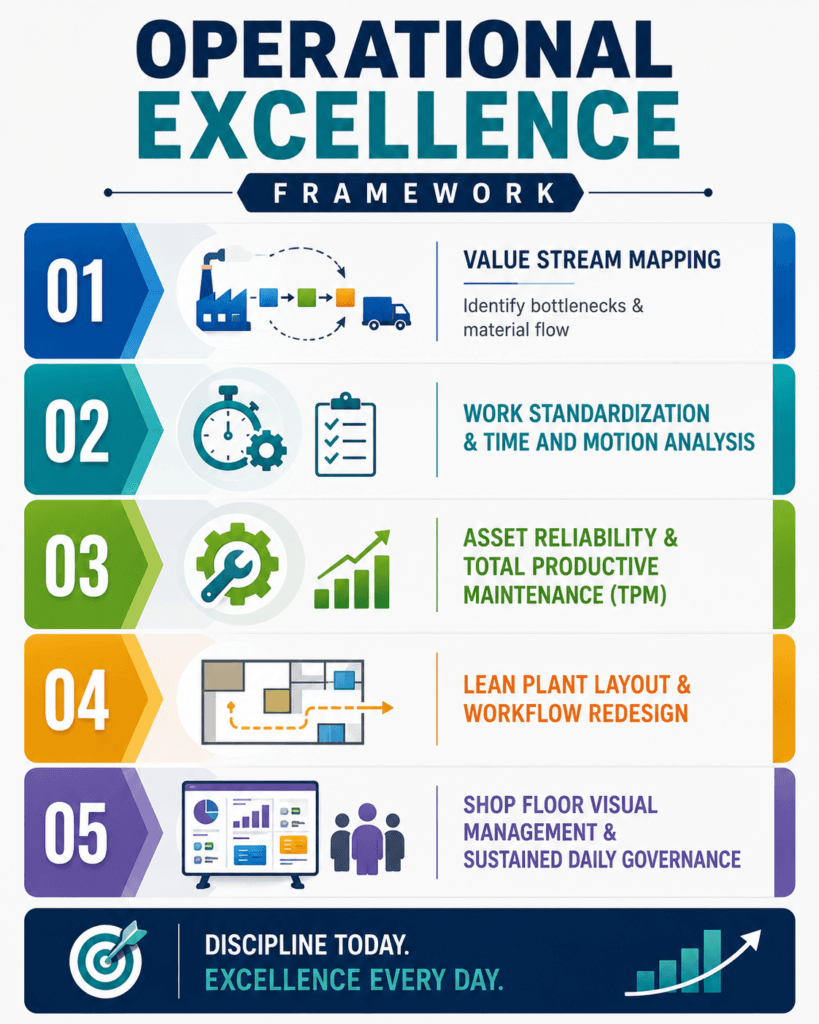
2. Time and Motion Studies for Industrial Workforce Enhancement
Where plant floor processes rely heavily on operator execution, industrial workforce productivity enhancement creates immediate operational gains. Time and Motion studies analyze each production step to establish consistency and remove physical friction:
- Cycle Time Analysis: Measuring operational standard times across shifts to build reliable baseline output targets.
- Line Balancing: Distributing physical workload evenly across workstations to remove line bottlenecks.
- Ergonomic Workstation Redesign: Positioning tooling and parts within direct reach to minimize physical strain, operator fatigue, and lost motion.
Pairing regular motion analysis with Standard Operating Procedures (SOPs) creates stable, repeatable daily output.
3. Asset Performance and Total Productive Maintenance (TPM)
Unexpected downtime on primary production equipment disrupts schedule execution and drives up operational overhead. Adopting structured Total Productive Maintenance (TPM) helps engineering and operations teams track and improve total equipment availability:
- Availability: Eliminating changeover delays, line setups, and unexpected machine breakdowns.
- Performance Rate: Stopping speed loss, minor idling, and recurring micro-stoppages.
- Quality Rate: Eliminating scrap, start-up losses, and rework during production runs.
Empowering shop floor operators through autonomous maintenance keeps equipment performing reliably and reduces total maintenance costs.
4. Lean Plant Layout and Facility Flow Optimization
In growing manufacturing environments across Egypt, expanding product lines can lead to disorganized plant footprints. Cluttered layouts cause crisscrossing transit routes, excessive material handling, and safety hazards.
Applying Lean factory layout and layout planning reconfigures machinery into streamlined cellular or flow-oriented configurations:
- Reduces internal transit distances for raw materials and Work-In-Progress (WIP).
- Reclaims unused floor space for additional production lines without requiring facility expansion.
- Streamlines total material movement from receiving bays directly to shipping docks.
When Should Factories Focus on Productivity Improvement in Egypt?
Determining when should factories focus on productivity improvement in Egypt is essential to protecting market share and profitability. Plant leaders should conduct structured operational assessments upon identifying key efficiency warning signs:
| Operational Warning Sign | Root Cause Breakdown | Immediate Implementation Strategy |
| High Overtime Costs | Unbalanced assembly lines and excessive operator motion | Conduct Time and Motion studies and balance line loads |
| Excessive Work-in-Progress (WIP) | Poor material flow and push-based inventory systems | Deploy Value Stream Mapping and visual pull mechanisms |
| Frequent Machine Downtime | Reactive maintenance and lack of preventive routine checks | Implement Autonomous Maintenance and TPM principles |
| Inconsistent Product Quality | Non-standardized work processes and missing visual controls | Establish Standardized Operating Procedures (SOPs) and 5S |
| Floor Space Bottlenecks | Disorganized equipment placement and accumulated floor scrap | Redesign facility layout using Lean Plant Design frameworks |
Partnering with specialized productivity improvement consulting for manufacturing in Egypt helps companies conduct objective plant diagnostics and implement structured on-site solutions.
How Can Productivity Improvement in Manufacturing Help Egypt?
Evaluating how can productivity improvement in manufacturing help Egypt reveals strong benefits for both individual manufacturing enterprises and the broader industrial ecosystem:
- Enhancing Market Competitiveness: Manufacturers competing locally or expanding into regional export markets need Lean operating structures to offset cost fluctuations and deliver high-quality products consistently.
- Resource and Capital Optimization: Extracting extra throughput from existing capital assets and facility floor space allows companies to scale production capacity without incurring expensive capital investments.
- Building Skilled Industrial Workforce: Operational Excellence initiatives train plant personnel in practical problem-solving methods, establishing a continuous improvement mindset across all organizational levels.
Practical Implementation Checklist for Factory Leadership
To achieve structured manufacturing efficiency improvement in Egypt, factory management can execute this stepwise approach:
- Perform a Plant Floor Diagnostic: Audit key operational metrics, including OEE baseline, cycle times, quality rejections, and WIP levels across main production lines.
- Remove Immediate Shop Floor Friction: Implement fundamental workplace organization (5S), standardize setup steps, and clear primary material transit pathways.
- Engage Hands-On Implementation Partners: Collaborate with operational transformation consultants who work alongside shop floor teams to solve real operational challenges in real time.
- Establish Visual Management Systems: Place visual management boards across key production areas to track target hourly output against actual execution.
Frequently Asked Questions (FAQs)
Why is productivity improvement in manufacturing important in Egypt?
Productivity improvement in manufacturing helps plants in Egypt lower unit costs, optimize operational flows, and maximize output from current equipment assets and floor space. Maintaining Lean operations allows businesses to adapt to dynamic market demands, improve margins, and strengthen export competitiveness.
What drives productivity improvement in manufacturing in Egypt?
Key drivers include systematic waste elimination using Lean Management, process standardization through Time and Motion studies, asset reliability via Total Productive Maintenance (TPM), and effective facility layout planning. Combining these tools with active shop floor participation builds sustainable operational gains.
When should factories focus on productivity improvement in Egypt?
Factories should prioritize productivity improvement when experiencing rising production costs, frequent machine downtime, high product scrap rates, floor space congestion, or when preparing to scale production capacity for new orders.
How do Lean studies improve workforce efficiency in manufacturing facilities?
Lean studies, such as Time and Motion Analysis, evaluate standard physical work steps to identify non-value-added actions like excessive walking, waiting, or manual handling. Eliminating these wasted motions and rebalancing line operations helps workers accomplish daily production goals safely and efficiently.
Contact us