Lean Manufacturing is becoming increasingly important as factories in Egypt look for practical ways to improve productivity, control costs, and compete in a more demanding industrial environment. Manufacturers today face pressure from changing customer expectations, rising operational costs, and the need to use resources more efficiently.
Rather than focusing only on increasing output, Lean Manufacturing helps organizations improve how work is performed by reducing waste, strengthening processes, and creating a culture of continuous improvement. For Egyptian factories, Lean provides a structured approach to achieving better operational efficiency while building stronger long-term manufacturing capabilities.
Key Takeaways
- Lean Manufacturing helps Egyptian factories improve efficiency by reducing waste and optimizing processes.
- Lean principles support cost reduction, productivity improvement, and better resource utilization.
- Tools such as 5S, Kaizen, and Value Stream Mapping (VSM) help manufacturers create more reliable operations.
- Lean adoption requires continuous improvement, employee involvement, and process discipline.
- Lean Manufacturing combined with Industry 4.0 can improve visibility and decision-making.
What Is Lean Manufacturing?
Lean Manufacturing is a systematic approach to improving operational performance by maximizing customer value while minimizing activities that do not create value.
The concept originated from the Toyota Motor Corporation Production System, where manufacturers focused on improving production flow, reducing waste, and continuously improving processes.
Unlike traditional manufacturing approaches that may rely on producing larger quantities or maintaining additional resources as a buffer, Lean focuses on understanding how work moves through a process and identifying opportunities for improvement.
The goal of Lean is not simply to reduce costs. Instead, it aims to create more efficient operations where:
- Processes are standardized
- Resources are used effectively
- Problems are identified earlier
- Employees contribute to improvements
- Customer value remains the focus
For manufacturing organizations, Lean provides a framework for improving productivity while maintaining quality and reliability.
The Five Core Principles of Lean Manufacturing
Lean Manufacturing is built around five fundamental principles.
1. Identify Value
The first principle is understanding what creates value for customers.
Manufacturers need to identify which activities contribute directly to delivering products that meet customer expectations and which activities consume resources without adding meaningful value.
This helps businesses focus improvement efforts on areas that create measurable impact.
2. Map the Value Stream
Value Stream Mapping (VSM) is used to understand how materials, information, and processes move through an operation.
By mapping the current process, manufacturers can identify:
- Delays
- Bottlenecks
- Unnecessary steps
- Excess movement
- Process inefficiencies
This creates a clearer picture of where improvements can be made.
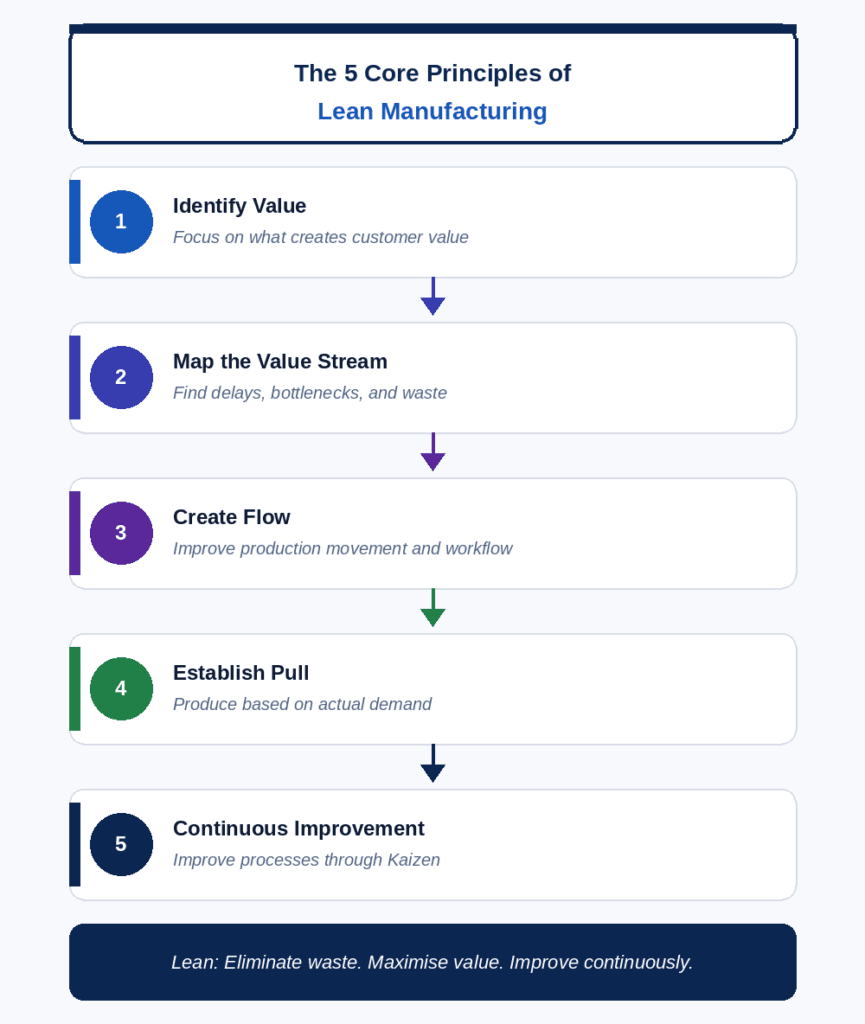
3. Create Flow
Lean Manufacturing focuses on creating smoother production flow.
Disruptions in workflow can lead to:
- Production delays
- Increased waiting time
- Lower productivity
- Higher operating costs
Improving flow allows materials, information, and activities to move more efficiently through production.
4. Establish Pull-Based Production
Traditional manufacturing may sometimes produce based on forecasts or assumptions.
Lean encourages a pull approach, where production activities are more closely connected to actual demand requirements.
This helps reduce:
- Excess production
- Unnecessary inventory
- Resource waste
5. Pursue Continuous Improvement
Continuous improvement, often associated with the Lean concept of Kaizen, focuses on making regular improvements rather than relying only on large transformation projects.
Small improvements over time can create significant operational benefits.
Why Lean Manufacturing Is Important for Egyptian Factories in 2026
Egyptian manufacturers operate in an environment where efficiency and adaptability are becoming increasingly important.
Factories are expected to improve performance while managing challenges such as:
- Increasing operational costs
- Need for higher productivity
- Greater competition
- Pressure for consistent quality
- Demand for faster response times
Lean Manufacturing provides manufacturers with a structured way to address these challenges.
Improving Operational Efficiency Through Lean
Operational efficiency is one of the main reasons manufacturers adopt Lean principles.
Lean helps factories examine how work is performed and identify opportunities to improve:
- Production processes
- Material movement
- Resource utilization
- Workplace organization
- Process consistency
For example, a production process may contain unnecessary movement, waiting periods, or repeated activities that consume time without improving the final product.
Lean methods help organizations identify these inefficiencies and develop better ways of working.
Improved operational efficiency can support:
- Higher productivity
- Better use of available resources
- More predictable production performance
Reducing Manufacturing Waste
Waste reduction is one of the central principles of Lean Manufacturing.
Lean identifies several types of waste that can reduce manufacturing performance.
Overproduction
Producing more than required can create unnecessary inventory and increase storage requirements.
Lean encourages better alignment between production activities and actual requirements.
Waiting
Waiting occurs when employees, equipment, or materials are delayed.
Examples include:
- Waiting for materials
- Waiting for approvals
- Waiting due to equipment issues
Reducing waiting time improves production flow.
Transportation
Unnecessary movement of materials increases handling time and may create additional risks.
Improving factory layouts and material flow can help reduce unnecessary transportation.
Over-Processing
Over-processing occurs when additional work is performed beyond what is required.
Examples include:
- Repeated inspections
- Unnecessary steps
- Duplicate activities
Lean helps organizations simplify processes while maintaining quality.
Inventory
Excess inventory can increase costs and hide operational problems.
Lean inventory approaches focus on maintaining appropriate stock levels while improving process reliability.
Motion
Unnecessary employee movement can reduce productivity.
Workplace organization practices such as 5S help improve efficiency by creating more organized work environments.
Defects
Defects create additional costs through:
- Rework
- Material waste
- Production delays
Lean emphasizes identifying root causes and preventing problems from recurring.
Underutilized Employee Knowledge
Employees often have valuable knowledge about operational challenges.
Lean encourages employee involvement in identifying problems and suggesting improvements.
Supporting Productivity Improvement in Manufacturing
Productivity improvement is a major objective for many factories.
Lean supports productivity improvement by focusing on:
- Reducing process delays
- Improving workflow
- Standardizing work methods
- Eliminating unnecessary activities
- Improving problem-solving practices
Rather than asking employees to simply work faster, Lean focuses on improving the system in which work is performed.
This creates more sustainable productivity improvements.
Benefits of Lean Manufacturing for Egyptian Factories
The benefits of Lean Manufacturing for Egyptian factories extend beyond reducing waste. Lean provides manufacturers with a structured approach to improving processes, strengthening operational control, and creating more reliable production systems.
When implemented effectively, Lean principles can support improvements in several areas.
Lower Operating Costs Through Waste Reduction
One of the key advantages of Lean Manufacturing is its ability to reduce unnecessary resource consumption.
Manufacturing costs are influenced by many factors, including:
- Material usage
- Production delays
- Rework activities
- Excess movement
- Inefficient processes
Lean helps organizations identify where resources are being consumed without creating additional value.
For example, reducing unnecessary process steps can lower labor requirements, while improving material flow can reduce handling effort and production delays.
The objective is not simply cutting costs, but improving how resources are used.
Improving Production Quality
Lean Manufacturing places strong emphasis on preventing problems rather than correcting them after they occur.
Quality improvement in Lean environments is supported through:
- Standardized processes
- Root cause analysis
- Problem-solving methods
- Employee involvement
When processes are clearly defined and continuously improved, manufacturers can reduce variations that lead to defects.
Improved quality contributes to:
- Lower rework requirements
- More consistent output
- Better customer satisfaction
Increasing Manufacturing Flexibility
Modern manufacturers need to respond quickly to changing customer requirements.
Lean principles improve flexibility by helping factories create:
- More efficient workflows
- Better production visibility
- Faster problem identification
- Improved resource allocation
Factories with stronger process control can adapt more effectively when production requirements change.
Creating a Culture of Continuous Improvement
A major difference between Lean and traditional manufacturing approaches is the focus on continuous improvement.
Lean encourages employees at all levels to participate in identifying problems and suggesting improvements. This creates a culture where improvement becomes part of daily operations rather than an occasional initiative.
The Kaizen philosophy supports this approach by encouraging small, consistent improvements over time.
Lean Manufacturing Tools Used by Factories
Lean Manufacturing relies on practical tools that help organizations identify problems, improve processes, and maintain better operational control.
Some of the most commonly used Lean tools include:
5S Workplace Organization
5S is one of the foundational Lean practices used to improve workplace organization.
The five steps include:
Sort
Removing unnecessary items from the workplace.
Set in Order
Organizing tools, materials, and equipment so they are easy to access.
Shine
Maintaining workplace cleanliness and identifying abnormal conditions.
Standardize
Creating consistent workplace practices.
Sustain
Maintaining improvements through discipline and regular review.
5S helps manufacturers create more organized work environments, reduce searching time, and improve workplace efficiency.
For Egyptian factories, 5S can provide a practical starting point for building Lean capabilities because it focuses on visible improvements and daily operational discipline.
Kaizen and Continuous Improvement
Kaizen means continuous improvement through small, ongoing changes.
Instead of relying only on major improvement projects, Kaizen encourages teams to regularly identify opportunities to improve their daily work.
Examples of Kaizen improvements include:
- Reducing unnecessary movement
- Improving workstation organization
- Simplifying processes
- Reducing recurring problems
The value of Kaizen comes from involving employees who directly interact with manufacturing processes.
Their practical knowledge can help identify improvement opportunities that may not be visible through data alone.
Value Stream Mapping (VSM)
Value Stream Mapping is a Lean tool used to analyze the flow of materials and information throughout a process.
A VSM exercise helps manufacturers understand:
- Where value is created
- Where delays occur
- Where waste exists
- How processes can flow more efficiently
For example, a factory may discover through Value Stream Mapping that production delays are not caused by machine capacity but by material movement, approval delays, or process interruptions.
This allows improvement efforts to focus on root causes rather than symptoms.
Lean Manufacturing Combined With Industry 4.0 in Egypt
The combination of Lean Manufacturing and Industry 4.0 is becoming increasingly relevant as factories explore digital transformation.
Lean focuses on improving processes and eliminating waste, while Industry 4.0 technologies provide better visibility and data-driven decision-making.
Together, they can support:
- Real-time production monitoring
- Improved performance tracking
- Faster identification of operational issues
- Better resource planning
However, technology alone does not create Lean operations.
Digital tools are most effective when supported by:
- Standardized processes
- Clear performance measures
- Continuous improvement practices
A factory with inefficient processes may simply automate inefficiencies if Lean principles are not addressed first.
Challenges of Lean Manufacturing Adoption
Although Lean Manufacturing provides significant benefits, successful adoption requires commitment and structured implementation.
Factories may face several challenges.
Changing Organizational Mindset
Lean requires a shift from simply completing tasks to continuously improving processes.
Employees and management need to understand that improvement is an ongoing responsibility.
Without employee engagement, Lean initiatives may become temporary activities rather than sustainable practices.
Maintaining Process Discipline
Lean depends on maintaining standards.
For example:
- 5S improvements need regular follow-up
- Standard processes need consistent application
- Performance measures need continuous monitoring
Without discipline, improvements can gradually decline.
Measuring the Right Performance Indicators
Factories need appropriate metrics to evaluate Lean progress.
Common performance indicators may include:
- Production efficiency
- Defect rates
- Process delays
- Inventory levels
- Delivery performance
Measuring only output quantity may overlook important improvement opportunities.
Connecting Lean Manufacturing With Factory Competitiveness
Lean manufacturing factories in Egypt can improve competitiveness by building stronger operational capabilities.
In competitive manufacturing environments, success depends not only on production volume but also on:
- Cost efficiency
- Quality consistency
- Delivery reliability
- Process flexibility
Lean helps factories strengthen these areas by creating more efficient and controlled operations.
For Egyptian manufacturers seeking long-term growth, Lean Manufacturing provides a framework for improving productivity while reducing operational waste.
Conclusion
Lean manufacturing practices provide Egyptian factories with a structured approach to improving efficiency, reducing waste, and strengthening operational performance.
As manufacturers face increasing pressure to control costs and improve productivity in 2026, Lean principles offer a practical method for creating more efficient production systems.
Through tools such as 5S, Kaizen, and Value Stream Mapping, factories can identify inefficiencies, improve workflows, and develop a culture of continuous improvement.
However, Lean Manufacturing is not a one-time project. Sustainable results require employee involvement, process discipline, accurate performance measurement, and ongoing improvement efforts.
For Egyptian factories aiming to improve competitiveness and operational excellence, Lean Manufacturing represents a long-term approach to building stronger manufacturing capabilities.
Frequently Asked Questions (FAQs)
What is Lean Manufacturing and why is it important?
Lean Manufacturing is an approach focused on maximizing customer value by reducing waste, improving processes, and creating more efficient production systems. It is important because it helps factories improve productivity, control costs, and strengthen operational performance.
What are the benefits of Lean Manufacturing for Egyptian factories?
The benefits of Lean Manufacturing for Egyptian factories include improved operational efficiency, reduced waste, lower operating costs, better production quality, improved workflow, and stronger continuous improvement capabilities.
What Lean tools are commonly used in manufacturing?
Common Lean tools include 5S workplace organization, Kaizen continuous improvement, Value Stream Mapping (VSM), standard work, and waste reduction practices.
How is Lean Manufacturing different from traditional manufacturing?
Traditional manufacturing often focuses on maximizing production output and maintaining larger buffers, while Lean Manufacturing focuses on creating value by improving flow, reducing waste, and continuously improving processes.
Can Lean Manufacturing work with Industry 4.0?
Yes. Lean Manufacturing and Industry 4.0 can complement each other. Lean improves processes and eliminates waste, while Industry 4.0 technologies provide data visibility and support better operational decisions.
Contact us