
Lean consultants in Egypt help manufacturing organizations improve operational efficiency by identifying waste, optimizing processes, and supporting continuous improvement initiatives. As manufacturers face increasing pressure to control costs, improve productivity, and respond faster to market requirements, Lean Manufacturing has become an important approach for strengthening factory performance.
Rather than focusing only on reducing expenses, Lean consultants help businesses understand how work is performed and where operational improvements can create measurable value. Through structured analysis, process improvement methods, and Lean principles, manufacturers can build more efficient production systems while improving quality, reliability, and long-term competitiveness.
Key Takeaways
- Lean consultants help manufacturers identify waste, improve processes, and strengthen operational efficiency.
- Effective Lean implementation focuses on improving systems rather than simply reducing resources.
- Lean tools such as 5S, Kaizen, and Value Stream Mapping (VSM) support sustainable manufacturing improvements.
- Successful Lean transformation requires employee involvement, process discipline, and continuous improvement.
- The right Lean approach helps factories reduce waste while improving productivity and operational performance.
What Do Lean Consultants Do?
Lean consultants in Egypt help manufacturing organizations improve the way work is performed by analyzing processes, identifying inefficiencies, and supporting structured improvement initiatives.
Their role goes beyond recommending isolated changes. Effective Lean consulting focuses on understanding the relationship between people, processes, materials, and information within a manufacturing environment.
For factories, operational problems are often connected. A production delay may not simply be a production issue; it could be related to material availability, workplace organization, unclear procedures, inefficient movement, or inconsistent processes.
Lean consultants in Egypt help organizations examine these connections and develop improvement approaches that address root causes rather than only treating symptoms.
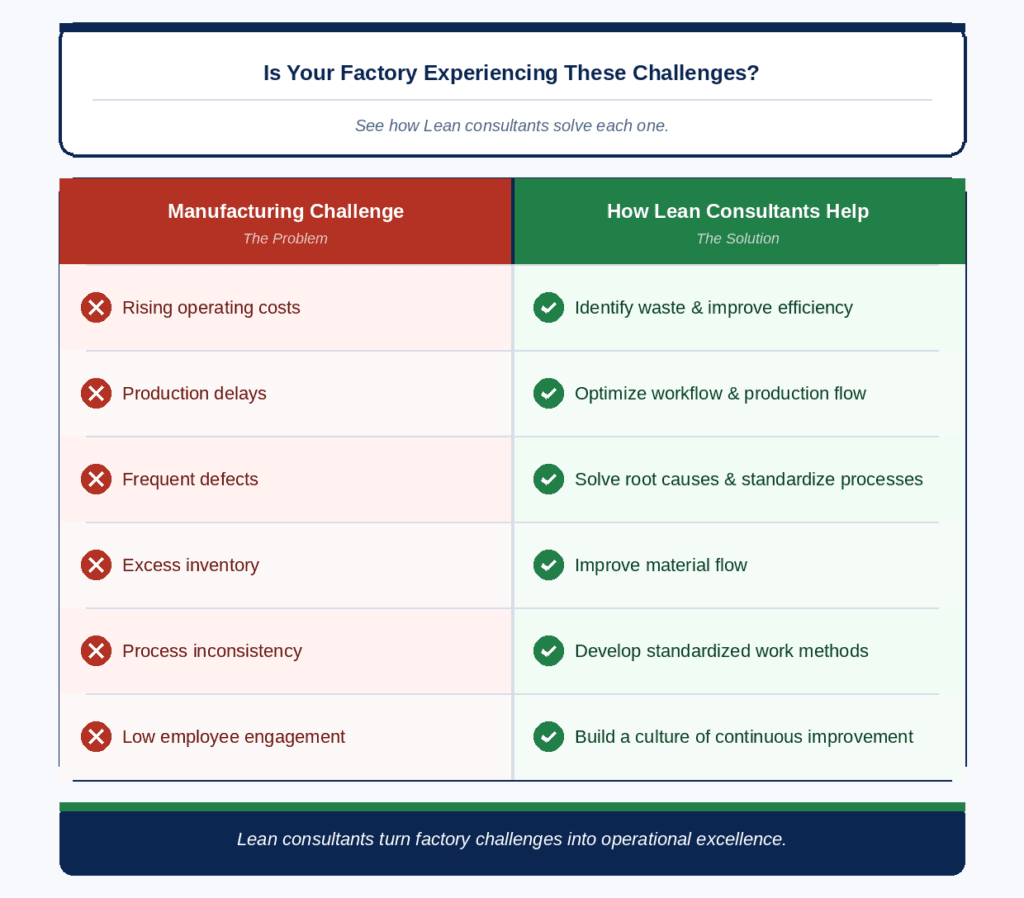
How Lean Consultants Help Manufacturers Reduce Costs
Cost reduction is one of the main reasons manufacturers explore Lean improvement initiatives. However, Lean does not approach cost reduction by simply cutting resources.
Instead, Lean consultants in Egypt focus on improving efficiency by removing activities that do not contribute value.
Improving Process Efficiency
Manufacturing processes often develop over time and may contain unnecessary steps, repeated activities, or inefficient workflows.
Lean consultants analyze processes to identify opportunities for improvement, such as:
- Simplifying workflows
- Reducing unnecessary movement
- Improving process sequence
- Standardizing activities
When processes become more efficient, manufacturers can improve productivity while making better use of existing resources.
Reducing Operational Waste
Waste reduction is one of the strongest contributors to Lean improvement.
By identifying waste sources, manufacturers can improve areas such as:
- Material utilization
- Production flow
- Workplace efficiency
- Resource allocation
For example, a factory may discover that productivity issues are caused not by insufficient resources but by inefficient processes, unclear responsibilities, or poor workflow design.
Lean helps organizations address these underlying causes.
Supporting Productivity Improvement
Productivity improvement is not only about producing more output. It also involves improving how effectively resources are used.
Lean consultants support productivity improvement by helping manufacturers develop:
- Better production workflows
- Standardized work methods
- More efficient processes
- Improved problem-solving practices
This creates a stronger foundation for sustainable manufacturing performance.
Lean Manufacturing Consulting Approach in Egypt
Lean Manufacturing consulting services in Egypt typically focus on helping manufacturers understand their current operational challenges and develop structured improvement plans.
While every manufacturing environment is different, Lean improvement approaches generally involve several stages.
Understanding Current Operations
The first step is developing an understanding of existing processes.
This includes identifying:
- Current workflow challenges
- Operational inefficiencies
- Areas of waste
- Improvement opportunities
A clear understanding of the current state allows manufacturers to prioritize improvements based on actual operational needs.
Developing Improvement Priorities
Not every improvement opportunity has the same impact.
Lean consultants help organizations evaluate which areas can provide the greatest operational benefits.
Priorities may include:
- Reducing process delays
- Improving workplace organization
- Increasing process consistency
- Improving production flow
The focus is on creating practical improvements that align with business objectives.
Supporting Continuous Improvement
Lean implementation is not a one-time activity.
Long-term results depend on creating a culture where teams continue identifying and solving problems. Continuous improvement involves:
- Monitoring performance
- Maintaining standards
- Encouraging employee participation
- Reviewing improvement opportunities regularly
This approach helps manufacturers maintain improvements over time rather than returning to previous operating methods.
Lean Consultants in Egypt: Industrial Zone Applications
Manufacturing companies operating in industrial zones often manage complex production environments involving multiple processes, suppliers, materials, and operational requirements.
Lean consultants industrial zones in Egypt can support manufacturers by helping them analyze operational challenges and identify improvement opportunities within their production systems.
Industrial environments often face challenges such as:
- Inefficient workflows
- Production delays
- Process variation
- Material movement issues
- Limited process visibility
Lean approaches help organizations examine these challenges systematically and develop more efficient operating practices.
Supporting Lean Manufacturing Factories in Egypt
Lean manufacturing factories in Egypt can benefit from structured improvement approaches that focus on long-term operational capability.
Manufacturers may consider Lean initiatives when they want to improve areas such as:
- Productivity
- Process consistency
- Waste reduction
- Workflow efficiency
- Operational discipline
The objective of Lean is not simply to reduce resources. It is to create better processes that allow factories to produce efficiently while maintaining quality and reliability.
Choosing Lean Manufacturing Consultants in Egypt
Selecting the right Lean improvement partner requires evaluating more than knowledge of Lean terminology.
Manufacturers should consider whether consultants understand real production environments and can connect improvement principles with practical factory challenges.
Understanding Manufacturing Operations
Lean improvements must be relevant to the way a factory operates. Manufacturers should look for consultants who understand:
- Production workflows
- Process challenges
- Operational constraints
- Manufacturing performance requirements
A strong understanding of manufacturing allows improvement recommendations to be practical rather than theoretical.
Using a Structured Improvement Methodology
Effective Lean improvement requires a systematic approach. A strong methodology should focus on:
- Understanding current conditions
- Identifying improvement opportunities
- Prioritizing actions
- Monitoring progress
This helps manufacturers move from identifying problems to creating measurable operational i”Lean consultants help Egyptian manufacturing organizations improve operational efficiency.
Creating Sustainable Improvements
Successful Lean initiatives should continue creating value after the initial improvement activities. Sustainable Lean practices require:
- Employee involvement
- Clear processes
- Performance monitoring
- Continuous improvement habits
The goal is to build internal capability so organizations can continue improving over time.
Why Hire a Lean Consultant Instead of Doing It Internally?
Many manufacturers begin Lean improvement using internal teams, but implementing Lean across an entire factory often requires specialized experience and an objective perspective.
Lean consultants help organizations:
- Identify improvement opportunities more quickly
- Apply proven Lean methodologies
- Train employees and supervisors
- Support change management
- Measure operational improvements using KPIs
- Develop long-term continuous improvement programs
For factories with limited internal Lean expertise, consultants can accelerate implementation while helping avoid common improvement challenges.
Conclusion
Lean consultants in Egypt help manufacturing organizations improve operational performance by identifying waste, strengthening processes, and supporting continuous improvement practices.
For manufacturers facing increasing pressure to improve efficiency and control costs, Lean provides a structured approach to creating better production systems.
Lean consultants help organizations understand their processes, identify improvement opportunities, and develop more efficient ways of working. However, successful Lean implementation depends on more than applying tools. Sustainable improvement requires employee involvement, process discipline, and a commitment to continuous improvement.
For Egyptian manufacturers seeking stronger operational capabilities, Lean consulting provides a pathway toward reducing waste, improving productivity, and building more competitive manufacturing operations.
Frequently Asked Questions (FAQs)
What do Lean consultants do for manufacturing companies?
Lean consultants help manufacturing companies identify operational inefficiencies, reduce waste, improve workflows, and develop continuous improvement practices. They analyze processes and support organizations in applying Lean principles to improve manufacturing performance.
How can Lean consultants reduce costs?
Lean consultants reduce costs by identifying waste within manufacturing processes, improving resource utilization, reducing unnecessary activities, and helping factories create more efficient workflows.
Why should Egyptian factories work with Lean manufacturing consultants?
Egyptian factories may work with Lean manufacturing consultants to improve productivity, reduce waste, strengthen process control, and develop more efficient manufacturing systems based on Lean principles.
How do I choose Lean manufacturing consultants in Egypt?
Manufacturers should evaluate consultants based on their understanding of manufacturing operations, improvement methodology, practical approach, and ability to support sustainable operational improvements.
Contact us