
As businesses across Egypt navigate changing market demands, rising operational costs, and increasing customer expectations, process efficiency has become a strategic priority rather than simply an operational objective. Organizations are looking for structured ways to improve quality, reduce waste, and strengthen long-term competitiveness.
While many organizations recognize the value of process improvement, implementing meaningful and sustainable change can be challenging without the right expertise. Existing processes may have evolved over many years, involve multiple departments, and include inefficiencies that are difficult to identify from within the organization.
This is where a Lean Six Sigma consultant plays an important role. By combining analytical techniques with structured improvement methodologies, consultants help organizations evaluate current operations, identify improvement opportunities, and establish systems that support continuous improvement.
For Egypt’s growing business landscape, working with a Lean Six Sigma consultant can help organizations build stronger operational foundations while aligning improvement initiatives with strategic business objectives.
Why Process Improvement Has Become a Business Priority
Today’s organizations are expected to deliver more than quality products or services. Customers increasingly expect faster delivery, greater consistency, responsive service, and reliable experiences across every interaction.
At the same time, businesses are managing challenges such as:
- Rising operational expenses
- More complex supply chains
- Increased competition
- Digital transformation initiatives
- Regulatory and quality requirements
- Growing customer expectations
Addressing these challenges often requires more than incremental changes. Organizations need structured methodologies that improve how work is performed across departments.
Lean Six Sigma provides one such framework by combining waste reduction with data-driven quality improvement. However, successful implementation depends not only on understanding the methodology but also on applying it effectively within an organization’s unique operating environment.
What Does a Lean Six Sigma Consultant Do?
A common misconception is that consultants simply recommend cost-cutting measures. In reality, their role is much broader.
A certified Lean Six Sigma Consultant for Egypt typically supports businesses throughout the improvement journey; from assessing current processes to helping teams sustain long-term improvements.
Their work often includes:
Assessing Existing Processes
Consultants begin by gaining a clear understanding of how work currently flows through the organization.
This may involve:
- Reviewing operational workflows
- Mapping business processes
- Observing day-to-day operations
- Interviewing stakeholders
- Examining available performance data
The objective is to develop an evidence-based understanding of how processes perform rather than relying on assumptions.
Identifying Root Causes
Many operational issues appear obvious on the surface but originate from deeper process-related challenges.
For example, delayed customer deliveries may result from inefficient planning, inconsistent communication between departments, inventory management issues, or approval bottlenecks rather than transportation alone.
Using structured analytical tools, consultants investigate these underlying causes before recommending solutions.
Prioritizing Improvement Opportunities
Organizations rarely have unlimited resources to improve every process simultaneously.
A Lean Six Sigma consultant helps leadership identify initiatives that are most closely aligned with strategic priorities, customer expectations, and operational performance. This ensures improvement efforts are focused where they can deliver meaningful business value.
Why External Expertise Can Be Valuable
Many organizations have capable internal teams with strong operational knowledge. However, internal teams are also closely connected to existing ways of working, which can make it more difficult to identify long-standing inefficiencies or question established practices.
An external consultant brings an independent perspective and a structured methodology for evaluating processes objectively.
This combination of organizational knowledge and external expertise often creates a stronger foundation for process improvement than relying on either approach alone.
Importantly, consultants do not replace internal teams. Instead, they work alongside business leaders and employees to facilitate collaboration, build internal capabilities, and support knowledge transfer throughout improvement initiatives.
Supporting Sustainable Change, Not Short-Term Fixes
Organizations sometimes view process improvement as a one-time project with a defined start and finish. Lean Six Sigma takes a different approach.
The methodology encourages businesses to establish systems for continuous evaluation, measurement, and refinement so that improvements continue long after an individual project concludes.
A Lean Six Sigma business consulting engagement in Egypt therefore focuses not only on solving immediate operational issues but also on helping organizations develop repeatable approaches to continuous improvement.
This may include:
- Establishing performance metrics
- Standardizing critical processes
- Improving cross-functional collaboration
- Creating governance for improvement initiatives
- Encouraging data-informed decision-making
These practices help organizations respond more effectively to future operational challenges rather than repeatedly addressing similar issues.
How Lean Six Sigma Consultants Support Different Business Functions
Although Lean Six Sigma originated in manufacturing, its principles apply across a wide range of business functions.
Operations
Consultants work with operations teams to improve workflow efficiency, reduce unnecessary activities, optimize resource utilization, and improve process consistency.
Quality Management
Quality-related initiatives often focus on reducing variation, improving compliance, strengthening documentation practices, and establishing measurable quality standards across processes.
Supply Chain and Logistics
Organizations managing procurement, warehousing, transportation, or inventory can use Lean Six Sigma process optimization techniques to improve coordination, reduce delays, and enhance overall supply chain performance.
Customer Experience
Many customer satisfaction challenges stem from inefficient internal processes rather than customer-facing interactions alone.
By improving response times, reducing errors, and streamlining service delivery, organizations can enhance customer experiences while also improving operational efficiency.
Why Data Matters in Lean Six Sigma
One of the defining characteristics of Lean Six Sigma is its emphasis on measurable improvement.
Rather than implementing changes based solely on intuition, consultants rely on operational data to understand current performance, identify opportunities, and evaluate the impact of improvement initiatives.
This data-driven approach helps organizations make informed decisions and prioritize initiatives based on measurable business outcomes rather than assumptions or anecdotal observations.
How Lean Six Sigma Consultants Support Digital Transformation
Digital transformation has become a major focus for organizations across industries. However, successful transformation requires more than implementing new software or technology platforms. Businesses must first understand and improve the processes that technology is intended to support.
A Lean Six Sigma consultant helps organizations evaluate existing workflows before digital solutions are introduced. By identifying unnecessary steps, process delays, and sources of variation, consultants help create more efficient processes that are better suited for automation and digital improvement.
For example, before implementing a digital workflow system, an organization may need to examine:
- How information moves between departments
- Where approval delays occur
- Which activities create unnecessary workload
- Where errors frequently happen
- Which performance indicators should be monitored
This approach supports smarter technology adoption because businesses are improving the process itself rather than simply digitizing inefficient practices.
When Should Egyptian Firms Hire a Lean Six Sigma Consultant?
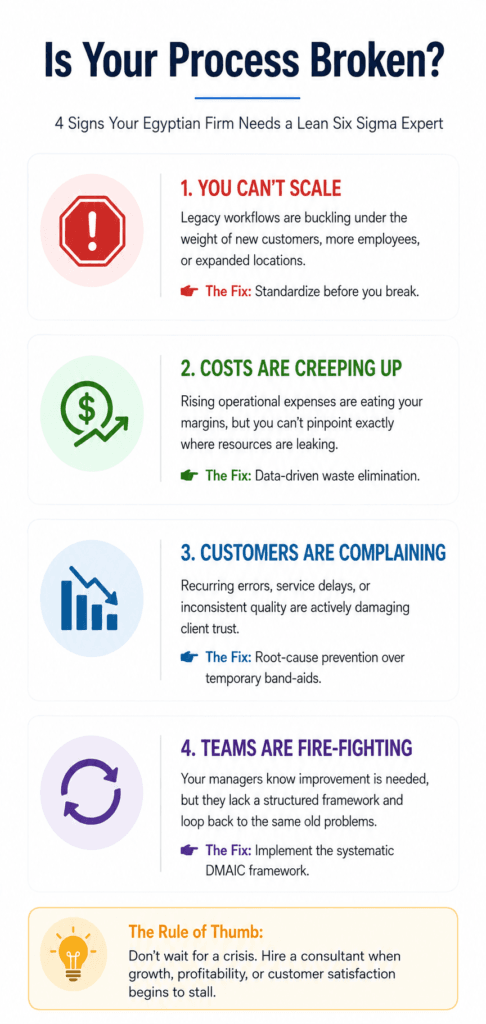
Organizations often consider engaging a consultant when operational challenges begin affecting growth, customer satisfaction, or profitability.
Some common situations where a Lean Six Sigma consultant for Egyptian businesses may consider can provide value include:
When Processes Become Difficult to Scale
As companies grow, processes that work for a smaller organization may become inefficient. Increased customers, employees, locations, or product lines can create complexity.
A consultant can help organizations review existing workflows and establish standardized processes that support sustainable growth.
When Operational Costs Increase
Rising costs may indicate inefficiencies within processes, resource allocation, inventory management, or workflow design.
Lean Six Sigma methods help organizations understand where resources are being consumed and identify opportunities to improve efficiency without compromising quality.
When Quality Issues Affect Customer Satisfaction
Recurring defects, service delays, errors, or inconsistent outputs can negatively impact customer trust.
A Lean Six Sigma approach focuses on identifying root causes and implementing preventive improvements rather than repeatedly addressing the same problems.
When Teams Need a Structured Improvement Approach
Some organizations understand that improvement is needed but lack a clear framework for execution.
A consultant can introduce structured methodologies, analytical tools, and improvement practices that help teams approach challenges systematically.
Common Misconceptions About Lean Six Sigma Consultants
Despite its widespread use globally, some misconceptions about Lean Six Sigma consulting continue to exist.
“Lean Six Sigma Is Only for Manufacturing”
While Lean Six Sigma has strong roots in manufacturing, its principles apply to any organization that manages processes.
Businesses in healthcare, logistics, banking, education, technology, and professional services can use Lean Six Sigma principles to improve efficiency and quality.
“Lean Six Sigma Only Focuses on Cost Reduction”
Cost reduction can be one outcome, but it is not the only objective.
A comprehensive Lean Six Sigma approach focuses on improving overall business performance through:
- Better process reliability
- Improved customer experience
- Reduced errors
- Faster cycle times
- More effective resource utilization
“Consultants Provide Solutions Without Understanding the Business”
Effective consulting requires collaboration and organizational understanding.
A qualified consultant spends time analyzing the current situation, engaging relevant stakeholders, and developing recommendations based on actual business needs.
How to Choose the Right Lean Six Sigma Consultant
Selecting a consultant is an important decision because successful improvement depends on both technical knowledge and practical implementation experience.
Organizations evaluating a certified Lean Six Sigma consultant for Egypt should consider several factors.
Relevant Methodology Knowledge
A consultant should demonstrate familiarity with recognized Lean Six Sigma frameworks, including approaches such as DMAIC (Define, Measure, Analyze, Improve, Control) and continuous improvement principles.
Organizations can also review whether consultants have relevant professional certifications, training, and experience applying improvement methodologies.
Ability to Understand Business Context
A methodology alone does not guarantee success. The consultant should understand the organization’s industry, operational environment, and business objectives.
Improvement recommendations should be practical, measurable, and aligned with organizational priorities.
Focus on Sustainable Improvement
The goal of Lean Six Sigma is not simply to complete an improvement project. Long-term value comes from helping organizations develop the capability to continue improving processes.
Consultants should emphasize knowledge sharing, employee involvement, and systems that allow organizations to maintain improvements over time.
The Long-Term Value of Lean Six Sigma Consulting
Organizations operate in constantly changing environments. Customer expectations, market conditions, technology, and operational challenges continue to evolve. Businesses that develop strong continuous improvement capabilities are better positioned to adapt in such an environment.
Through structured Six Sigma continuous improvement methods, organizations can create a mindset where employees actively identify problems, analyze processes, and seek better ways of working.
This approach supports Operational Excellence by making improvement part of everyday business practices rather than an occasional initiative.
Conclusion
For Egypt firms seeking sustainable growth, operational efficiency is becoming increasingly important. A Lean Six Sigma consultant provides organizations with structured expertise to analyze processes, identify improvement opportunities, and build systems that support continuous improvement.
Rather than focusing only on short-term fixes, Lean Six Sigma consultants help businesses develop stronger operational capabilities through data-driven analysis, process optimization, and collaboration with internal teams.
Whether an organization is improving manufacturing operations, streamlining service delivery, optimizing supply chains, or preparing for digital transformation, Lean Six Sigma provides a practical framework for creating more efficient and reliable processes.
By adopting a structured improvement approach, Egypt businesses can strengthen operational performance, improve customer value, and build a foundation for long-term competitiveness.
Frequently Asked Questions
Why hire a Lean Six Sigma consultant for Egypt businesses?
Hiring a Lean Six Sigma consultant helps businesses identify process inefficiencies, analyze root causes, and implement structured improvement initiatives. Consultants provide objective expertise, proven methodologies, and guidance to help organizations achieve measurable operational improvements.
How does a Lean Six Sigma consultant improve processes in Egypt?
A Lean Six Sigma consultant improves processes by analyzing current workflows, using data to identify inefficiencies, applying improvement frameworks such as DMAIC, and helping teams implement solutions that improve quality, efficiency, and consistency.
What results can businesses expect from working with a Lean Six Sigma consultant?
Results depend on business objectives and implementation effectiveness, but organizations commonly aim to achieve improved process efficiency, reduced waste, better quality consistency, faster workflows, and stronger continuous improvement capabilities.
Is hiring a Lean Six Sigma consultant worth it for Egypt companies?
For organizations facing operational challenges or seeking structured growth, Lean Six Sigma consulting can provide a systematic approach to improving processes and making data-driven decisions. The value depends on selecting the right approach, defining clear objectives, and maintaining commitment to improvement.
Contact us