
Businesses across Egypt are operating in an increasingly competitive environment where efficiency, quality, and adaptability have become critical factors for sustainable growth. Organizations are under constant pressure to improve customer experiences, optimize resources, reduce operational inefficiencies, and create processes that can support future expansion.
However, achieving operational improvement requires more than identifying problems. Organizations need a structured approach that helps them understand existing processes, analyze performance challenges, implement effective solutions, and maintain improvements over time.
This is where a Lean Six Sigma consultant provides value. By applying proven process improvement methodologies, consultants help businesses develop a systematic approach to improving operations, reducing waste, and creating a culture of continuous improvement.
A Lean Six Sigma Consultant for Egypt typically combines Lean principles, Six Sigma analytical methods, and practical business understanding to help organizations improve process performance while aligning initiatives with strategic objectives.
Understanding the Lean Six Sigma Consultant Approach
A Lean Six Sigma consultant approach is based on the principle that business improvements should be driven by data, process understanding, and measurable outcomes.
Instead of implementing changes based on assumptions, consultants follow a structured improvement cycle to understand:
- How current processes operate
- Where inefficiencies occur
- What factors create performance issues
- Which improvements can create the greatest impact
- How improvements can be sustained over time
This approach commonly follows the DMAIC framework:
- Define
- Measure
- Analyze
- Improve
- Control
DMAIC provides a structured roadmap for solving process challenges and is widely recognized as one of the core approaches used in Six Sigma improvement initiatives.
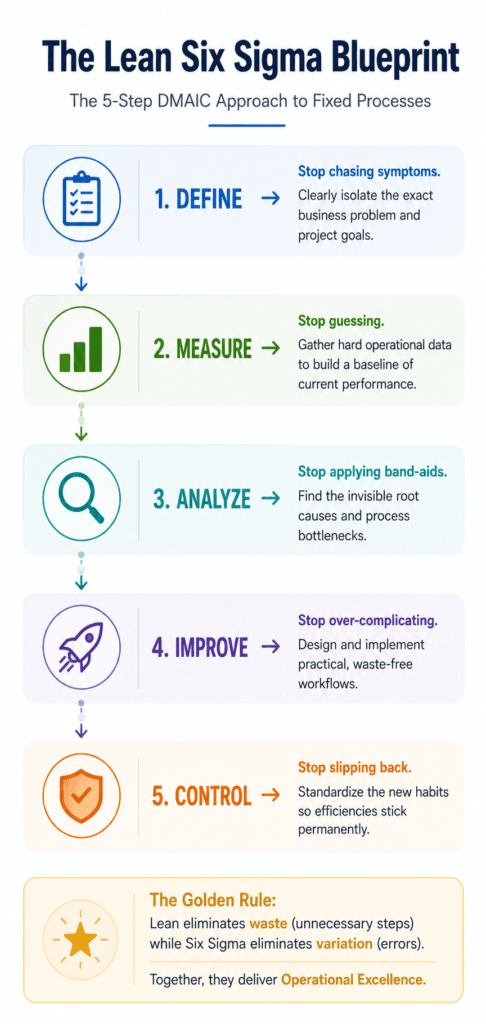
Step 1: Define — Understanding Business Objectives and Problems
The first stage of a Lean Six Sigma project focuses on clearly defining the improvement opportunity.
A consultant works with business stakeholders to understand:
- The current business challenge
- Customer expectations
- Operational objectives
- Key performance indicators (KPIs)
- Project scope and priorities
A clearly defined problem statement prevents organizations from addressing symptoms instead of actual causes.
For example, a business may identify that customer complaints are increasing. However, the underlying issue may involve delays in internal processes, inconsistent service procedures, communication gaps, or unclear responsibilities.
The Define phase ensures that improvement efforts focus on solving the right problem.
Step 2: Measure — Establishing a Performance Baseline
After defining the improvement objective, consultants analyze the current state of the process.
The Measure phase focuses on collecting relevant information to understand existing performance levels.
This may include:
- Process cycle times
- Error rates
- Customer feedback
- Resource utilization
- Workflow data
- Process documentation
Accurate measurement is essential because improvement decisions should be based on evidence rather than assumptions.
Through Lean Six Sigma process optimization, organizations gain visibility into how processes currently perform and where opportunities for improvement exist.
Without a clear baseline, businesses cannot accurately determine whether changes are creating meaningful improvements.
Step 3: Analyze — Identifying Root Causes
One of the most important aspects of the Lean Six Sigma consultant approach is moving beyond surface-level problems.
Many operational issues are symptoms of deeper process challenges. A consultant uses analytical techniques to identify the root causes behind inefficiencies.
During the Analyze phase, teams may examine:
- Process bottlenecks
- Sources of variation
- Workflow dependencies
- Communication gaps
- Unnecessary activities
- Factors contributing to errors
Root cause analysis helps organizations avoid temporary fixes and focus on solutions that address the actual reasons behind performance problems.
This approach is particularly valuable for businesses managing complex operations where multiple departments and processes interact.
Applying Lean Principles to Improve Efficiency
While Six Sigma focuses heavily on reducing variation and improving consistency, Lean principles focus on eliminating activities that do not create value for customers.
A Lean Six Sigma consultant evaluates processes to identify different forms of waste, including:
- Waiting time
- Excess movement
- Unnecessary processing
- Overproduction
- Defects
- Excess inventory
- Underutilized employee capabilities
By reducing waste, organizations can improve efficiency while creating smoother workflows.
For Egyptian businesses operating in competitive markets, improving process efficiency can support better resource utilization and stronger operational performance.
Step 4: Improve — Designing and Implementing Solutions
After identifying root causes, the next step is developing practical improvements.
The Improve phase focuses on designing solutions that address identified problems while considering business realities such as resources, operational requirements, and organizational readiness.
Potential improvement activities may include:
- Simplifying workflows
- Standardizing procedures
- Redesigning process steps
- Improving communication between teams
- Reducing unnecessary approvals
- Enhancing process controls
A successful improvement initiative is not only about finding a better process on paper. It must also be practical for employees to implement and maintain.
This is why collaboration between consultants, leadership, and operational teams is an important part of the Lean Six Sigma approach.
The Importance of Change Management in Lean Six Sigma Projects
Process improvement often requires changes in established ways of working. Even well-designed solutions may fail if employees do not understand the purpose behind the changes or how they will benefit daily operations.
A Lean Six Sigma consultant helps organizations manage this transition by supporting:
- Employee involvement
- Clear communication
- Process training
- Leadership alignment
- Continuous feedback
Creating ownership among employees increases the likelihood that improvements become part of normal business operations rather than temporary initiatives.
Step 5: Control — Sustaining Improvements Over Time
Implementing improvements is only one part of a successful Lean Six Sigma initiative. Organizations also need systems that ensure those improvements continue delivering value over time.
The Control phase focuses on maintaining process performance through monitoring, standardization, and continuous evaluation.
A Lean Six Sigma consultant may support organizations by helping establish:
- Performance measurement systems
- Process documentation
- Standard operating procedures (SOPs)
- Review mechanisms
- Improvement tracking methods
Without proper controls, processes may gradually return to previous practices, reducing the long-term impact of improvement efforts.
The goal of this phase is to help businesses develop sustainable improvement capabilities rather than depend on individual projects or external support.
Adapting the Lean Six Sigma Approach for Egypt’s Industries
One of the strengths of Lean Six Sigma is its flexibility. The methodology can be adapted to different industries because it focuses on improving processes rather than applying a one-size-fits-all solution.
The principles remain the same: understand the process, identify challenges, improve performance, and sustain results.
How Lean Six Sigma Supports Operational Excellence
Operational Excellence is not achieved through a single improvement project. It requires organizations to continuously evaluate how work is performed and identify opportunities to improve.
A Lean Six Sigma business consulting approach supports Operational Excellence in Egypt by helping businesses:
Make Data-Driven Decisions
Organizations often make operational decisions based on experience or assumptions. Lean Six Sigma introduces a more analytical approach by using measurable information to guide improvements.
Improve Process Visibility
Many inefficiencies remain hidden because organizations lack clear visibility into how work moves across departments.
Process mapping and analysis help businesses understand current operations and identify improvement opportunities.
Create Standardized Processes
Standardization reduces inconsistency and helps organizations maintain reliable performance as they grow.
Clear processes also make it easier to train employees and measure operational outcomes.
Encourage Continuous Improvement
A strong Lean Six Sigma culture encourages employees to identify challenges, suggest improvements, and participate in solving operational problems.
This supports long-term organizational capability rather than relying only on external expertise.
Common Mistakes Businesses Should Avoid During Lean Six Sigma Implementation
Although Lean Six Sigma provides a structured framework, organizations may face challenges if implementation is approached incorrectly.
Starting Without Clear Objectives
Improvement projects should begin with clearly defined business goals. Without clear objectives, organizations may invest time and resources in initiatives that do not create meaningful value.
Ignoring Employee Involvement
Employees who perform daily processes often have valuable insights into operational challenges.
Excluding teams from improvement initiatives can create resistance and reduce the effectiveness of implemented solutions.
Focusing Only on Tools
Lean Six Sigma includes many analytical tools, but successful improvement depends on applying the right tools to the right problems.
The methodology is not simply about completing templates or following procedures, it is about improving business performance.
Failing to Maintain Improvements
Without monitoring and ownership, improvements may decline over time.
Organizations need ongoing measurement and accountability to ensure processes continue performing effectively.
Building a Long-Term Lean Six Sigma Mindset
The most successful organizations view Lean Six Sigma as more than a project methodology. They use it as a management approach that encourages continuous learning and improvement.
For Egypt businesses seeking sustainable growth, developing this mindset can help create organizations that are more efficient, adaptable, and customer-focused.
A Lean Six Sigma consultant can support this transformation by introducing structured improvement practices, facilitating problem-solving, and helping teams develop the skills required for ongoing operational excellence.
Conclusion
The Lean Six Sigma consultant approach for Egyptian businesses provides a structured framework for improving processes, reducing inefficiencies, and creating sustainable operational improvements.
Through the DMAIC methodology, consultants help organizations define challenges, measure performance, analyze root causes, implement improvements, and establish controls that maintain results.
Whether applied in manufacturing, healthcare, logistics, or service industries, Lean Six Sigma helps businesses move from reactive problem-solving toward proactive continuous improvement.
For organizations looking to improve efficiency, strengthen quality, and prepare for future growth, adopting a structured Lean Six Sigma approach can provide a practical foundation for Operational Excellence.
Frequently Asked Questions
How does a Lean Six Sigma consultant improve processes in Egypt?
A Lean Six Sigma consultant improves processes by analyzing existing workflows, identifying sources of waste and variation, applying structured improvement methods such as DMAIC, and helping organizations implement measurable solutions that improve efficiency and quality.
What approach does a Lean Six Sigma consultant use?
A Lean Six Sigma consultant typically uses a structured approach based on the DMAIC framework: Define, Measure, Analyze, Improve, and Control. This methodology helps organizations understand problems, identify root causes, implement improvements, and sustain results.
How does Lean Six Sigma process optimization work?
Lean Six Sigma process optimization works by examining how processes currently operate, identifying inefficiencies, reducing waste, minimizing variation, and implementing improvements based on data analysis and business objectives.
Why is Lean Six Sigma important for Egypt businesses?
Lean Six Sigma is important for Egypt businesses because it provides a systematic approach to improving operational efficiency, enhancing quality, reducing process waste, and building capabilities for continuous improvement in competitive markets.
Is Lean Six Sigma consulting services worth it in Egypt?
Lean Six Sigma consulting services can provide value for organizations seeking structured process improvement, better operational performance, and sustainable growth. The effectiveness depends on clear objectives, leadership support, employee involvement, and proper implementation.
Contact us