Industrial manufacturing in Egypt stands at a critical juncture. As global supply chains realign and regional markets demand higher volumes, factory leadership across Egypt faces both unprecedented growth opportunities and sharp operational challenges. Expanding output, protecting profit margins, and staying competitive require more than simply adding shift hours or purchasing extra machinery. Sustainable growth demands systematic productivity improvement in manufacturing.
For plant owners, site directors, and operations managers across Egypt, improving factory efficiency is no longer optional. Fluctuating raw material prices, currency adjustments, and tight lead-time expectations mean operational friction directly impacts the bottom line.
This article examines why productivity improvement manufacturing initiatives in Egypt are vital for sustained industrial success, how structured frameworks solve floor-level waste, and how factories can achieve lasting Operational Excellence.
Why Is Productivity Improvement in Manufacturing Important in Egypt?
Understanding why productivity improvement in manufacturing is important for Egypt requires analyzing the operational realities on today’s plant floor. Manufacturing facilities often encounter invisible losses that degrade profitability over time.
Without a structured efficiency drive, factories face several compounding risks:
- Margin Compression: Rising costs for energy, raw materials, and logistics eat into operating margins if unit conversion costs remain unoptimized.
- Underutilized Asset Capacity: High-capital production lines often run below design speeds due to minor stoppages, slow changeovers, and unplanned breakdowns.
- Capital Misallocation: Management teams frequently buy new machinery or lease extra floor space when existing equipment and floor layouts are capable of delivering higher output.
- Labor Inefficiencies: Unbalanced work lines, excessive operator motion, and waiting times lead to high overtime costs without a proportional increase in standard production output.
Prioritizing factory productivity improvement strategies enables organizations in Egypt to extract hidden capacity, lower cost per unit, and build agile operations capable of adapting to fluctuating market conditions.
Key Challenges Solved by Manufacturing Efficiency Improvement in Egypt
Deploying focused manufacturing efficiency improvement methodologies allows plant leaders in Egypt to address operational pain points systematically. Rather than managing through daily firefighting, factories can tackle root causes across operations.
Addressing these root causes transforms chaotic factory environments into controlled, predictable production systems.
Strategic Framework for Manufacturing Productivity Improvement in Egypt
Achieving repeatable performance gains requires a robust manufacturing performance improvement framework. A structured approach ensures that operational changes are sustainable rather than temporary.
1. Value Stream Mapping and Workflow Streamlining
At the heart of manufacturing productivity improvement is the elimination of non-value-added steps. Value Stream Mapping (VSM) allows operations teams to analyze material flow and information flow from initial material intake to finished goods shipment.
- Identifying Material Stagnation: Pinpointing exact locations where work-in-progress (WIP) sits idle between processing steps.
- Eliminating Redundant Handling: Streamlining transit routes to minimize unnecessary touching or moving of parts.
- Reducing Cycle Lead Times: Shortening total throughput time, allowing faster order fulfillment and lower working capital requirements.
Through systematic VSM, plant leadership gains full visibility over shop floor friction points.
2. Industrial Workforce Productivity Enhancement
In manual and semi-automated production environments across Egypt, industrial workforce productivity enhancement delivers immediate throughput improvements. Workforce optimization focuses on process design and ergonomic ease rather than pushing operators to work harder.
Key techniques include:
- Time and Motion Studies: Observing standard work actions to uncover lost movement, tool searching, or unnecessary bending.
- Line Balancing: Reallocating task loads evenly across line operators to avoid bottleneck stations where parts accumulate.
- Standard Operating Procedures (SOPs): Establishing clear, visual instructions at workstations to maintain process consistency across all shifts.
Standardizing operator routines minimizes human error, reduces employee fatigue, and stabilizes daily output rates.
3. Equipment Reliability and Overall Equipment Effectiveness (OEE)
Maximizing asset availability is critical for high-capital processes. Unscheduled downtime on primary production lines halts output across the entire facility.
Implementing Total Productive Maintenance (TPM) helps operations teams measure and systematically raise Overall Equipment Effectiveness (OEE):
- Availability Rate: Reducing machine setup time, quickening product changeovers, and preventing unexpected mechanical breakdowns.
- Performance Rate: Eliminating micro-stoppages, idling, and speed reductions that slow down daily cycle times.
- Quality Rate: Preventing start-up defects and scrap during regular production runs.
Empowering machine operators with autonomous maintenance skills ensures early problem detection before minor defects become major breakdowns.
4. Lean Facility Design and Shop Floor Space Optimization
When production volume grows, unorganized floor space can become a major operational barrier. Material pathways crisscross, transit aisles get blocked, and inventory gets misplaced.
Applying Lean Plant Layout principles reorganizes machinery and work stations into dedicated, flow-oriented layouts:
- Cellular Layouts: Creating compact U-shaped workstations that shorten operator walking distance and speed up communication.
- Reclaiming Usable Floor Space: Freeing up shop floor footprint for future lines without investing in building extensions.
- Logistics Optimization: Establishing clear entry and exit points for raw materials and finished goods to prevent traffic bottlenecks.
What Drives Productivity Improvement in Manufacturing in Egypt?
Understanding what drives productivity improvement in manufacturing across Egypt involves examining both leadership commitment and cultural execution on the shop floor. True transformation requires a shift from sporadic interventions to a continuous improvement mindset.
Key drivers include:
- Daily Work Management: Establishing structured, short daily reviews at visual shop floor management boards to track output against targets, identify hourly gaps, and assign immediate corrective actions.
- Process Standardization: Ensuring that every shift executes operations according to standard methods, preventing variation in quality and cycle times.
- Data-Driven Decision Making: Tracking precise operational metrics like OEE, line cycle times, and scrap percentages instead of relying on subjective estimates.
- Partnering with Execution Specialists: Engaging experienced productivity improvement consulting for manufacturing in Egypt brings fresh external perspectives, structured methodologies, and hands-on implementation support directly on the shop floor.
When Should Factories Focus on Productivity Improvement in Egypt?
Recognizing when factories should focus on productivity improvement prevents operational challenges from turning into customer dissatisfaction or financial loss.
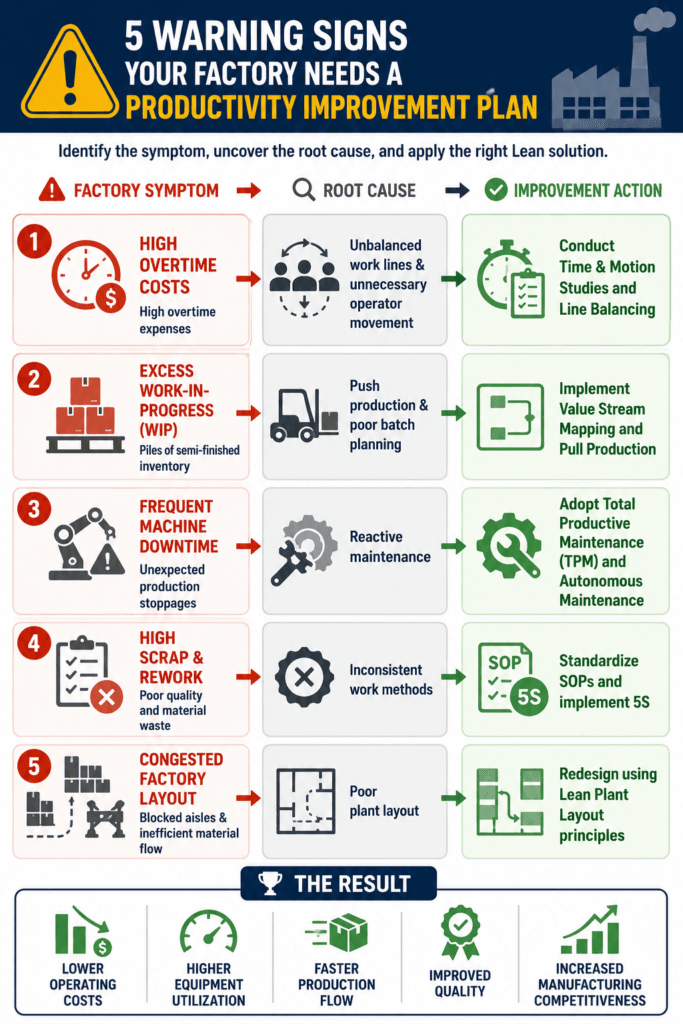
Operations leaders should initiate an operational review when encountering these specific shop floor symptoms:
| Observed Plant Floor Symptom | Underlying Operational Root Cause | Targeted Improvement Action Plan |
| High Overtime Expenses | Unbalanced work lines and redundant manual motions | Execute Time and Motion Study and rebalance line operator tasks |
| Piles of Semi-Finished WIP | Push production and uncoordinated batch sizing | Implement Value Stream Mapping and pull-based production controls |
| Frequent Machine Stoppages | Reactive, firefighting maintenance approach | Deploy Autonomous Maintenance routines and Total Productive Maintenance (TPM) |
| High Scrap and Rework Rates | Inconsistent standard work procedures across shifts | Establish clear visual standard operating procedures (SOPs) and 5S controls |
| Crowded, Blocked Aisles | Poor physical layout and unorganized floor space | Redesign factory footprint using Lean Plant Design frameworks |
How Can Productivity Improvement in Manufacturing Help Egypt?
Evaluating how productivity improvement in manufacturing can help Egypt highlights clear strategic benefits at both the enterprise level and across the broader national industrial market:
- Expanding Regional and Global Exports: Efficient manufacturing lowers unit conversion costs, allowing local manufacturers to price competitively in international export markets while preserving healthy profit margins.
- Optimizing Capital and Foreign Currency Usage: Increasing plant output through waste elimination enables factories to scale production using existing machinery and floor space, conserving capital resources.
- Creating Skilled Industrial Jobs: Upgrading shop floor operations through Lean management, 5S, and TPM builds specialized technical and managerial capabilities across the manufacturing workforce.
- Building Business Resilience: Agility, quick setup times, and flexible layout arrangements prepare plants to weather sudden market shifts or supply chain interruptions.
Actionable Steps for Factory Management in Egypt
To implement sustainable manufacturing productivity optimization strategies, plant leaders in Egypt can follow this practical step-by-step roadmap:
- Conduct a Shop Floor Diagnostic Audit: Measure existing baseline metrics including OEE, line cycle times, inventory turns, and scrap rates.
- Establish Visual Daily Work Governance: Set up visual management boards near production lines to track hourly performance and manage active daily action logs.
- Engage Hands-On Implementation Partners: Work with specialized management consultants who focus on real-time execution alongside shop floor teams.
- Focus on Standard Work and 5S: Build a clean, organized, and standardized physical workplace to establish operational stability before introducing complex automation.
Frequently Asked Questions (FAQs)
Why is productivity improvement in manufacturing important in Egypt?
Productivity improvement is vital because it directly strengthens operational resilience, lowers unit costs, and maximizes asset performance without requiring heavy capital expenditure. It helps manufacturing facilities handle rising input costs and remain competitive across both domestic and international markets.
How can productivity improvement in manufacturing help in Egypt?
Improving plant productivity builds operational capability, stabilizes supply chains, and boosts factory throughput. By reducing process waste, upgrading workforce skills, and maximizing asset availability, industrial facilities can meet customer demand and expand their production capacity efficiently.
What drives productivity improvement in manufacturing in Egypt?
Key drivers include structured Lean management frameworks, Total Productive Maintenance (TPM) practices, workflow optimization, standardized work instructions, and active daily governance. Engaging shop-floor teams in continuous problem-solving ensures lasting operational gains.
When should factories focus on productivity improvement in Egypt?
Factories should focus on productivity improvement immediately, especially when experiencing capacity constraints, rising operating costs, frequent machine failures, high scrap rates, or delayed delivery schedules. Starting an operational diagnostic highlights key bottleneck areas for fast, target-driven improvements.
Contact us