In the current global economic landscape, industrial facilities are navigating a complex matrix of rising material costs, fluctuating supply chain dynamics, and increasing demands for operational sustainability. For the Egyptian industrial sector, navigating these variables requires a shift away from short sighted cost cutting measures toward comprehensive, long term planning. Implementing a unified strategy for waste reduction operations in the manufacturing industry is no longer optional; it is a fundamental requirement for securing competitive advantage and protecting bottom line profitability.
While deploying individual methods or best practices yields localized improvements, a true strategy aligns those tactical efforts into a cohesive, organization-wide mission. A strategic approach ensures that every department, from procurement to final assembly, operates under a shared vision of maximizing value and eliminating non-value-adding activities. By approaching efficiency through a strategic lens, factories in Egypt can transform isolated successes into sustained Operational Excellence.
The Need for Manufacturing Waste Elimination Strategies in Egypt
Many industrial facilities approach waste management reactively. When defect rates spike or inventory holding costs become unmanageable, management teams often deploy temporary fixes to address the immediate pain point. However, without underlying manufacturing waste elimination strategies, these problems inevitably resurface.
A strategic approach fundamentally changes how an organization views its resources. It moves the focus from managing waste after it is created to preventing waste before it enters the production cycle. Effective waste reduction strategies for the manufacturing industry of Egypt require leadership teams to evaluate their entire value stream. This high-level evaluation identifies systemic flaws in production planning, facility layout, and resource allocation. By addressing these systemic root causes, organizations build resilient operations capable of adapting to market fluctuations without compromising output quality or operational efficiency.
Formulating an Operational Waste Reduction Framework for Egypt
To execute a strategy effectively, Egypt’s industrial leaders must build a structured environment that supports change. An operational waste reduction framework serves as the architectural blueprint for this transformation. This framework provides clear guidelines on how waste reduction goals will be set, measured, and achieved across all operational tiers.
A robust strategic framework typically encompasses several critical phases:
- Comprehensive Baseline Assessment: Before defining a future state, organizations must rigorously audit their current operational reality. This involves mapping out all material flows and identifying exact points where resources are consumed without adding customer value.
- Strategic Goal Alignment: Waste reduction targets must align directly with broader business objectives. If the primary business goal is improving cash flow, the operational framework should prioritize inventory reduction and lead time acceleration.
- Tactical Deployment Plan: The framework must break high-level strategies into actionable, daily tasks for shop floor teams. This step bridges the gap between executive vision and frontline execution.
- Continuous Review Cycles: A strategic framework is not static. It requires scheduled review periods where leadership evaluates performance metrics and recalibrates the approach based on real world results.
By utilizing this structured framework in Egypt’s manufacturing industry, waste reduction initiatives transition from theoretical concepts into measurable daily routines.
Core Pillars of a Waste Reduction Strategy
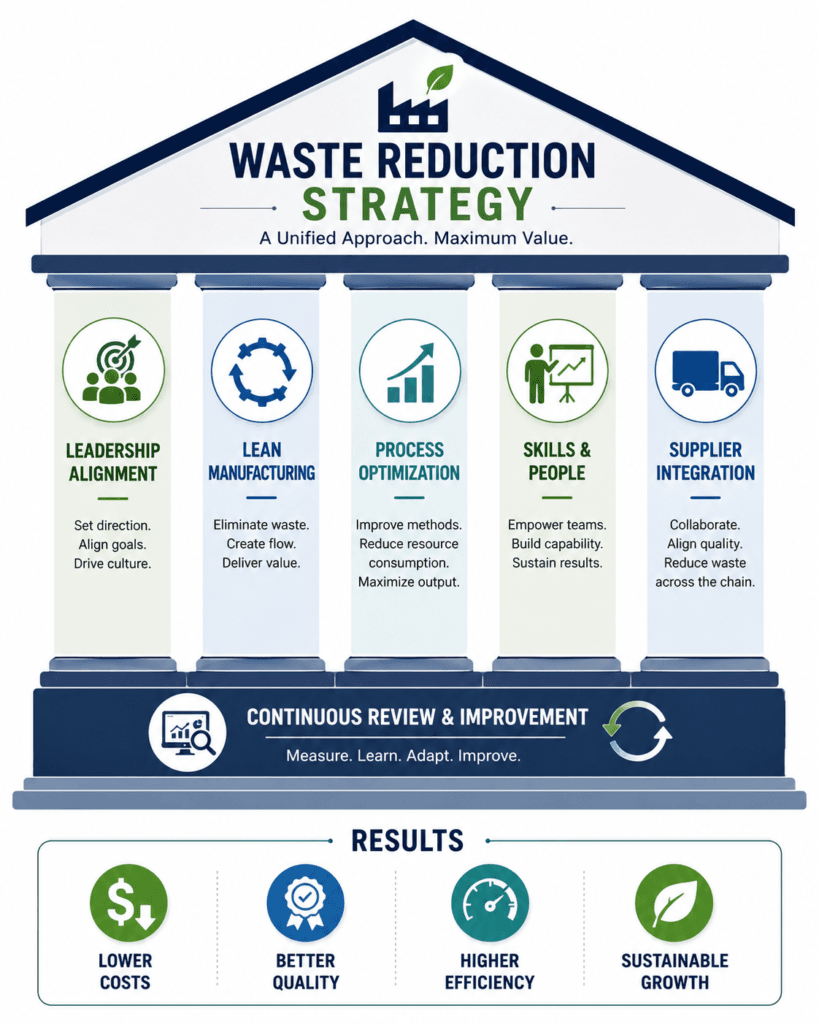
Developing a world class industrial operation requires integrating several strategic pillars simultaneously. These core strategies ensure that waste is aggressively targeted from multiple operational angles.
1. Deploying Lean Manufacturing Waste Reduction Methods
At the heart of any effective industrial strategy is the adoption of Lean thinking. Lean manufacturing waste reduction methods prioritize the creation of continuous, uninterrupted flow. Strategically, this means moving away from traditional batch and queue processing, which inherently builds up excessive work-in-progress (WIP) inventory and masks quality defects.
Instead, a Lean strategy implements pull systems based strictly on customer demand. By producing only what is needed exactly when it is needed, facilities eliminate overproduction and drastically reduce storage requirements. Implementing this strategy requires careful synchronization of machine cycle times and highly responsive material handling protocols.
2. Industrial Process Waste Optimization
While Lean methods focus on flow, industrial process waste optimization focuses on the technical engineering of the production steps themselves. Strategically optimizing processes involves analyzing machine parameters, tooling selections, and operational sequences to ensure they require the absolute minimum amount of energy and raw material.
This strategy often involves standardizing operating procedures so every worker executes tasks using the most efficient documented method. Furthermore, optimizing processes means designing quality checks directly into the workstation. By preventing a defective component from moving to the next operational phase, factories eliminate the compounding waste of processing bad materials.
3. Strategic Capacity Building and Skill Development
The most technically advanced strategy will fail without an equipped and motivated workforce to execute it. A core strategy for waste reduction involves continuous investment in human capital. Frontline operators are the closest to the daily friction points of production.
A successful strategy systematically trains these operators in problem solving methodologies and empowers them to halt production when they detect anomalies. Building a culture of proactive problem solvers ensures that waste reduction becomes a daily, self sustaining activity rather than a top down management directive.
4. Supplier Integration and Material Synchronization
Waste often enters a facility before a single machine is turned on. Poor quality raw materials or erratic delivery schedules force plants to hold massive safety stocks, tying up vital capital. A comprehensive strategy extends beyond the four walls of the factory and integrates key suppliers into the waste reduction mission. By collaborating with vendors to improve incoming material quality and synchronize delivery schedules, manufacturing plants can significantly lower internal holding costs and minimize material sorting wastes.
Leveraging External Expertise for Strategic Acceleration
Transitioning an entire organizational culture toward continuous improvement is a complex undertaking. Many leadership teams recognize the need for change but struggle with the internal bandwidth or specialized knowledge required to execute a massive operational pivot.
This is where engaging specialized waste reduction consulting professionals becomes a strategic advantage in Egypt’s manufacturing industry. External consultants bring unbiased perspectives, allowing them to spot hidden inefficiencies that internal teams may have normalized over time.
Partnering with manufacturing waste reduction experts in Egypt allows facilities to bypass common implementation pitfalls. These experts provide proven deployment roadmaps, facilitate intensive training sessions, and help establish the necessary performance tracking infrastructure. Utilizing professional industrial waste reduction services in Egypt accelerates the timeline from initial assessment to measurable financial return, ensuring that strategic goals translate into concrete operational savings.
Frequently Asked Questions
How does waste reduction in the manufacturing industry help Egypt?
Waste reduction strategies enable the Egyptian industrial sector to maximize output using fewer resources. By lowering internal production costs and improving product quality, facilities can offer more competitive pricing. This operational maturity strengthens the entire national supply chain and makes the local industrial sector highly competitive in both regional and global markets.
Why is waste reduction in the manufacturing Industry important in Egypt?
With volatile raw material prices and tightening economic conditions, preserving profit margins is critical for industrial survival. Waste reduction is important because it serves as an internal profit generator. By eliminating non-value-adding activities and recovering lost machine capacity, organizations can self fund their growth without relying on expensive capital investments.
What drives waste reduction in the manufacturing industry in Egypt?
The primary drivers include the continuous rise in global supply chain costs, increased energy expenses, and more aggressive competition from international manufacturers. Additionally, stringent customer requirements for faster delivery times and higher quality standards compel organizations to eliminate internal process friction.
How can waste reduction in the manufacturing industry cut costs?
Waste reduction directly cuts costs by lowering the volume of raw materials scrapped due to defects. It also eliminates the financial burden of storing, handling, and managing excess inventory. Furthermore, by optimizing workflows and reducing machine downtime, facilities get more productive output per labor hour and lower their energy consumption per unit produced.
When should factories focus on waste reduction in Egypt?
Waste reduction should not be treated as a periodic project; it must be a continuous, daily strategic focus. However, leadership must launch aggressive, structured waste reduction initiatives immediately if they observe declining profit margins, chronic failure to meet customer delivery dates, or rising instances of quality rejections from the market.
Contact us