
Organizational change is rarely achieved through a single initiative. Successful transformation is typically the result of strong leadership, structured planning, clear communication, and sustained employee engagement. While every organization follows its own path, many change initiatives share common challenges and proven approaches. The representative case studies below illustrate how manufacturing and industrial organizations in Saudi Arabia can apply organizational change management principles to strengthen Operational Excellence, improve collaboration, and support long-term business transformation. These examples are intended for educational purposes and reflect common organizational change scenarios rather than specific client engagements.
Key Takeaways
- Successful organizational change begins with a clear vision and strong leadership commitment.
- Employee engagement and communication are essential throughout the change journey.
- Organizational culture has a significant impact on the success of transformation initiatives.
- Structured change management improves consistency, accountability, and long-term adoption.
- Continuous improvement helps organizations sustain change beyond implementation.
Why Organizational Change Requires a Structured Approach
Organizations often introduce new strategies, operational improvements, or business initiatives with the expectation that employees will quickly adapt. In reality, successful transformation requires careful planning, leadership alignment, and ongoing communication.
The importance of organizational change lies in its ability to help organizations manage change in a structured way while maintaining operational stability and employee engagement.
The following representative scenarios demonstrate common approaches used to support organizational change management in Saudi Arabia.
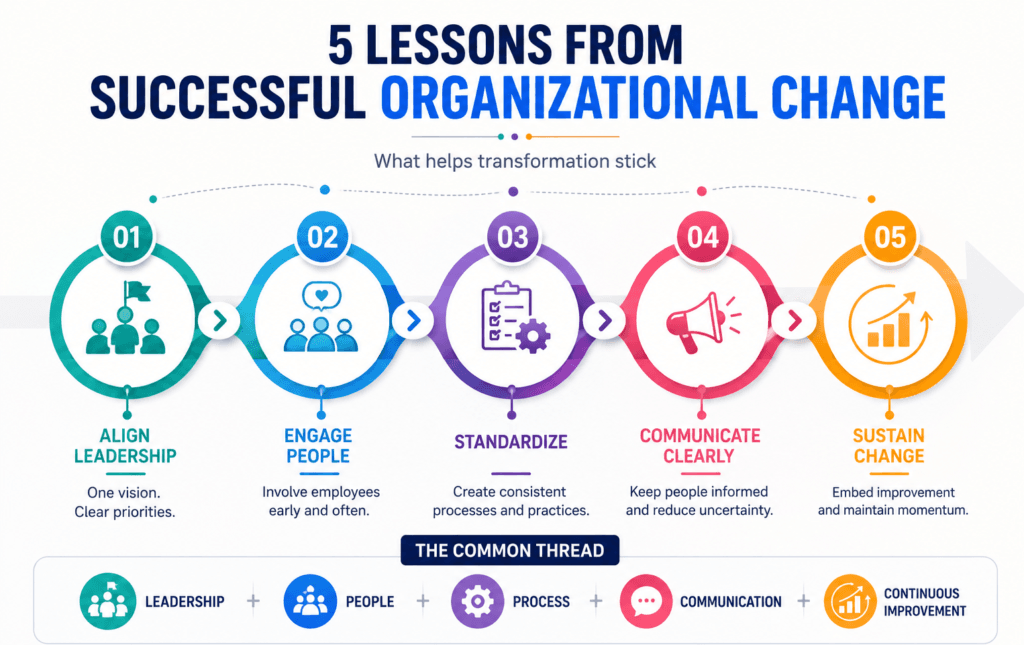
Illustrative Case Study 1: Aligning Leadership Around a Common Vision
Challenge
A manufacturing organization introduced several operational improvement initiatives, but different leadership teams communicated conflicting priorities. Employees became uncertain about expectations, leading to inconsistent implementation across departments.
Change Approach
The organization established a shared transformation vision supported by:
- Leadership alignment workshops
- Clear communication objectives
- Defined governance responsibilities
- Regular executive progress reviews
Outcome
Leadership communicated consistent priorities across the organization, improving collaboration, decision making, and employee confidence throughout the transformation process.
Key Lesson
Organizational change is more successful when leaders present a unified vision and consistently reinforce business priorities.
Illustrative Case Study 2: Building a Culture That Supports Continuous Improvement
Challenge
An industrial organization introduced several improvement initiatives, but employee participation remained limited because improvement activities were viewed as management responsibilities rather than shared organizational goals.
Change Approach
Leadership focused on strengthening organizational culture in Saudi Arabia by encouraging employee involvement through:
- Structured improvement discussions
- Cross functional collaboration
- Recognition of employee contributions
- Regular feedback sessions
Outcome
Employees became more engaged in identifying improvement opportunities, strengthening collaboration while supporting a culture of continuous improvement.
Key Lesson
Sustainable organizational change depends on creating an environment where employees actively participate in business improvement.
Illustrative Case Study 3: Standardizing Organizational Processes
Challenge
Different departments followed inconsistent management practices, creating communication gaps and reducing operational visibility.
Change Approach
The organization implemented a structured change management process that included:
- Standardized management procedures
- Clearly defined responsibilities
- Regular performance reviews
- Consistent communication practices
Outcome
Improved consistency across departments strengthened accountability while making operational performance easier to monitor and manage.
Key Lesson
Standardization creates a stronger foundation for organizational alignment and sustainable business performance.
Illustrative Case Study 4: Supporting Business Transformation Through Employee Engagement
Challenge
A business transformation initiative introduced significant operational changes, but employees were uncertain about how the changes would affect their daily responsibilities.
Change Approach
Leadership developed an employee focused communication strategy supported by:
- Regular leadership updates
- Interactive workshops
- Feedback opportunities
- Change champions across departments
Outcome
Greater employee understanding reduced uncertainty while encouraging stronger participation throughout the transformation journey.
Key Lesson
Employee engagement is one of the most important drivers of successful organizational change.
Illustrative Case Study 5: Sustaining Organizational Change
Challenge
Following a successful implementation, improvement activities gradually slowed because progress reviews became less frequent and accountability weakened.
Change Approach
Leadership embedded continuous improvement into routine management practices through:
- Regular performance reviews
- Leadership accountability
- Ongoing progress monitoring
- Continuous feedback and refinement
Outcome
The organization maintained momentum by integrating improvement into everyday operations rather than treating transformation as a completed project.
Key Lesson
Successful organizational change continues long after implementation through consistent leadership, performance reviews, and continuous improvement.
Common Success Factors Across Organizational Change Initiatives
Although every transformation is unique, successful organizational change initiatives often share several characteristics.
Strong Leadership Commitment
Visible leadership involvement builds confidence while reinforcing organizational priorities throughout the transformation journey.
Clear Communication
Consistent communication reduces uncertainty, strengthens engagement, and helps employees understand the purpose behind organizational change.
Employee Participation
Organizations achieve stronger results when employees contribute ideas, participate in improvement activities, and support implementation efforts.
Structured Governance
Clearly defined responsibilities, progress reviews, and accountability mechanisms help maintain momentum and ensure organizational alignment.
Continuous Improvement
Successful organizations recognize that transformation is an ongoing process requiring regular evaluation, learning, and refinement.
These principles support broader business transformation initiatives in Saudi Arabia while strengthening organizational capability over time.
Applying These Lessons to Future Organizational Change
Organizations planning future transformation initiatives should focus on:
- Developing a clear organizational change strategy
- Aligning leadership around shared objectives
- Building a culture that supports adaptability
- Engaging employees throughout the change process
- Reviewing progress regularly and refining implementation plans
By combining these practices with structured governance and continuous improvement, organizations can improve their ability to manage change successfully while supporting long-term Operational Excellence.
Conclusion
Successful organizational change is rarely defined by a single project or initiative. Instead, it is built through consistent leadership, engaged employees, effective communication, and a structured approach to managing transformation.
These illustrative case studies demonstrate common organizational change scenarios that organizations across Saudi Arabia may encounter during business transformation. While every organization faces unique circumstances, the principles behind successful change remain consistent. By focusing on leadership alignment, organizational culture, employee engagement, and continuous improvement, businesses can build the capability needed to manage change confidently and sustain long-term performance.
Frequently Asked Questions
Why is organizational change important for businesses in Saudi Arabia?
Organizational change helps businesses improve operational performance, strengthen collaboration, adapt to changing business requirements, and support long-term transformation.
What are the key factors behind successful organizational change?
Strong leadership, effective communication, employee engagement, structured governance, and continuous improvement are among the most important factors contributing to successful organizational change.
How does organizational culture influence organizational change?
A supportive organizational culture encourages collaboration, adaptability, and employee participation, making it easier to implement and sustain change initiatives.
What is a structured change management process?
A structured change management process provides a framework for planning, implementing, monitoring, and sustaining organizational change while supporting employees throughout the transformation.