
Manufacturers are continually seeking ways to improve efficiency, optimize resources, and strengthen operational performance. While investing in new technologies and expanding production capabilities can support growth, addressing inefficiencies within existing operations often delivers equally meaningful improvements. A business management consultant helps organizations identify operational waste, streamline business processes, and implement structured improvement strategies that enhance productivity and support long-term Operational Excellence. Rather than focusing on isolated issues, consultants work with businesses to build systems that promote continuous improvement across the organization.
Key Takeaways
- Business management consultants help organizations identify and reduce operational waste through structured process improvement.
- Eliminating non value adding activities improves efficiency, resource utilization, and overall business performance.
- Operational Excellence depends on standardized processes, data-driven decision making, and continuous improvement.
- Sustainable waste reduction requires collaboration across functions rather than isolated improvement initiatives.
- Long-term operational success comes from building a culture of continuous improvement supported by strong business processes.
Reducing Industrial Waste: The Business Challenge
Industrial waste is not limited to material losses. It also includes inefficient processes, unnecessary activities, delays, repeated work, underutilized resources, and operational practices that consume time and effort without creating value.
As organizations grow, these inefficiencies can become embedded within everyday operations. Individual issues may appear manageable, but collectively they can affect productivity, decision making, and operational performance.
Many businesses recognize opportunities to improve efficiency but find it difficult to identify the underlying causes of operational waste while managing day to day activities. An objective assessment helps organizations understand where inefficiencies exist and develop practical strategies to address them.
This is where a business management consultant supports organizations by evaluating operations, identifying improvement opportunities, and building structured approaches to Operational Excellence in Saudi Arabia.
Understanding Industrial Waste from a Business Perspective
Reducing industrial waste is about improving how work is performed across the organization.
Examples of operational waste include:
- Unnecessary process steps
- Waiting time between activities
- Rework caused by inconsistent processes
- Duplicate tasks across departments
- Excess movement of information or materials
- Inefficient resource allocation
- Poor coordination between business functions
- Delays in decision making
Addressing these challenges strengthens overall business performance while creating more efficient and consistent operations.
Through business process improvement, organizations in Saudi Arabia can simplify workflows, improve collaboration, and eliminate activities that do not contribute to business objectives.
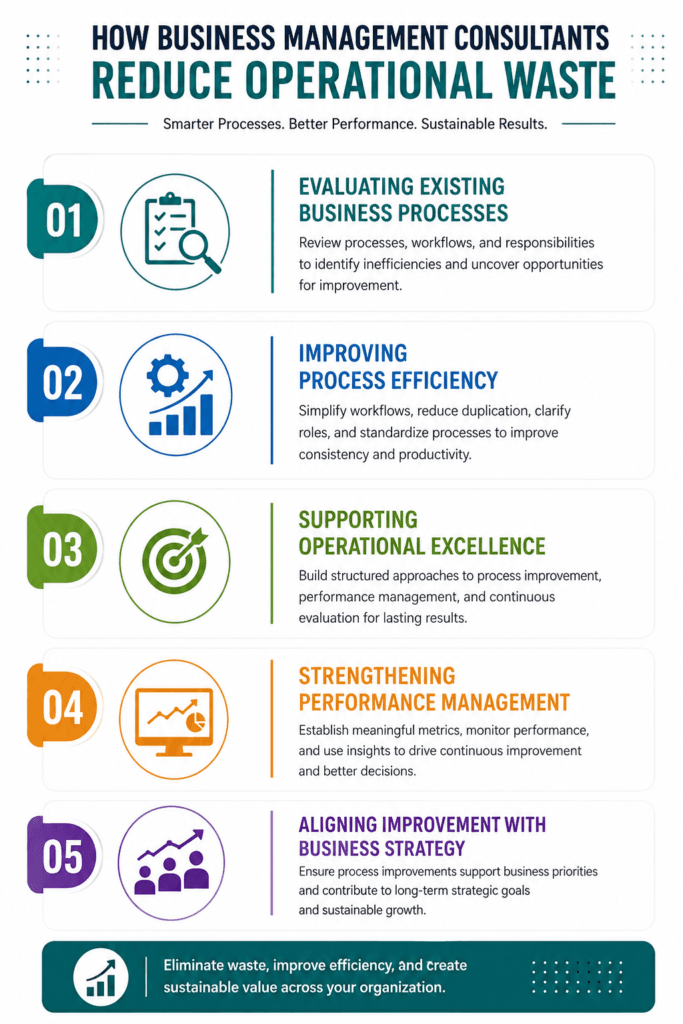
How Business Management Consultants Reduce Operational Waste
Evaluating Existing Business Processes
Every improvement initiative begins with understanding the current state.
Consultants review business processes, operational workflows, organizational responsibilities, and decision-making practices to identify inefficiencies that affect overall performance.
Rather than focusing on individual departments, they evaluate how activities interact across the organization to uncover opportunities for improvement.
Improving Process Efficiency
Once inefficiencies are identified, consultants develop practical recommendations that simplify workflows and improve operational consistency.
This may involve clarifying responsibilities, reducing duplicated activities, improving communication between teams, or standardizing business processes.
Many organizations engage business efficiency consultants in Saudi Arabia to establish more effective operating models that support productivity and long-term business performance.
Supporting Operational Excellence
Operational Excellence is achieved through disciplined execution rather than isolated improvement projects.
Through Operational Excellence consulting in KSA, consultants help organizations develop structured approaches to process improvement, performance management, and continuous evaluation.
This creates an environment where improvement becomes part of normal business operations instead of an occasional initiative.
Strengthening Performance Management
Reducing operational waste requires visibility into business performance.
Performance management consulting providers in Saudi Arabia help organizations establish meaningful performance measures that support informed decision making and continuous improvement.
Regular performance reviews enable businesses to monitor progress and identify new opportunities to improve efficiency.
Aligning Improvement with Business Strategy
Operational improvements deliver greater value when they support broader business objectives.
A Saudi Arabia business strategy consultant helps ensure that process improvements align with organizational priorities, enabling businesses to improve efficiency while supporting long-term strategic goals.
Why Continuous Improvement Matters
Eliminating waste is not a one time project.
Business environments continue to evolve, customer expectations change, and operational requirements become more complex over time.
Organizations that embrace continuous improvement regularly review their processes, evaluate performance, and refine operations to maintain efficiency.
Consultants help establish governance, review mechanisms, and improvement frameworks that allow organizations to sustain progress long after individual initiatives have been completed.
Best Practices for Reducing Industrial Waste in Saudi Arabia
Assess Current Operations
Understand how work flows across the organization before introducing changes.
Prioritize High Impact Improvements
Focus on addressing the most significant sources of operational inefficiency first.
Standardize Business Processes
Consistent procedures improve operational reliability and reduce unnecessary variation.
Encourage Cross Functional Collaboration
Improvement initiatives are more successful when production, operations, quality, engineering, supply chain, and leadership work toward shared objectives.
Measure and Refine Performance
Continuous monitoring helps organizations evaluate results and identify new opportunities for improvement.
Common Challenges During Waste Reduction Initiatives
Resistance to Process Changes
Employees may be hesitant to adopt new ways of working without clear communication and leadership support.
Fragmented Workflows
Disconnected business processes often create unnecessary delays and duplicated effort.
Limited Performance Visibility
Without meaningful performance measures, organizations may struggle to identify the root causes of inefficiency.
Inconsistent Process Standards
Variations in how work is performed can reduce operational consistency and make improvement efforts more difficult to sustain.
Working with business advisory services helps organizations address these challenges through structured analysis, practical implementation, and ongoing performance evaluation.
Building a Culture of Operational Excellence
Reducing industrial waste is not solely about improving individual processes. It requires organizations to build a culture where efficiency, collaboration, and continuous improvement are part of everyday operations.
A Management consulting firm helps Saudi Arabia businesses establish structured improvement frameworks, strengthen governance, and align Operational Excellence initiatives with long-term business objectives.
By embedding improvement into daily decision making, organizations create lasting operational capabilities that support productivity, adaptability, and sustainable business performance.
Conclusion
Industrial waste often results from inefficient processes, fragmented workflows, and inconsistent ways of working rather than isolated operational issues. A business management consultant helps organizations identify these inefficiencies, strengthen business processes, and implement structured improvement strategies that support Operational Excellence.
For businesses across Saudi Arabia, reducing industrial waste is about creating more efficient, agile, and resilient operations. By aligning process improvement with business strategy, encouraging cross functional collaboration, and fostering a culture of continuous improvement, organizations can strengthen performance while building a solid foundation for long-term success.
Frequently Asked Questions
How does a business management consultant reduce industrial waste?
A business management consultant evaluates business processes, identifies operational inefficiencies, streamlines workflows, and implements structured improvement initiatives that reduce non-value-adding activities and improve operational performance.
What is operational waste in a business environment?
Operational waste includes unnecessary activities, duplicated work, waiting time, inefficient resource utilization, process delays, and other tasks that consume resources without creating business value.
How does business process improvement reduce waste?
Business process improvement simplifies workflows, removes unnecessary activities, improves coordination between teams, and creates more consistent operations that support greater efficiency.
Why is Operational Excellence important for reducing industrial waste?
Operational Excellence promotes standardized processes, continuous improvement, performance management, and effective collaboration, helping organizations reduce inefficiencies and sustain long-term operational improvements.
When should a business engage a management consultant for operational improvement?
Businesses should consider engaging a consultant when they identify recurring operational inefficiencies, process bottlenecks, inconsistent performance, or opportunities to strengthen business processes and improve overall operational effectiveness.