Manufacturing efficiency is rarely improved through a single initiative. Sustainable results usually come from consistently identifying process losses, addressing their causes, and establishing better ways of working.
For organizations focused on operational efficiency in manufacturing Saudi Arabia, Lean manufacturing and continuous improvement provide practical methods for achieving this.
Lean focuses on creating customer value while reducing activities that consume resources without adding value. Continuous improvement builds on this by making problem-solving and process optimization an ongoing part of operations.
When applied together, these approaches can support productivity improvement, waste reduction, cost efficiency, and stronger operational performance.
What Is Continuous Improvement in Manufacturing?
Continuous improvement is a structured approach to making incremental or significant improvements to processes over time.
It involves:
- Understanding the current process
- Identifying a performance gap
- Investigating the cause
- Developing an improvement
- Measuring the outcome
- Standardizing successful changes
- Repeating the process
Its objective is to make processes more stable, efficient, predictable, and capable of delivering the required results.
How Lean Manufacturing Supports Operational Efficiency
Lean manufacturing initiatives for Saudi Arabia focus on reducing waste and improving the flow of value through an operation.
Common forms of waste include:
- Waiting
- Excess inventory
- Unnecessary movement
- Transportation
- Overprocessing
- Defects
- Overproduction
The specific form of waste varies between organizations and processes.
The important point is that waste represents resources being consumed without creating equivalent value. Removing unnecessary activities can improve process efficiency without requiring additional capacity.
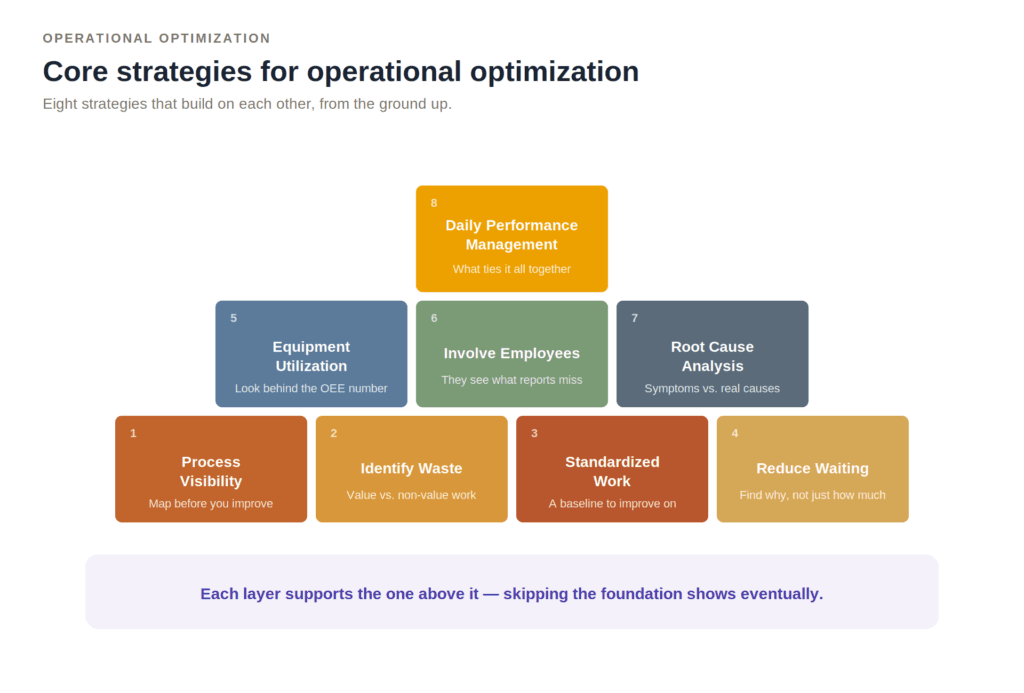
Core Strategies for Operational Optimization
1. Start With Process Visibility
Before improving a process, organizations need to understand how it currently works.
Process mapping can help teams visualize the movement of materials, information, and work. Value Stream Mapping (VSM) can provide a broader view of the flow from the beginning of a process to its completion. This can reveal:
- Delays
- Bottlenecks
- Excess work-in-process
- Repeated activities
- Unnecessary movement
- Information gaps
A process that appears efficient when individual activities are viewed separately may reveal significant losses when the complete flow is examined.
2. Identify Waste
VSM is also particularly useful when organizations need to understand how work moves through a larger process.
Rather than looking only at individual tasks, teams examine the complete flow. The objective is to distinguish activities that contribute to value from activities that consume resources without creating equivalent value. This can help organizations prioritize improvement opportunities.
However, VSM should not become a documentation exercise. Its purpose is to support decisions about how the process can work better.
3. Improve Standardized Work
Continuous improvement is difficult to sustain when processes are constantly performed differently.
Standardized work establishes the best-known method for performing a process under current conditions. It can define:
- Work sequence
- Required materials
- Process conditions
- Quality requirements
- Expected timing
Once a standard exists, teams can identify deviations and determine whether the process or the standard needs improvement.
Standardization therefore provides a foundation for both operational control and future improvement.
4. Reduce Waiting and Process Delays
Waiting is one of the most common sources of operational inefficiency. Employees may wait for materials, equipment, information, approvals, inspections, or preceding process steps.
The important question is not simply how much waiting exists. Teams need to understand why the waiting occurs.
For example, repeated material delays may indicate a problem with replenishment or internal logistics. Repeated approval delays may indicate an unnecessary decision point. Recurring equipment delays may indicate a reliability issue.
Root cause analysis helps ensure that teams address the underlying problem rather than simply managing the symptom.
5. Improve Equipment Utilization
Equipment performance directly affects production flow. When machines are unavailable or operate below expected performance, available capacity is lost.
Overall Equipment Efficiency (OEE) can provide a structured method for examining equipment performance through availability, performance, and quality.
However, the metric itself is only the starting point. Improvement teams should investigate the losses behind the number. Questions might include:
- Why does downtime occur?
- Which interruptions happen repeatedly?
- Why are minor stoppages recurring?
- Are quality problems linked to equipment conditions?
- Are maintenance practices addressing recurring causes?
This connects Lean improvement with equipment-focused performance management.
6. Involve Employees in Continuous Improvement
Continuous improvement works best when employees are active participants.
People working directly with processes often have detailed knowledge of recurring problems, unnecessary steps, and practical constraints. Their involvement can help organizations identify opportunities that may not be obvious from performance reports alone.
Employee involvement can include:
- Problem identification
- Improvement suggestions
- Process observation
- Root cause analysis
- Testing solutions
- Standardization
This also helps create a stronger continuous improvement culture.
The goal is to make improvement part of normal operational management rather than an occasional project.
7. Use Root Cause Analysis
One of the most important principles of continuous improvement is distinguishing symptoms from causes.
Suppose a process repeatedly experiences delays. Adding additional resources may reduce the immediate impact, but the underlying cause may remain. Root cause analysis encourages teams to ask why the problem is occurring.
Depending on the situation, organizations can use methods such as:
- Five Whys
- Cause-and-effect analysis
- Process observation
- Data analysis
- Pareto analysis
The appropriate method depends on the complexity of the problem. The objective is always the same: understand what is actually driving the performance gap.
8. Build a Daily Performance Management Routine
Continuous improvement becomes more sustainable when performance is reviewed regularly.
A practical daily management process can include a small number of relevant indicators. These might include:
- Safety issues
- Quality
- Production
- Delivery
- Downtime
- Productivity
- Improvement actions
The purpose is not to create excessive reporting. It is to identify deviations early and provide a structured opportunity to address them.
A short, focused review can be more useful than a large performance report that is rarely acted upon.
Continuous Improvement Strategies for Saudi Manufacturing Success
Organizations looking for continuous improvement strategies for Saudi manufacturing success can begin by establishing a simple improvement system.
Define the Current State
Understand how the process operates today.
Identify the Performance Gap
Determine what is preventing the process from meeting its expected outcome.
Prioritize the Problem
Focus on losses with meaningful operational impact.
Investigate the Cause
Use process observation and structured problem-solving.
Implement the Improvement
Test a practical solution.
Measure the Result
Compare performance with the original baseline.
Standardize the Improvement
Update the process so that the improvement becomes part of normal work.
Continue Monitoring
Ensure that the improvement is sustained and identify the next opportunity.
This creates a repeatable improvement cycle.
Lean and Technology Can Work Together
Lean and Industry 4.0 should not be viewed as separate improvement strategies.
Lean can identify process waste. Digital technologies can provide additional information about where and when that waste occurs.
For example, a manufacturing organization may identify recurring downtime as a major source of lost capacity. Equipment monitoring can provide more detailed information about when interruptions occur. The improvement team can then investigate the underlying causes.
This creates a practical connection between smart manufacturing in KSA and Lean improvement.
Technology provides visibility. Lean provides the problem-solving structure.
Conclusion
For organizations seeking operational efficiency in the Saudi Arabian manufacturing sector, Lean manufacturing and continuous improvement provide practical approaches for improving process performance.
The strongest results come when these methods are treated as part of a connected improvement system rather than isolated initiatives.
Continuous improvement is ultimately about creating an organization that can identify problems, understand their causes, implement effective solutions, and continue improving.
Frequently Asked Questions
How does Lean manufacturing improve operational efficiency?
Lean manufacturing improves operational efficiency by identifying and reducing activities that consume resources without creating equivalent value. This can include waiting, excess inventory, unnecessary movement, overprocessing, defects, and other forms of process waste.
What are effective continuous improvement strategies for manufacturing?
Effective strategies include process mapping, Value Stream Mapping, standardized work, root cause analysis, employee involvement, performance measurement, daily management, and structured improvement cycles.
How does value stream mapping improve manufacturing efficiency?
Value Stream Mapping provides a broader view of how materials, information, and work move through a process. It can help teams identify delays, bottlenecks, excess work-in-process, and other sources of inefficiency.
How can manufacturers sustain continuous improvement?
Manufacturers can sustain improvement by standardizing successful changes, monitoring relevant KPIs, involving employees, reviewing performance regularly, and treating problem-solving as an ongoing management activity.
Can Lean and Industry 4.0 be used together?
Yes. Lean can help identify waste and process problems, while Industry 4.0 technologies can improve operational visibility and provide data that supports analysis. Together, they can strengthen process improvement when technology is applied to clearly defined operational needs.