Lean manufacturing provides a structured approach to improving productivity by identifying waste, improving process flow, standardizing work, and involving employees in continuous improvement. For manufacturers seeking to increase productivity in Saudi Arabia, Lean can provide a practical framework for understanding where time, resources, effort, and capacity are being lost. The objective is not simply to make employees work faster or reduce resources. It is to create more effective processes that consistently deliver the required output with less unnecessary effort, delay, variation, and rework.
Key Takeaways
- Lean manufacturing improves productivity by addressing waste and inefficiency within production processes.
- Better process flow, standardized work, and root cause problem solving can reduce avoidable productivity losses.
- Employee involvement is essential because operators often have direct knowledge of process problems.
- Lean methods such as Value Stream Mapping (VSM), 5S, Kaizen, and standardized work should be selected according to the problem being addressed.
- Sustainable Lean productivity improvement requires measurement, management involvement, and continuous improvement.
What Is Lean Manufacturing?
Lean manufacturing is an approach to managing and improving processes by focusing on value, flow, waste reduction, and continuous improvement.
The central idea is straightforward:
Create more value with less unnecessary effort and resource consumption.
Lean does not mean simply cutting costs or reducing the number of employees. Instead, it examines how work is performed and asks whether each activity contributes to the required outcome.
Activities that do not contribute sufficient value may represent opportunities for improvement. Common sources of waste include:
- Waiting
- Unnecessary movement
- Overprocessing
- Defects
- Rework
- Excess inventory
- Unnecessary production
- Underused employee capabilities
By addressing these sources of waste, Lean can contribute directly to manufacturing productivity improvement.
Why Lean Manufacturing Matters for Productivity
Manufacturing productivity depends on how effectively an organization uses its available resources.
Even when equipment and employees are capable of performing efficiently, productivity can suffer when the surrounding process contains unnecessary delays or interruptions.
For example, employees may spend time waiting for materials.
Equipment may remain idle while a previous process is completed.
Products may require rework because of inconsistent process conditions.
Information may be delayed between production stages.
These issues consume resources without increasing productive output.
Lean provides methods for identifying these losses and improving the system that creates them.
How Lean Manufacturing Increases Productivity
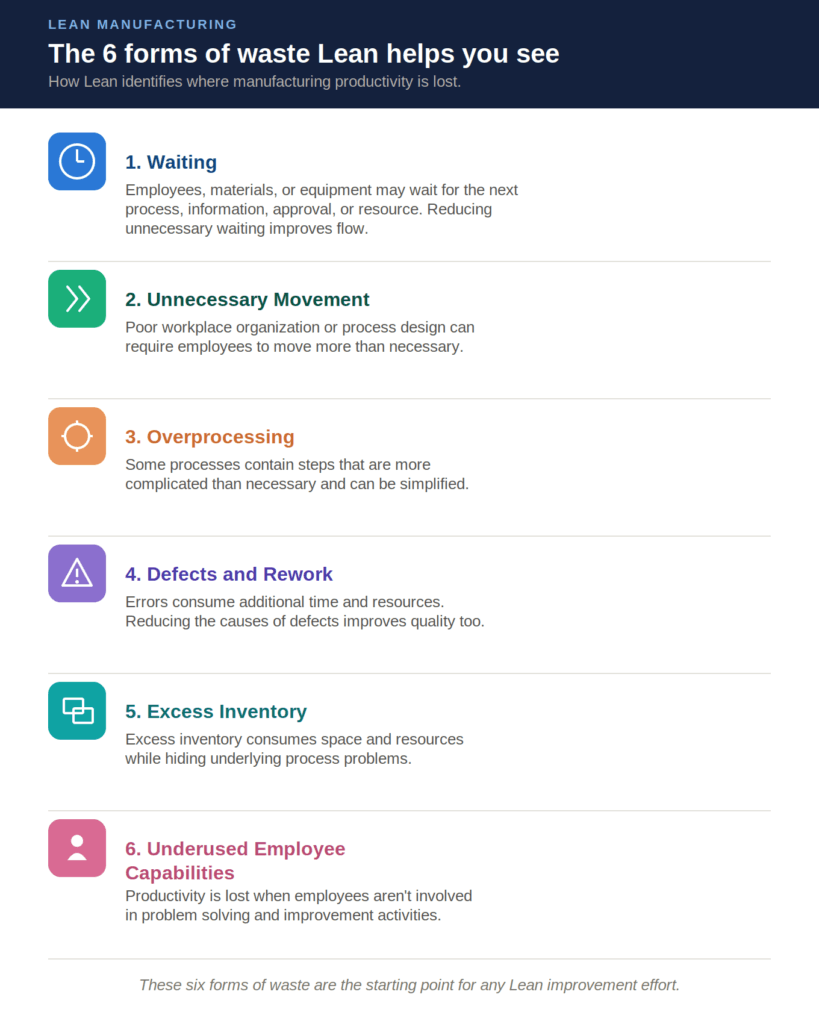
1. Reducing Process Waste
Waste represents effort or resource consumption that does not contribute sufficiently to the required outcome.
Lean encourages organizations to identify waste systematically.
Waiting
Employees, materials, or equipment may wait for the next process, information, approval, or resource.
Reducing unnecessary waiting improves flow.
Unnecessary Movement
Poor workplace organization or process design can require employees to move unnecessarily.
Better workplace and process design can reduce this movement.
Overprocessing
Some processes contain activities that are more complicated than necessary. Simplifying unnecessary steps can improve productivity.
Defects and Rework
Errors consume additional time and resources. Reducing the causes of defects can improve both productivity and quality.
Excess Inventory
Excess inventory can consume space and resources while hiding underlying process problems.
Underused Employee Capabilities
Organizations may lose productivity when employees are not involved in problem solving or improvement activities.
Lean addresses this by recognizing employee knowledge as an important improvement resource.
2. Improve Production Flow
Production flow describes how work moves through the manufacturing process.
Poor flow can create:
- Bottlenecks
- Waiting
- Work accumulation
- Unnecessary movement
- Production interruptions
- Uneven workloads
Lean encourages organizations to examine the complete process rather than optimizing individual workstations in isolation.
An individual workstation may operate efficiently while the overall production process remains inefficient.
The goal is to improve the movement of work through the entire system.
3. Use Value Stream Mapping (VSM)
Value Stream Mapping is one of the practical tools used in Lean manufacturing. It provides a visual representation of how materials and information move through a process.
A value stream analysis can help identify:
- Process steps
- Waiting
- Handoffs
- Information flow
- Bottlenecks
- Inventory
- Rework
- Improvement opportunities
The purpose is not simply to create a diagram.
The map should help teams understand the current state and determine how the process could perform more effectively.
For organizations developing manufacturing productivity improvement strategies in Saudi Arabia, Value Stream Mapping can provide a useful starting point for identifying process losses.
4. Standardize Work
Standardized work establishes a consistent method for performing important activities.
Without a clear standard, employees may perform the same activity differently. This can create variation in:
- Quality
- Cycle time
- Resource consumption
- Safety
- Output
Standardization provides a baseline from which improvement can take place.
A typical approach is:
- Understand the current process
- Identify the most effective known method
- Define the standard
- Train relevant employees
- Monitor execution
- Identify deviations
- Improve the standard when a better method is established
Standardized work should therefore be viewed as a foundation for continuous improvement, not as a restriction on improvement.
5. Apply 5S to Improve Workplace Efficiency
5S is a Lean approach focused on workplace organization and standardization. The traditional framework includes:
- Sort
- Set in Order
- Shine
- Standardize
- Sustain
A well-organized workplace can make abnormalities more visible and reduce unnecessary searching and movement.
However, 5S should not be treated simply as a housekeeping exercise.
Its greater value comes from creating a disciplined workplace where conditions are visible and deviations can be identified quickly.
6. Use Kaizen for Continuous Improvement
Kaizen refers to continuous improvement through incremental changes. It encourages employees to identify problems and participate in developing solutions.
This is particularly relevant to productivity because many operational problems are visible to employees performing the work every day.
Kaizen can help organizations:
- Identify recurring problems
- Reduce unnecessary activities
- Improve work methods
- Strengthen standards
- Encourage employee participation
- Build improvement capability
A strong Kaizen culture makes improvement part of everyday work rather than something that occurs only during formal projects.
7. Improve Quality Through Lean
Quality problems can reduce productivity because defective work often requires additional resources.
Those resources may include:
- Additional labor
- Materials
- Inspection
- Rework
- Processing time
- Management attention
Lean therefore treats quality as part of process performance.
Organizations can improve productivity by addressing the causes of defects rather than relying only on final inspection.
Root Cause Problem Solving
A structured approach can include:
- Define the problem
- Understand the current condition
- Collect relevant information
- Identify potential causes
- Validate the root cause
- Implement corrective action
- Measure the result
- Standardize the improvement
This helps prevent recurring problems from consuming resources.
8. Improve Workforce Productivity Through Lean
Lean manufacturing recognizes that employees are an important source of operational knowledge.
Operators often know where:
- Work gets delayed
- Materials are difficult to access
- Equipment causes recurring problems
- Instructions are unclear
- Processes require unnecessary effort
- Quality issues originate
Organizations can use this knowledge by involving employees in improvement activities.
Workforce productivity can improve when employees have:
- Clear standards
- Appropriate training
- Accessible information
- Effective tools
- Defined responsibilities
- Opportunities to contribute to improvement
Lean should therefore improve the system in which employees work rather than simply asking employees to produce more.
9. Connect Lean With Equipment Reliability
Equipment performance can directly influence manufacturing productivity.
Recurring equipment problems can create:
- Downtime
- Production interruptions
- Quality variation
- Maintenance workload
- Unplanned schedule changes
Lean improvement can be complemented by Total Productive Maintenance, or TPM.
TPM focuses on proactive equipment care and broader employee involvement in equipment performance.
Lean and TPM can therefore work together:
Lean improves process flow and reduces waste.
TPM supports equipment reliability and effectiveness.
Together, they can address different sources of manufacturing productivity loss.
10. Reduce Manufacturing Costs Through Lean
Lean can contribute to manufacturing cost reduction by reducing unnecessary resource consumption.
Potential areas include:
- Rework
- Waiting
- Excessive movement
- Unnecessary processing
- Material waste
- Excess inventory
- Equipment losses
- Inefficient workflows
The objective should not be to reduce costs regardless of operational consequences.
A sustainable approach considers the relationship between cost, productivity, quality, and customer value.
Reducing an activity that protects quality, for example, may create greater costs elsewhere.
Lean and Manufacturing Productivity in Saudi Arabia
Organizations seeking to improve manufacturing productivity in Saudi Arabia can use Lean principles as part of a broader Operational Excellence approach.
The specific application should depend on the organization’s current condition.
One organization may need to address production flow.
Another may have greater opportunities in quality.
Another may need to improve equipment reliability.
Another may have significant workforce or information flow challenges.
Lean provides a framework for identifying these problems rather than prescribing exactly the same solution to every organization.
How to Implement Lean Manufacturing for Productivity Improvement
Step 1: Define the Productivity Objective
Determine what needs to improve.
This could involve:
- Production flow
- Cycle time
- Quality
- Equipment effectiveness
- Workforce productivity
- Resource utilization
- Cost
Step 2: Understand the Current State
Observe the process and collect relevant information.
Avoid relying exclusively on assumptions or historical reports.
Step 3: Identify Waste
Determine where waiting, rework, unnecessary movement, overprocessing, defects, or other forms of waste occur.
Step 4: Identify Root Causes
Understand why the waste exists.
Removing symptoms without addressing causes can result in temporary improvements.
Step 5: Select Appropriate Lean Methods
Choose tools according to the problem.
For example:
- Value Stream Mapping for process flow
- 5S for workplace organization
- Kaizen for incremental improvement
- Standardized Work for process consistency
- TPM for equipment effectiveness
Step 6: Implement the Improvement
Define responsibilities, communicate changes, and involve employees.
Step 7: Measure the Outcome
Use appropriate indicators to determine whether productivity has improved.
Step 8: Standardize and Sustain
Successful improvements should become part of normal operating practice.
Measuring Lean Productivity Improvement
Measurement is important because organizations need evidence that an improvement has produced the intended result.
Possible indicators include:
- Production output
- Cycle time
- Rework
- Defects
- Downtime
- Equipment availability
- Changeover performance
- Resource utilization
- Productivity
Organizations should avoid measuring everything.
The most useful measures are those connected directly to the improvement objective.
Overall Equipment Effectiveness (OEE)
Overall Equipment Effectiveness can help organizations evaluate equipment effectiveness through availability, performance, and quality.
OEE can be useful when equipment performance is a significant productivity constraint.
However, it should not be treated as a complete measure of manufacturing productivity.
Productivity also depends on people, materials, process flow, quality, and other operational factors.
Common Lean Manufacturing Mistakes
Implementing Tools Without Understanding the Problem
Lean tools should be selected based on actual operational needs.
Treating 5S as Housekeeping
5S should support workplace organization, visibility, standardization, and discipline.
Ignoring Employee Input
Employees should participate in identifying problems and developing practical improvements.
Focusing Only on Short-Term Results
Lean is designed to create sustainable improvement capability.
Measuring Too Many Indicators
Excessive measurement can create reporting work without improving decision making.
Failing to Standardize Improvements
Without standards and follow up, improvements may not be sustained.
Lean Manufacturing and Continuous Improvement
Lean manufacturing is strongest when continuous improvement becomes part of everyday management.
A continuous improvement cycle can be structured around:
Identify → Analyze → Improve → Measure → Standardize → Repeat
This creates an operating environment in which problems become opportunities to improve processes.
Over time, the objective is to make improvement capability part of the organization’s normal way of working.
Conclusion
The role of Lean manufacturing in increasing productivity extends beyond reducing visible waste.
Lean provides a structured way to understand how work flows through a manufacturing system, identify sources of loss, improve process consistency, involve employees, and develop continuous improvement capability.
For organizations seeking to increase productivity in Saudi Arabia, Lean can complement quality improvement, TPM, workforce productivity initiatives, and appropriate technology adoption.
The most effective Lean programs begin with real operational problems rather than predetermined tools. By understanding the current state, addressing root causes, measuring results, and standardizing successful improvements, manufacturers can create stronger foundations for sustainable productivity improvement.
Frequently Asked Questions
How does Lean manufacturing increase productivity?
Lean manufacturing increases productivity by reducing waste, improving process flow, standardizing work, reducing rework, addressing root causes, and involving employees in continuous improvement.
What Lean tools can improve manufacturing productivity?
Common Lean methods include Value Stream Mapping, 5S, Kaizen, standardized work, visual management, and root cause problem solving. TPM can complement Lean when equipment reliability is a significant productivity issue.
How can Lean help increase productivity while reducing costs in KSA?
Lean can reduce unnecessary resource consumption by addressing waiting, rework, excessive movement, overprocessing, defects, and other forms of operational waste.
What is the role of employees in Lean manufacturing?
Employees are important participants in Lean because they often have direct knowledge of process problems. Involving them in problem identification and improvement can strengthen both productivity and continuous improvement capability.
How can manufacturers measure Lean productivity improvement?
Manufacturers can use relevant measures such as production output, cycle time, quality, rework, downtime, equipment performance, resource utilization, and productivity. The appropriate measures depend on the improvement objective.