In today’s competitive global marketplace, organizational performance depends heavily on workforce efficiency. Managing operational teams across evolving economic landscapes requires Egyptian business leaders to maximize output without increasing physical burnout, operational costs, or turnover. Simply urging employees to work faster rarely produces sustainable productivity gains. Instead, real workforce transformation demands systematic workflow design, structured standard operating routines, and the elimination of physical and process friction.
Partnering with specialized productivity consultants in Egypt allows enterprises to modernize their labor management practices. By combining data backed observation with proven continuous improvement frameworks, professional business productivity consultants in Egypt convert latent human potential into scalable operational performance.
The Complexities of Modern Workforce Management
Many enterprises experience a disconnect between workforce effort and operational throughput. Operational leaders frequently report that despite employees working long hours and incurring significant overtime costs, order fulfillment remains slow, lead times stay long, and error rates remain high.
This gap is rarely caused by a lack of employee dedication. In most operational environments, workforce potential is continuously eroded by systematic operational barriers:
- Unbalanced Workload Distribution: Unoptimized task allocation causes structural bottlenecks, leaving some workers overburdened while others experience idle waiting time.
- Ergonomic and Motion Inefficiencies: Poorly designed physical workstations, distant tool storage, and excessive material handling waste valuable time and increase worker fatigue.
- Execution Variation Across Shifts: Different shifts or teams perform identical tasks using varying methods, resulting in inconsistent cycle times and output quality.
- Excessive Firefighting: Supervisors spend their shifts resolving short term operational disruptions rather than coaching teams or enforcing standard routines.
How Consultants Drive Sustainable Workforce Optimization in Egypt
Achieving high performing workforce operations requires a structured shift from intuitive management to analytical optimization. Experienced corporate productivity consultants in Egypt deploy systematic tools that evaluate, redesign, and stabilize human work processes. 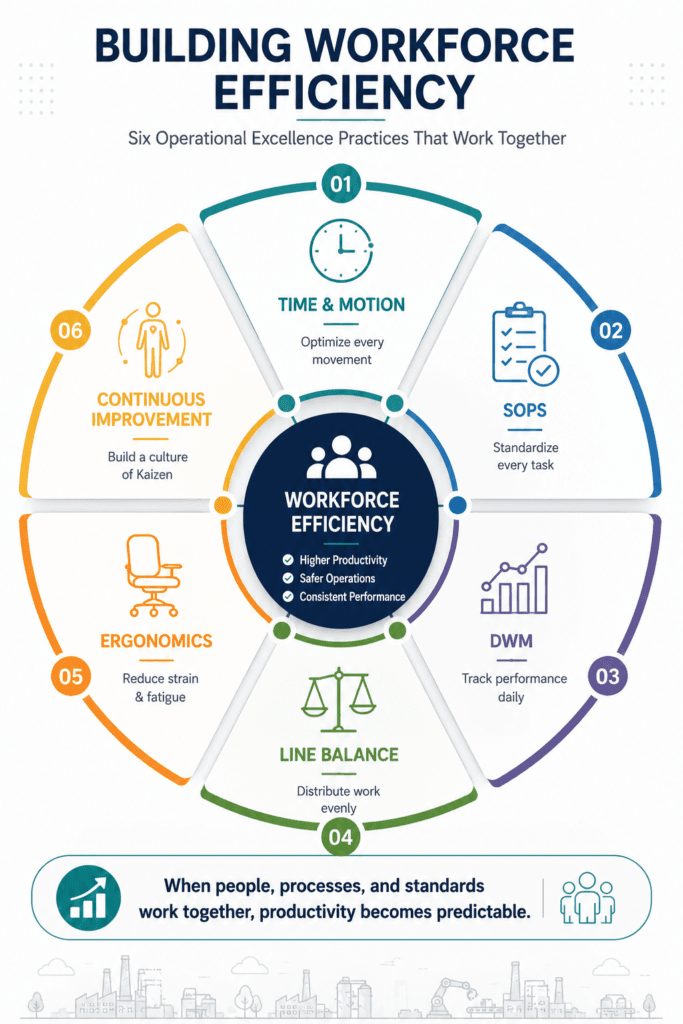
1. Workstation Ergonomics and Layout Redesign
In optimal operating environments, material and tools move to the human worker, not the other way around. Using motion economy principles, operational productivity consultants in Egypt observe floor activities directly at the point of execution, often referred to as the Gemba.
Redesigning workstation layouts minimizes unnecessary bending, lifting, reaching, and excessive walking. Streamlining the physical workspace lowers operator fatigue, enhances safety, and directly improves hourly production output.
2. Time and Motion Studies Grounded in Standardized Time
Standardized work is the foundational building block of Lean operations. Productivity improvement consultants in Egypt utilize formal Time and Motion studies based on International Labour Organization (ILO) standards to establish realistic, fair, and achievable baseline performance targets.
These studies expose hidden non value added steps, such as waiting for approval, searching for tools, or manually re entering data. Advanced analytics tools, such as specialized workforce performance solutions, capture shop floor data to provide real time insights into worker utilization and fatigue reduction. Eliminating these unnecessary tasks ensures that every working minute is dedicated to value creating activities.
3. Workload Balancing and Line Optimization
In multi step operational flows, overall output is governed by the speed of the slowest workstation. Operational experts conduct rigorous line balancing exercises to distribute work content evenly across all team members.
Synchronizing cycle times reduces work in progress inventory, prevents operational congestion, and ensures that all personnel contribute equally to target output.
Sustaining Performance Through Daily Work Management
Workforce transformation cannot rely solely on physical layout adjustments; it requires a permanent behavioral shift supported by robust operational governance. Leading business efficiency consulting services introduce structured Daily Work Management (DWM) frameworks to embed long term operational discipline.
Standard Operating Procedures and Visual Management
Standard Operating Procedures (SOPs) must be clear, visual, and accessible directly at the workstation. Integrating 6S standards (5S plus Safety) with visual operational boards, standardized work combination sheets, and clear cues helps operators execute tasks correctly every time. This drastically reduces onboarding time for new personnel and stabilizes output quality.
Active Supervisory Coaching
Under a structured DWM framework, the role of front line supervisors evolves from passive monitoring to active operational coaching. Consultants train supervisors to conduct regular hourly checks, track visual performance metrics, identify operational deviations immediately, and address short term problems using structured root cause analysis rather than temporary workarounds.
Key Operational Insight: Real workforce efficiency is not achieved by forcing employees to exert more physical effort; it is unlocked by removing systematic friction from their environment, standardizing successful workflows, and empowering teams with structured daily support.
Strategic Impact of Optimized Workforce Efficiency
Deploying comprehensive workplace productivity improvement strategies yields clear operational gains across key business parameters:
| Operational Focus Area | Consulting Mechanism | Business Outcome |
| Labor Output | Motion study & ergonomic workspace layout | Increased unit throughput per operator hour without extra shift hours. |
| Operational Costs | Line balancing & waste elimination | Substantial reduction in non essential overtime and shift costs. |
| Process Quality | Standardized Work & Visual SOPs | Drop in defect rates, lower rework time, and higher consistency. |
| Supervisory Effectiveness | Daily Work Management (DWM) implementation | Transition from reactive firefighting to continuous root cause problem solving. |
Partnering for Long Term Operational Growth in Egypt
Transforming workforce efficiency in Egypt is a comprehensive process that requires deep analytical expertise, proven continuous improvement frameworks, and strong change management capability. External productivity consultants act as force multipliers for enterprise leadership, providing the objectivity and hands on execution needed to build high performing, self-sustaining operational teams.
Frequently Asked Questions
How do productivity consultants help Egyptian businesses?
Productivity consultants analyze physical and administrative workflows, remove operational bottlenecks, conduct Time and Motion studies, and implement continuous improvement methodologies like Lean and Six Sigma. They help companies optimize workforce productivity, reduce waste, lower operating costs, and establish daily visual management systems.
Why should companies hire productivity consultants in Egypt?
External productivity consultants bring objective analysis, specialized methodologies, and implementation experience across diverse operating environments. They help organizations execute structural operational changes rapidly without pulling internal managers away from daily execution priorities.
What services do productivity consultants offer in Egypt?
Productivity consultants offer operational diagnostic audits, line balancing, workstation ergonomic redesign, Time and Motion studies, Daily Work Management implementation, Total Productive Maintenance (TPM), process layout optimization, and workforce capability building.
When do businesses need productivity consultants in Egypt?
Businesses should engage productivity consultants when encountering capacity bottlenecks, high overtime costs, inconsistent output quality across shifts, excessive lead times, low labor productivity, or when scaling operations requires structured execution models.
Contact us