In the manufacturing industry, cost reduction has become a strategic priority for manufacturers looking to improve competitiveness, increase efficiency, and strengthen operational performance. For factories in Egypt, controlling production costs requires more than reducing expenses; it requires identifying inefficiencies, improving processes, and making better use of available resources.
Lean Manufacturing provides a structured approach to achieving sustainable cost reduction by eliminating waste, improving workflow, and increasing operational efficiency. Instead of focusing on short-term cost-cutting measures, Lean methods help manufacturers create more reliable processes that support productivity improvement and long-term business growth.
This article explains how Lean principles and tools can help Egyptian manufacturers reduce operational costs while maintaining quality and production performance.
Key Takeaways
- Lean Manufacturing reduces costs by eliminating waste and improving process efficiency.
- Sustainable cost reduction focuses on improving how resources are used rather than simply reducing resources.
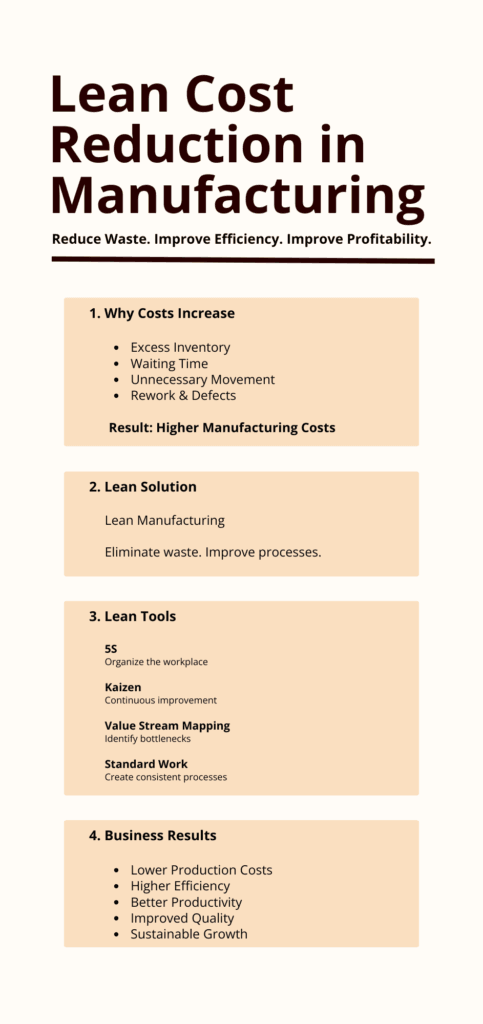
- Tools such as 5S, Kaizen, Value Stream Mapping (VSM), and Standard Work help identify manufacturing inefficiencies.
- Data-driven improvement approaches create more reliable and measurable cost optimization results.
Why Cost Reduction Is Critical for Manufacturing Companies
Manufacturing costs directly influence profitability, competitiveness, and the ability to respond to market changes. Every production process involves multiple cost drivers, including materials, labor, equipment utilization, energy consumption, inventory, and quality-related losses.
For many manufacturers in Egypt, rising costs are not always caused by a single major issue. Instead, costs often accumulate through repeated operational inefficiencies, such as unnecessary movement, production delays, excessive inventory, rework, or inconsistent processes.
For example, a factory may experience higher production costs because employees spend additional time searching for tools, machines frequently wait for materials, or defective products require additional processing. Each individual issue may appear small, but together they create significant operational losses.
This is why effective cost reduction strategies for the manufacturing industry focus on improving the overall production system rather than applying isolated cost-cutting actions.
Reducing costs should not mean compromising product quality, reducing necessary resources, or creating operational risks. The objective is to improve efficiency by identifying activities that consume resources without creating additional value.
How Lean Manufacturing Helps Reduce Costs
Lean Manufacturing is a systematic approach focused on maximizing customer value while minimizing waste. Originally developed from the Toyota Production System, Lean principles are now widely used across manufacturing industries to improve productivity, quality, and operational performance.
The foundation of Lean cost reduction is the identification and elimination of waste.
In manufacturing, waste refers to activities that consume time, materials, space, or effort without increasing customer value.
Common examples of waste include:
- Producing more than customer demand requires
- Waiting between production steps
- Moving materials unnecessarily
- Repeating work because of defects
- Maintaining excessive inventory
- Using inefficient processes
By identifying these sources of waste, manufacturers can improve process flow and reduce unnecessary operating costs.
The goal of Lean is not simply to produce less or spend less. Instead, it helps organizations create processes where resources are used more effectively.
Lean Manufacturing Cost Reduction Methods
5S: Improving Workplace Efficiency
One of the most commonly applied Lean manufacturing cost reduction methods is 5S workplace organization.
A disorganized production environment can create hidden costs. Employees may spend time searching for tools, materials may be difficult to locate, and work areas may not support efficient movement.
The 5S approach improves workplace organization through five principles:
- Sort: Removing unnecessary items from the workplace
- Set in Order: Organizing required tools and materials for easy access
- Shine: Maintaining clean and efficient work areas
- Standardize: Creating consistent workplace practices
- Sustain: Maintaining improvements through discipline and regular review
While 5S may appear simple, effective implementation can improve workplace visibility, reduce unnecessary movement, and create stronger process discipline.
For manufacturers, better organization supports operational efficiency by allowing employees to spend more time on value-adding activities.
Kaizen: Creating Continuous Improvement
Kaizen focuses on continuous improvement through small, ongoing changes.
Rather than waiting for large improvement projects, Kaizen encourages teams to identify problems and develop practical solutions as part of daily operations.
Manufacturing employees often have direct knowledge of process challenges because they work with equipment, materials, and production activities every day.
A Kaizen approach creates opportunities to improve areas such as:
- Production workflows
- Material handling
- Workplace organization
- Quality processes
- Equipment utilization
Over time, many small improvements can contribute to meaningful productivity improvement.
Kaizen also supports a stronger improvement culture because employees become active participants in identifying and solving operational challenges.
Value Stream Mapping: Identifying Hidden Cost Drivers
Value Stream Mapping (VSM) is a Lean tool used to analyze the complete flow of materials and information through a production process.
Many manufacturing inefficiencies are difficult to identify without understanding the entire process. A single production step may appear efficient, but delays before or after that step may create unnecessary costs.
VSM helps manufacturers identify:
- Waiting time
- Process bottlenecks
- Excess movement
- Delays between operations
- Non-value-added activities
By visualizing the current process and identifying improvement opportunities, manufacturers can make more informed decisions about where cost reduction efforts should focus.
This makes VSM an important tool of process optimization for reducing manufacturing costs.
Standard Work: Reducing Process Variation
Standard Work focuses on establishing consistent methods for performing manufacturing activities.
When employees perform the same task differently, production results can vary. This may affect quality, cycle time, productivity, and overall operational efficiency.
Standard Work helps manufacturers define:
- The most effective process sequence
- Expected operating methods
- Quality requirements
- Performance standards
Creating consistent processes makes it easier to identify problems and improve performance over time.
It also provides a foundation for continuous improvement because teams can measure improvements against a defined standard.
Step-by-Step Cost Reduction Approach in Manufacturing
Effective cost reduction strategies for manufacturing in Egypt should follow a structured approach rather than relying on temporary cost-cutting actions.
Step 1: Understand Current Cost Drivers
The first step in Lean Manufacturing is understanding where costs are being generated.
Manufacturers should analyze areas such as:
- Production processes
- Material usage
- Equipment performance
- Quality losses
- Inventory levels
- Process delays
Without understanding the causes behind high costs, improvement efforts may focus on the wrong areas.
Step 2: Identify Operational Waste
After understanding current performance, manufacturers can evaluate where waste exists.
Lean Manufacturing analysis helps identify activities that increase cost without improving customer value.. These opportunities may include:
- Reducing unnecessary movement
- Improving workflow
- Eliminating repeated work
- Improving production planning
Step 3: Prioritize Improvement Opportunities
Not every improvement opportunity has the same impact.
Manufacturers should prioritize initiatives based on:
- Potential cost impact
- Ease of implementation
- Operational importance
- Available resources
A structured approach helps organizations focus on improvements that create measurable value.
Step 4: Sustain Improvements Through Monitoring
Cost reduction is not a one-time activity. Manufacturers need ongoing measurement to ensure improvements continue delivering results.
Common performance indicators include:
- Production efficiency
- Cycle time
- Scrap levels
- Downtime
- Cost per unit
- Inventory performance
Continuous monitoring helps organizations maintain improvements and identify new opportunities.
Manufacturing Cost Reduction Consulting in Egypt: Creating Sustainable Improvements
Many manufacturers understand the need to reduce costs but struggle with identifying where improvement opportunities exist and how to implement changes effectively. This is where manufacturing cost reduction consulting in Egypt can provide value by bringing structured analysis, improvement methodologies, and operational expertise.
A successful cost reduction approach begins with understanding the current manufacturing system. Instead of focusing only on reducing expenses, consultants typically evaluate how processes operate, where resources are being lost, and which improvements can create sustainable benefits.
For manufacturing organizations, this approach helps shift cost reduction from a reactive activity into a continuous improvement strategy.
A structured improvement process may include:
- Reviewing current operational performance
- Identifying sources of waste and inefficiency
- Analyzing process flow
- Prioritizing improvement opportunities
- Supporting implementation of improvement actions
- Monitoring performance improvements
The objective is not simply to reduce costs temporarily but to improve the way resources are utilized across the manufacturing operation.
Why Sustainable Cost Reduction Requires Process Improvement
Unlike Lean Manufacturing, Unlike Lean Manufacturing, traditional cost-cutting approaches often focus on immediate reductions, such as reducing spending or limiting resources. While these actions may provide short-term benefits, they may not address the underlying causes of high manufacturing costs.
For example, reducing inventory without improving planning processes may create material shortages. Reducing labor without improving workflows may increase production delays. Cutting maintenance activities may increase equipment downtime.
Lean-based cost reduction takes a different approach.
It focuses on improving the system by asking questions such as:
- Why does this process require unnecessary time?
- Where does waste occur?
- Why do quality problems repeat?
- How can resources be used more effectively?
This approach supports industrial cost reduction solutions across Egypt by creating improvements that are connected to operational performance rather than isolated cost reductions.
Measuring the Success of Manufacturing Cost Reduction
Effective cost reduction requires measurement. Without clear performance indicators, organizations may struggle to determine whether improvement initiatives are creating real value.
Manufacturers can evaluate cost optimization efforts through operational and financial indicators.
Cost Per Unit
Cost per unit helps organizations understand whether production improvements are reducing the resources required to manufacture products.
Changes may result from:
- Reduced waste
- Improved productivity
- Better process flow
- Lower rework requirements
Productivity Performance
Productivity measures how effectively resources are converted into output.
Improved productivity may come from:
- Reduced waiting time
- Better workflow design
- Improved employee efficiency
- Reduced process interruptions
Quality-Related Costs
Quality problems create additional manufacturing expenses through:
- Rework
- Scrap
- Additional inspections
- Customer-related issues
Lean methods help reduce these costs by focusing on prevention and process improvement.
Downtime Reduction
Equipment and process interruptions can significantly affect manufacturing costs.
Improving workflow, maintenance practices, and problem-solving processes can help reduce unnecessary downtime and improve operational reliability.
Cost Reduction Strategies for Manufacturing in Egypt
Manufacturers in Egypt operate in diverse sectors, but many face similar challenges related to efficiency, resource utilization, and operational performance.
Effective cost reduction strategies for Manufacturing sectors of Egypt often focus on improving fundamental manufacturing practices, including:
Improving Process Flow
Better process flow reduces delays and unnecessary movement between production activities. Manufacturers can improve flow by analyzing:
- Production sequences
- Material movement
- Workplace layout
- Process dependencies
Reducing Manufacturing Waste
Waste reduction is one of the central principles of Lean Manufacturing. Reducing waste does not only lower direct costs; it also improves production stability. Common improvement areas for reducing waste include:
- Reducing unnecessary processing
- Improving material usage
- Preventing defects
- Reducing waiting periods
Improving Inventory Efficiency
Inventory represents both a resource and a cost. Excess inventory can increase:
- Storage requirements
- Handling activities
- Obsolescence risks
- Working capital requirements
Lean principles help manufacturers evaluate inventory needs and improve alignment between production requirements and available resources.
Strengthening Standardized Processes
Consistent processes help reduce variation and improve predictability.
Standardization supports:
- Better quality control
- Faster training
- Improved performance monitoring
- Easier identification of improvement opportunities
The Relationship Between Lean Cost Reduction and Business Growth
Cost reduction is often viewed only as a way to improve profitability. However, effective cost optimization also creates opportunities for business growth.
When manufacturers reduce unnecessary operational costs, they may improve their ability to:
- Invest in improvements
- Increase competitiveness
- Respond to market requirements
- Improve customer value
The purpose of Lean Manufacturing is not simply to make operations cheaper. It is to create more efficient and reliable systems that support long-term performance.
A factory that improves its processes can often achieve better results with the same resources.
Lean Methods vs Traditional Cost Cutting Approaches
Traditional cost reduction often focuses on reducing expenses after costs have already increased.
Lean cost reduction focuses on understanding why costs increase in the first place.
| Traditional Cost Cutting | Lean Cost Reduction |
| Focuses on reducing expenses | Focuses on eliminating waste |
| Often provides short-term results | Builds sustainable improvement |
| May affect resources directly | Improves resource utilization |
| Reacts to cost problems | Prevents operational inefficiencies |
This difference is important for manufacturers because long-term competitiveness depends on building efficient processes rather than repeatedly reducing resources.
Conclusion
Cost reduction in the manufacturing industry requires more than reducing expenses. Sustainable improvement comes from understanding operational challenges, eliminating waste, and improving how resources are used.
Lean Manufacturing provides manufacturers with practical methods to reduce unnecessary costs while improving productivity, quality, and operational efficiency. Through tools such as 5S, Kaizen, Value Stream Mapping, and Standard Work, organizations can identify inefficiencies and create stronger production systems.
For Egyptian manufacturers, adopting structured Lean Manufacturing cost reduction methods can support better cost control and improved competitiveness. The most effective cost reduction strategies are those that create long-term operational improvements rather than temporary savings.
By focusing on process optimization, waste reduction, and continuous improvement, manufacturers can build more efficient operations that support sustainable business growth.
Frequently Asked Questions (FAQs)
How does cost reduction in the manufacturing industry work in Egypt?
Cost reduction in the manufacturing industry works by identifying operational inefficiencies, reducing waste, improving resource utilization, and optimizing production processes. In Egypt, manufacturers can use Lean Manufacturing principles to analyze workflows and create structured improvement plans that reduce unnecessary costs while maintaining quality.
What are the best cost reduction strategies for manufacturing?
The best cost reduction strategies include reducing manufacturing waste, improving process efficiency, standardizing operations, optimizing inventory levels, improving productivity, and applying Lean tools such as 5S, Kaizen, and Value Stream Mapping.
How does Lean Manufacturing reduce production costs?
Lean Manufacturing reduces production costs by eliminating activities that do not add customer value. It helps manufacturers reduce waste, improve workflow, prevent defects, and use materials, labor, and equipment more efficiently.
What are Lean manufacturing cost reduction methods?
Lean manufacturing cost reduction methods include 5S workplace organization, Kaizen continuous improvement, Value Stream Mapping, Standard Work, waste reduction practices, and process optimization. These methods help manufacturers identify inefficiencies and improve operational performance.
Contact us