Cost reduction in the manufacturing industry has become a major priority for factories seeking to improve competitiveness, increase efficiency, and maintain sustainable growth. As manufacturers face increasing pressure to improve productivity while controlling operational expenses, automation has become an important approach for improving process performance and resource utilization.
For Egyptian manufacturers, automation can support cost optimization by improving production consistency, reducing manual inefficiencies, increasing process visibility, and enabling better decision-making. However, successful automation is not simply about introducing new technology, it requires understanding operational challenges and selecting solutions that address specific improvement opportunities.
This article explains how automation contributes to manufacturing cost reduction, the areas where it creates value, and how manufacturers can approach automation strategically.
Key Takeaways
- Automation can reduce manufacturing costs by improving efficiency, consistency, and resource utilization.
- The most effective automation strategies begin with understanding existing process challenges.
- Industry 4.0 technologies improve visibility and support better manufacturing decisions.
- Automation works best when combined with strong processes and continuous improvement practices.
Why Automation Has Become Important for Manufacturing Cost Reduction
Manufacturing operations depend on the effective coordination of people, processes, equipment, and information. When these elements are not aligned, factories may experience higher costs caused by inefficiencies such as production delays, inconsistent output, quality issues, and excessive manual effort.
Traditional cost reduction approaches often focus on reducing expenses directly. However, long-term cost optimization requires manufacturers to improve how resources are used.
Automation supports this objective by helping factories perform processes more efficiently, consistently, and reliably.
For example, repetitive manual activities may require significant labor time and can be affected by variation between operators. Automated systems can help standardize these activities, allowing employees to focus on higher-value tasks while improving process reliability.
The goal of automation is not simply to replace manual activities. Instead, effective automation helps manufacturers create stronger production systems where technology supports better performance.
This approach is particularly relevant for cost reduction in the manufacturing industry in Egypt, where manufacturers increasingly focus on improving operational efficiency and maintaining competitiveness.
How Automation Reduces Manufacturing Costs
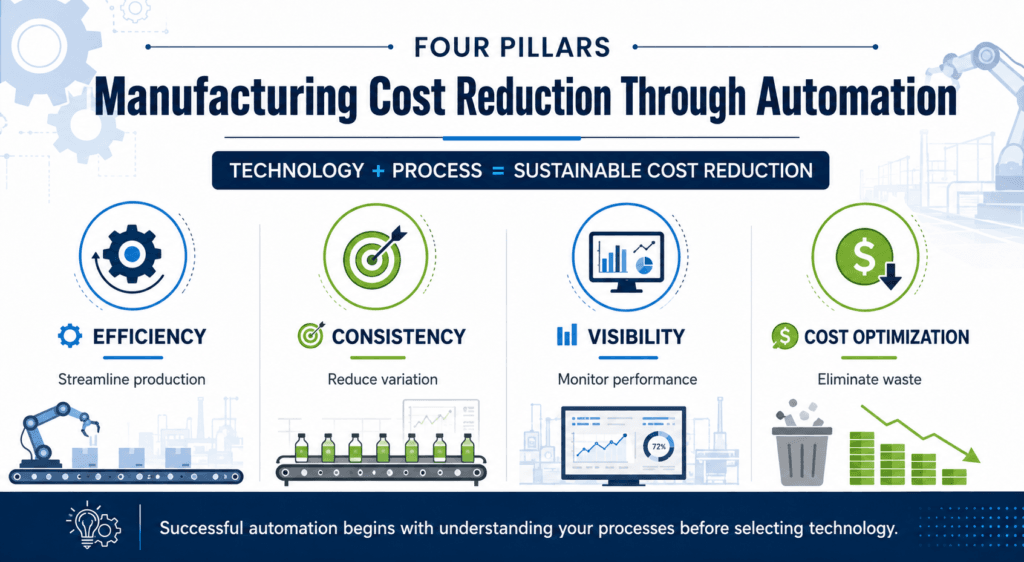
Automation can influence manufacturing costs in several ways. The greatest manufacturing cost reduction benefits usually come from improving process efficiency, reducing waste, and increasing operational visibility.
Improving Production Efficiency
One of the primary benefits of automation is improving the efficiency of manufacturing processes.
Manual production activities may involve delays caused by:
- Repetitive tasks
- Process interruptions
- Inconsistent working methods
- Limited production visibility
Automation can help reduce these inefficiencies by creating more predictable and controlled processes. Improved efficiency can contribute to:
- Higher productivity
- More consistent output
- Better utilization of production resources
- Reduced process delays
For manufacturers, improving efficiency does not necessarily mean increasing production speed alone. It means creating processes that use available resources more effectively.
Reducing Quality-Related Costs
Quality issues represent a significant barrier to manufacturing cost reduction. Defects, rework, scrap, and additional inspections consume resources without creating additional customer value.
Automation can support quality improvement by increasing process consistency and reducing variation. For example, automated processes can help manufacturers maintain more consistent operating conditions compared with processes that depend heavily on manual execution.
Reducing variation can help organizations:
- Improve product consistency
- Reduce rework requirements
- Lower material waste
- Improve production reliability
However, automation should be supported by proper process design. Automating an inefficient process may simply reproduce existing problems at a faster pace.
Improving Resource Utilization
Manufacturing cost reduction is influenced by how effectively factories use their resources.
Automation can help improve the utilization of:
- Equipment
- Materials
- Production time
- Employee capabilities
When repetitive or time-consuming activities are improved through automation, employees can dedicate more attention to activities requiring problem-solving, monitoring, and process improvement. This supports productivity improvement by allowing organizations to achieve better results from existing resources.
Increasing Manufacturing Visibility Through Data
Modern automation is increasingly connected with digital technologies that improve access to operational information.
Smart manufacturing approaches can provide manufacturers with better visibility into areas such as:
- Production performance
- Equipment status
- Process conditions
- Operational trends
Better data availability allows managers and production teams to make decisions based on actual performance information rather than assumptions. This supports manufacturing industry cost optimization in Egypt by helping organizations identify inefficiencies earlier and respond with more informed improvement actions.
Automation Technologies Supporting Manufacturing Cost Optimization
Automation can take different forms depending on the needs of each manufacturing environment. The right approach depends on factors such as production requirements, process complexity, and manufacturing cost reduction objectives.
Industrial Automation Systems
Industrial automation involves using technology to control or support manufacturing activities.
Examples may include:
- Automated production equipment
- Process control systems
- Automated material handling systems
- Production monitoring technologies
These systems can help improve consistency and reduce manual inefficiencies in suitable applications.
However, automation decisions should always be based on operational needs rather than technology adoption alone.
Digital Monitoring and Smart Manufacturing
Smart manufacturing combines automation with data collection and analysis. Through digital monitoring, manufacturers can gain better understanding of:
- Production performance
- Equipment utilization
- Process issues
- Improvement opportunities
This supports faster problem identification and enables organizations to make more effective operational decisions.
For manufacturers exploring manufacturing cost reduction solutions in Egypt, digital visibility can be an important factor in identifying where costs are generated and where improvements can be made.
Industry 4.0 and Manufacturing Cost Optimization
Industry 4.0 represents the integration of digital technologies, automation, connectivity, and data-driven decision-making within manufacturing.
While Industry 4.0 technologies provide new opportunities, successful implementation depends on having strong operational foundations.
Manufacturers should first understand:
- Current process performance
- Existing inefficiencies
- Improvement priorities
Technology creates the greatest manufacturing cost reduction value when it supports well-designed processes. This is why many organizations combine Lean principles with digital transformation. Lean helps identify and eliminate waste, while technology can improve visibility and control.
Choosing the Right Automation Approach for Cost Reduction
Automation for manufacturing cost reduction should not begin with selecting technology. It should begin with understanding the manufacturing challenge.
A structured approach helps manufacturers avoid investing in solutions that do not address their actual needs.
Assessing Processes Before Automation
Before implementing automation, manufacturers should evaluate:
- Current workflow
- Process performance
- Sources of inefficiency
- Improvement opportunities
A process with unnecessary steps or unclear responsibilities may require process improvement before automation.
This is where automation and Lean Manufacturing often complement each other.
Lean methods help optimize processes, while automation helps improve efficiency after processes are properly understood.
Identifying High-Impact Automation Opportunities
Not every manufacturing activity requires automation. The best opportunities are often processes where automation can create measurable improvement, such as:
- Highly repetitive activities
- Processes with frequent errors
- Tasks requiring consistent execution
- Activities involving significant manual effort
Manufacturers should evaluate automation opportunities based on expected manufacturing cost reduction benefits rather than simply adopting new technology.
Manufacturing Cost Reduction Consulting for Automation Decisions
Manufacturing cost reduction consulting in Egypt helps organizations identify where automation can create measurable value. By analyzing processes, identifying inefficiencies, and evaluating improvement opportunities, manufacturers can make automation decisions that align with business objectives and operational requirements.
A structured consulting approach focuses on:
- Current cost drivers
- Process performance
- Improvement opportunities
- Potential impact of automation
This helps ensure automation investments support operational goals and deliver sustainable improvements, rather than introducing technology without a clear business purpose.
Challenges Manufacturers Should Consider Before Automation
Although automation can provide significant manufacturing cost reduction benefits, manufacturers should consider several factors before implementation.
Initial Investment Considerations
Automation requires evaluation of expected value, operational requirements, and long-term benefits. The right solution depends on whether the improvement opportunity justifies the investment.
Process Readiness
Automation works best when processes are clearly defined and understood. Before introducing automation, organizations should establish:
- Standard processes
- Clear responsibilities
- Performance measurement methods
Employee Adaptation
Successful automation requires people to understand and work effectively with new systems. Employee involvement, training, and process understanding are all important parts of successful implementation.
How Automation Supports Long-Term Business Growth
Effective automation can contribute to manufacturing cost reduction and business growth by helping manufacturers become more efficient, consistent, and competitive.
By improving operational performance, automation can support:
- Better production reliability
- Improved customer responsiveness
- Stronger cost control
- More effective resource utilization
However, automation should be viewed as part of a broader improvement strategy rather than a standalone solution.
The strongest results usually come when technology supports clear processes, continuous improvement, and operational discipline.
Conclusion
Cost reduction in the manufacturing industry requires a strategic approach that focuses on improving efficiency, reducing waste, and optimizing resource utilization.
Automation provides manufacturers with opportunities to improve productivity, increase consistency, reduce process inefficiencies, and strengthen operational visibility. However, successful automation depends on understanding current processes and selecting technologies that address real business needs.
For Egyptian manufacturers, combining automation with structured improvement practices can support stronger manufacturing industry cost optimization strategies and create more efficient production systems.
The goal of automation is not simply to reduce costs; it is to build manufacturing operations that are more reliable, productive, and prepared for future growth.
Frequently Asked Questions (FAQs)
How does automation reduce manufacturing costs in Egypt?
Automation reduces manufacturing costs by improving productivity, reducing process variation, increasing consistency, and improving resource utilization. It helps manufacturers address inefficiencies while creating more reliable production processes.
What are the benefits of automation for Egyptian factories?
Automation can help Egyptian factories improve operational efficiency, reduce manual errors, increase production consistency, improve process visibility, and support better cost management.
Is automation better than Lean Manufacturing for cost reduction?
Automation and Lean Manufacturing address different improvement areas. Lean focuses on eliminating waste and improving processes, while automation uses technology to improve efficiency and consistency. Many manufacturers benefit from applying Lean principles before selecting automation opportunities.
What role does Industry 4.0 play in manufacturing cost optimization?
Industry 4.0 supports manufacturing cost optimization by improving data visibility, enabling better monitoring, and helping organizations make more informed operational decisions.
Should every manufacturing process be automated?
No. Automation should be evaluated based on operational requirements, expected benefits, and process suitability. The most effective approach is to automate areas where technology can create measurable improvement.
Contact us