Egypt’s industrial landscape is entering a transformative phase. Moving toward the objectives of Egypt Vision 2030, industrial leadership is shifting focus from traditional, manual production paradigms to tech-enabled, highly scalable operational frameworks. Building dynamic, resilient operations requires merging foundational operational discipline with modern digital systems.
The future of productivity improvement in manufacturing in Egypt lies at the intersection of Lean manufacturing, Total Productive Maintenance (TPM), and smart industrial technologies. Factory leaders who combine process discipline with real-time data will achieve long-term market leadership and sustained cost efficiency.
Strategic Drivers Shaping the Industrial Landscape in Egypt
Several structural shifts are accelerating the need for advanced operational practices across Egyptian manufacturing facilities:
- National Industrial Modernization Goals: Ongoing government programs are promoting deeper local manufacturing, higher-quality exports, and greater industrial value added.
- Global Supply Chain Realignment: Egypt’s strategic geographic location makes it an ideal hub for fast-turnaround regional supply chains, requiring shorter lead times and zero-defect quality standards.
- Volatile Operational Costs: Rising energy prices, shifting material costs, and global inflation require factories to maintain lean conversion costs to protect operating margins.
To capitalize on these shifts, executive teams must deploy a clear manufacturing performance improvement framework that balances short-term cost control with long-term digital growth.
Convergence of Lean Principles and Smart Factory Technologies
While advanced technologies offer new capabilities, automation cannot fix underlying process inefficiencies. Implementing digital tools on an unbalanced or wasteful line only automates existing waste.
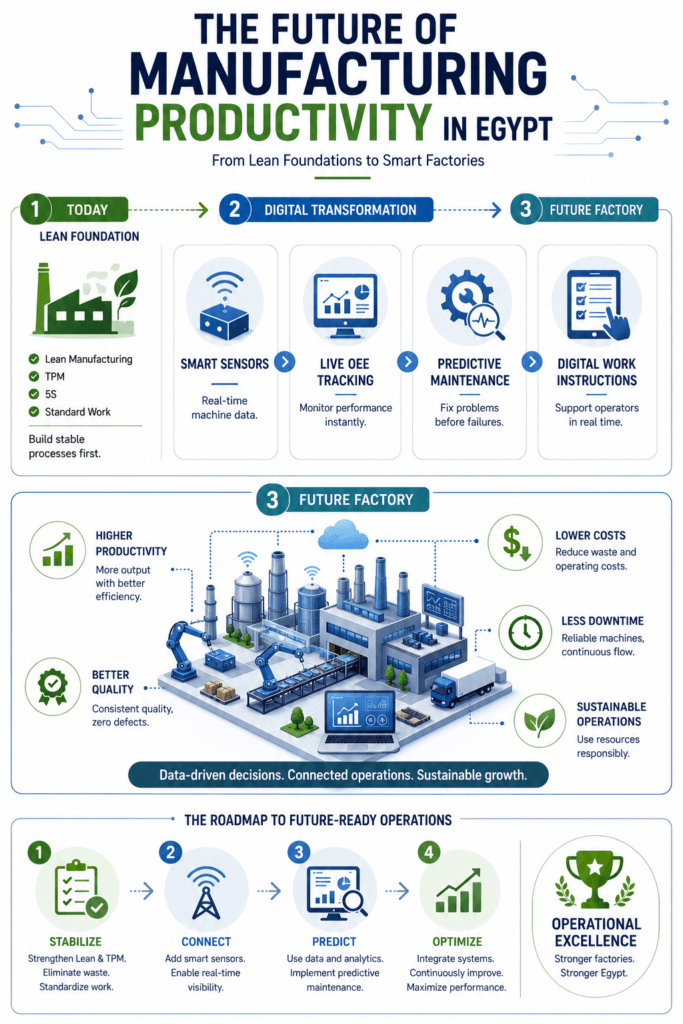
The future relies on a structured, phased approach where classic Lean and TPM foundations are enhanced by smart, data-driven systems.
1. Advanced Overall Equipment Effectiveness Tracking and Industrial Connectivity
Traditional OEE tracking relies on manual operator logsheets, often introducing delayed reporting and tracking inaccuracies. Modern factory productivity improvement strategies in Egypt integrate industrial smart sensors directly into production machinery.
Installing non-intrusive sensor networks directly onto factory equipment provides immediate operational visibility:
Real-time OEE tracking automatically records micro-stoppages, cycle time speed losses, and scrap counts without burdening line operators. This real-time data stream feeds directly into central dashboards, allowing shop-floor managers to respond to process deviations instantly.
2. Predictive Maintenance Replacing Reactive Repairs
Machinery maintenance is evolving from calendar-based schedules to predictive maintenance. By monitoring vibration patterns, thermal signatures, and electrical loads in real time, maintenance teams can identify potential component failures days or weeks before an actual breakdown occurs.
Transitioning to predictive maintenance yields major operational gains:
- Minimized Unplanned Downtime: Machine repairs are scheduled during planned changeovers or quiet shifts, preventing unexpected line stoppages.
- Extended Machinery Lifespan: Addressing minor mechanical frictions early prevents cascading component damage.
- Lower Spare Parts Inventory: Maintenance departments order specific parts as needed rather than holding excessive backup inventory.
3. Smart Workforce Support and Industrial Workforce Productivity Enhancement
Future productivity frameworks focus heavily on supporting human operators rather than replacing them. Achieving long-term industrial workforce productivity enhancement involves equipping operators with real-time digital tools:
- Digital Work Instructions: Standard Operating Procedures (SOPs) presented on visual touchscreens reduce training times and ensure consistent task execution across shifts.
- Digital Gemba Walks: Supervisors use mobile devices to log process deviations, tag safety risks, and trigger automated work orders during daily shop-floor audits.
- Automated Skill Matrices: Systems track worker certifications and skill levels, automatically assigning certified operators to complex equipment.
Sustainability and Green Manufacturing Practices
Future manufacturing productivity optimization strategies in Egypt must integrate resource efficiency into daily operations. Sustainable manufacturing focuses on systematically reducing resource consumption, energy usage, and material scrap alongside traditional time and cost metrics.
Key focus areas for green operational improvement include:
- Energy Value Stream Mapping: Mapping electricity, steam, and compressed air usage along the production line highlights energy losses during standby periods.
- Material Yield Optimization: Standardizing raw material preparation and processing steps lowers scrap rates and minimizes rework cycles.
- Circular Material Flows: Setting up dedicated recycling systems on the shop floor allows process offcuts to be reused directly in production.
Role of Productivity Improvement Consulting in Egypt’s Manufacturing Sector
Adopting advanced operational practices requires structured methodology, change management experience, and execution capabilities. Partnering with specialized productivity improvement consulting manufacturing professionals helps plant leadership in Egypt navigate complex transformations effectively.
Specialized advisory teams provide essential execution support:
- Digital Readiness Diagnostics: Evaluating current shop-floor processes to identify high-return areas for digital tool integration.
- Process Stabilization Guidance: Stabilizing manual workflows, line layouts, and standard operating procedures (SOPs) before introducing digital automation.
- Change Management Coaching: Training plant management, supervisors, and operators to embrace data-driven daily routines.
- Sustenance Frameworks: Establishing long-term auditing systems to ensure process improvements remain permanent.
Roadmap for Future-Proofing Factory Operations in Egypt
For plant directors planning long-term manufacturing efficiency improvement initiatives in Egypt, the following strategic roadmap establishes a reliable path forward.
Phase 1: Foundational Stabilization and Lean Implementation
Ensure core Lean and TPM discipline is active across the shop floor. Standardize manual work procedures, establish 5S workplace organization, and institute structured daily management reviews to eliminate baseline waste.
Phase 2: Pilot Digital Connectivity and Real-Time Tracking
Deploy smart sensors and digital tracking tools on critical bottleneck machinery. Replace manual downtime logs with automated OEE tracking dashboards to capture clear, accurate operational data.
Phase 3: Advanced Analytics and Predictive Execution
Scale connectivity across all primary manufacturing lines. Implement predictive maintenance protocols, integrate digital SOPs for line operators, and connect real-time shop-floor data into plant-wide Enterprise Resource Planning (ERP) and Manufacturing Execution System (MES) systems.
Frequently Asked Questions
What drives productivity improvement in manufacturing in Egypt?
Future productivity growth is driven by combining structured Lean frameworks with modern digital technologies like smart sensors, real-time OEE tracking, predictive maintenance, and standardized operator work instructions. Combining process discipline with real-time data ensures continuous operational gains.
How can productivity improvement in manufacturing help Egypt?
Improving factory productivity helps manufacturing plants increase production throughput, lower conversion costs, and achieve zero-defect product quality. This allows regional facilities to maximize local asset utilization, meet international export standards, and build resilient industrial supply chains.
Why is productivity improvement in manufacturing important in Egypt?
Productivity improvement is critical for protecting profit margins against changing input costs, avoiding unnecessary capital expenditures, and unlocking hidden factory capacity. It provides the operational stability required to support broader national industrial expansion goals.
When should factories focus on productivity improvement in Egypt?
Factories should begin productivity improvement initiatives immediately. Addressing operational bottlenecks, equipment downtime, or material waste early prepares production lines for seamless tech integration and long-term market competitiveness.
Contact us