Organizations operating in Riyadh’s industrial hubs are continually looking for ways to improve operational consistency, strengthen team coordination, and support sustainable performance. While long-term strategies set the direction, success depends on how effectively work is managed every day. Daily Work Management provides a structured framework for aligning teams, tracking performance, resolving operational issues, and driving continuous improvement through disciplined daily routines. By implementing Daily Work Management effectively, organizations in Riyadh’s industrial hubs can strengthen Operational Excellence while supporting broader business objectives across Saudi Arabia.
Key Takeaways
- Daily Work Management creates structured routines that improve operational consistency and accountability.
- Successful implementation begins with standardized processes, leadership commitment, and employee engagement.
- Visual management and daily performance reviews improve communication and decision making.
- A phased implementation approach helps organizations embed continuous improvement into everyday operations.
- Daily Work Management supports Operational Excellence by connecting strategy with daily execution.
Why Daily Work Management Matters
Industrial organizations often invest significant effort in improving business processes, strengthening operations, and developing long-term strategies. However, these initiatives deliver lasting value only when they are supported by disciplined daily execution.
Organizations within Riyadh’s industrial hubs operate in environments where coordination, operational visibility, and timely decision making are essential to maintaining consistent performance. Without structured management routines, communication gaps, delayed issue resolution, and inconsistent priorities can reduce operational effectiveness.
Daily Work Management helps organizations in Saudi Arabia establish a management system that supports consistent execution while reinforcing broader Operational Excellence strategies across KSA.
The Foundation of Daily Work Management
Daily Work Management is a structured management approach that helps leaders and teams review operational performance, align priorities, identify issues early, and coordinate improvement activities through standardized routines.
Rather than functioning as an isolated improvement initiative, Daily Work Management becomes part of everyday operations by creating clear expectations for communication, accountability, and follow through.
For organizations in Riyadh’s industrial hubs, this structured approach creates greater operational stability while supporting continuous improvement across business functions.
Core Elements of Successful Implementation
Standardized Daily Routines
Consistency is the cornerstone of effective Daily Work Management.
Organizations should establish structured daily routines for reviewing priorities, monitoring operational performance, discussing challenges, and assigning improvement actions.
Implementing standardized DWM Operations in Saudi ensures that management practices remain consistent across teams and departments.
Visual Management
Visual management provides teams with immediate access to operational information.
Performance boards, dashboards, and standardized reporting enable leaders to review priorities, monitor progress, and identify issues quickly during daily discussions.
Clear visibility supports faster decision making while improving communication across the organization.
Daily Performance Reviews
Daily performance reviews should focus on operational priorities rather than lengthy status updates.
Effective reviews examine key performance indicators (KPIs), discuss operational deviations, evaluate ongoing improvement activities, and assign responsibility for follow up actions.
Regular performance discussions also strengthen accountability throughout the organization.
Structured Issue Escalation
Not every operational issue can be resolved during a daily meeting.
A clearly defined escalation process ensures that unresolved challenges are communicated to the appropriate decision makers while maintaining ownership and accountability.
Continuous Improvement
Daily Work Management should encourage teams to identify improvement opportunities every day.
Embedding continuous improvement into routine management activities enables organizations to strengthen operational performance while building a culture of ongoing learning and refinement.
A Practical Roadmap for Implementation
Assess Existing Management Practices
Review current meeting structures, communication methods, performance reporting, and decision-making processes to understand how work is currently managed.
This assessment provides the foundation for developing an implementation plan that reflects the organization’s operational needs.
Define Clear Objectives
Organizations should establish measurable objectives before introducing Daily Work Management.
These objectives may include improving communication, increasing operational visibility, strengthening accountability, supporting faster decision making, or improving process consistency.
Develop Standard Management Routines
Create consistent daily management practices that define meeting structures, reporting expectations, review processes, and follow up responsibilities.
Standardization helps ensure that Daily Work Management becomes an integral part of everyday operations.
Introduce Visual Performance Management
Visual management should provide clear information about operational priorities, improvement activities, performance trends, and unresolved issues.
Accessible information enables teams to identify problems quickly and respond more effectively.
Build Leadership Capability
Leaders play an essential role in maintaining the discipline required for successful Daily Work Management.
Training should focus on effective communication, meeting facilitation, coaching, performance reviews, and structured problem solving.
Review and Improve
Implementation should be treated as an evolving management system rather than a completed project.
Organizations should regularly evaluate Daily Work Management practices, gather employee feedback, and refine management routines to support changing operational priorities.
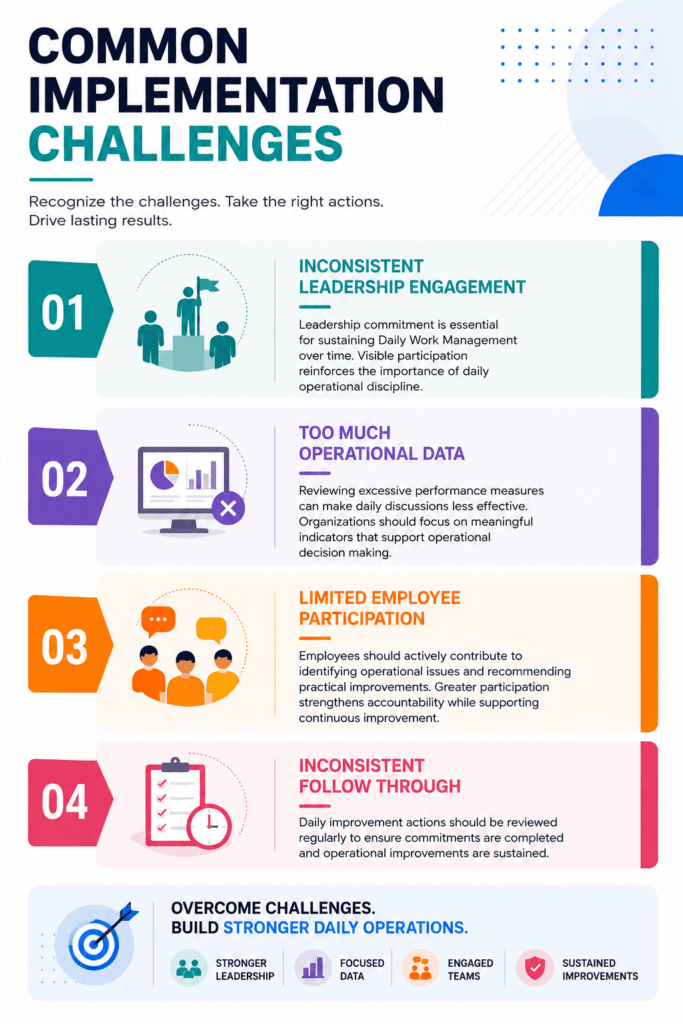
Common Implementation Challenges
Inconsistent Leadership Engagement
Leadership commitment is essential for sustaining Daily Work Management over time.
Visible participation reinforces the importance of daily operational discipline.
Too Much Operational Data
Reviewing excessive performance measures can make daily discussions less effective.
Organizations should focus on meaningful indicators that support operational decision making.
Limited Employee Participation
Employees should actively contribute to identifying operational issues and recommending practical improvements.
Greater participation strengthens accountability while supporting continuous improvement.
Inconsistent Follow Through
Daily improvement actions should be reviewed regularly to ensure commitments are completed and operational improvements are sustained.
Best Practices for Organizations in Riyadh’s Industrial Hubs
Keep Daily Reviews Structured
Maintain concise meetings focused on priorities, operational performance, and improvement actions.
Standardize Management Practices
Consistent routines improve communication, accountability, and operational discipline across teams.
Encourage Cross Functional Collaboration
Daily Work Management becomes more effective when departments work together to solve operational challenges.
Focus on Continuous Improvement
Small, consistent improvements often create more sustainable results than infrequent large-scale initiatives.
Align Daily Activities with Business Objectives
Daily management should reinforce broader organizational priorities and support long-term Operational Excellence.
This practical approach reflects the principles of Lean Daily Management and Lean Daily Work, helping organizations improve execution while maintaining flexibility as business needs evolve.
Conclusion
Implementing Daily Work Management within Riyadh’s industrial hubs requires more than introducing daily meetings or performance boards. It involves creating a structured management system that connects daily execution with strategic objectives through standardized routines, leadership engagement, and continuous improvement.
For organizations operating in Riyadh and across Saudi Arabia, Daily Work Management provides a practical framework for improving operational visibility, strengthening accountability, and building a culture of Operational Excellence. By implementing structured daily management practices and continually refining them over time, organizations can create more resilient operations that are better equipped to support long term business success.
Frequently Asked Questions
How do you implement Daily Work Management in Saudi factories?
Successful implementation begins with standardized daily routines, visual management, performance reviews, leadership engagement, and continuous improvement. Organizations should also establish clear responsibilities and regularly review operational performance.
Why are Riyadh’s industrial hubs adopting Daily Work Management?
Organizations in Riyadh’s industrial hubs are strengthening Operational Excellence by improving communication, increasing accountability, and embedding continuous improvement into daily operations through structured management practices.
What are the core components of Daily Work Management?
Daily Work Management includes standardized routines, visual management, daily performance reviews, structured issue escalation, leadership engagement, and continuous improvement.
How does Lean Daily Management improve operational performance?
Lean Daily Management strengthens operational performance by improving communication, reducing inefficiencies, standardizing management practices, and enabling faster problem solving.
Why is Daily Work Management important for Operational Excellence in Saudi Arabia?
Daily Work Management helps organizations improve execution, strengthen collaboration, enhance operational visibility, and support continuous improvement, making it an important element of Operational Excellence initiatives across Saudi Arabia.