
Digital transformation gives Saudi organizations unprecedented ways to collect information, monitor processes, automate activities, and improve decision making. However, technology alone does not guarantee better operational performance.
Lean Six Sigma provides a structured approach for understanding processes, identifying waste, reducing variation, and solving root causes. When these two methodologies are integrated carefully, organizations can create a formidable foundation for long-term Operational Excellence.
While Lean Six Sigma initiatives often focus purely on traditional methods, pairing them with digital capabilities ensures that Saudi Arabian organizations identify what should be improved before using technology to monitor, manage, and optimize those processes.
Key Takeaways
- Lean Six Sigma and digital transformation address different, highly complementary aspects of modern operational improvement.
- Applying structured process improvement techniques helps organizations identify which workflows require optimization before introducing costly technology.
- The DMAIC framework provides a robust structure for combining human-led process optimization with data-driven digital capabilities.
- Industry 4.0 technologies dramatically strengthen Lean Six Sigma manufacturing efforts in KSA through advanced visibility, real-time data collection, analytics, and intelligent automation.
- Digital transformation must support a clearly defined business challenge rather than serve as an empty objective itself.
Why Integrate Lean Six Sigma With Digital Transformation?
Digital transformation alters how organizations collect, process, share, and utilize operational information. Modern technologies support automated data collection, process monitoring, analytics, workflow automation, connected systems, digital performance dashboards, predictive analysis, and executive decision support.
However, technology does not automatically eliminate underlying waste. Consider a manual process containing multiple unnecessary approvals. Digitizing those approvals may reduce physical paperwork, but the redundant steps still exist.
This is precisely where Lean Six Sigma becomes indispensable:
- Lean Six Sigma asks: Does this process need to work this way in the first place?
- Digital transformation asks: How can technology make this newly improved process more effective and scalable?
This logical sequence creates a practical roadmap for successful Lean Six Sigma consulting strategies in KSA.
What Is Lean Six Sigma?
Lean Six Sigma combines two powerful, complementary improvement philosophies to target multiple operational friction points simultaneously:
- Lean focuses on: Waste elimination, flow maximization, value creation, process efficiency, and continuous improvement.
- Six Sigma focuses on: Variation reduction, defect minimization, data analysis, process consistency, and root cause analysis.
Together, they establish a disciplined methodology driven by the DMAIC cycle (Define, Measure, Analyze, Improve, Control). This cycle also acts as an ideal framework for guiding digital integration.
How Lean Six Sigma and Digital Transformation Complement Each Other
The relationship can be summarized simply: Lean Six Sigma improves the process, while digital transformation strengthens the improved process.
For instance, an organization might discover that employees spend substantial time manually gathering redundant information from separate locations. A targeted project can first determine why the information is collected, which data fields are mandatory, where duplication occurs, and where errors enter the system. Only then can the organization evaluate whether digital tools can eliminate manual labor.
Leveraging DMAIC as a Digital Framework
- Define: Establish the real business problem; such as long lead times or poor visibility; instead of prematurely declaring a need to “implement new software.”
- Measure: Understand current performance by tracking cycle times and error frequencies to establish a baseline.
- Analyze: Investigate true root causes using Six Sigma techniques in KSA to distinguish between superficial symptoms and systemic flaws.
- Improve: Redesign, simplify, and standardize workflows before applying automation.
- Control: Sustain gains using digital tools like automated monitoring, alerts, and performance dashboards.
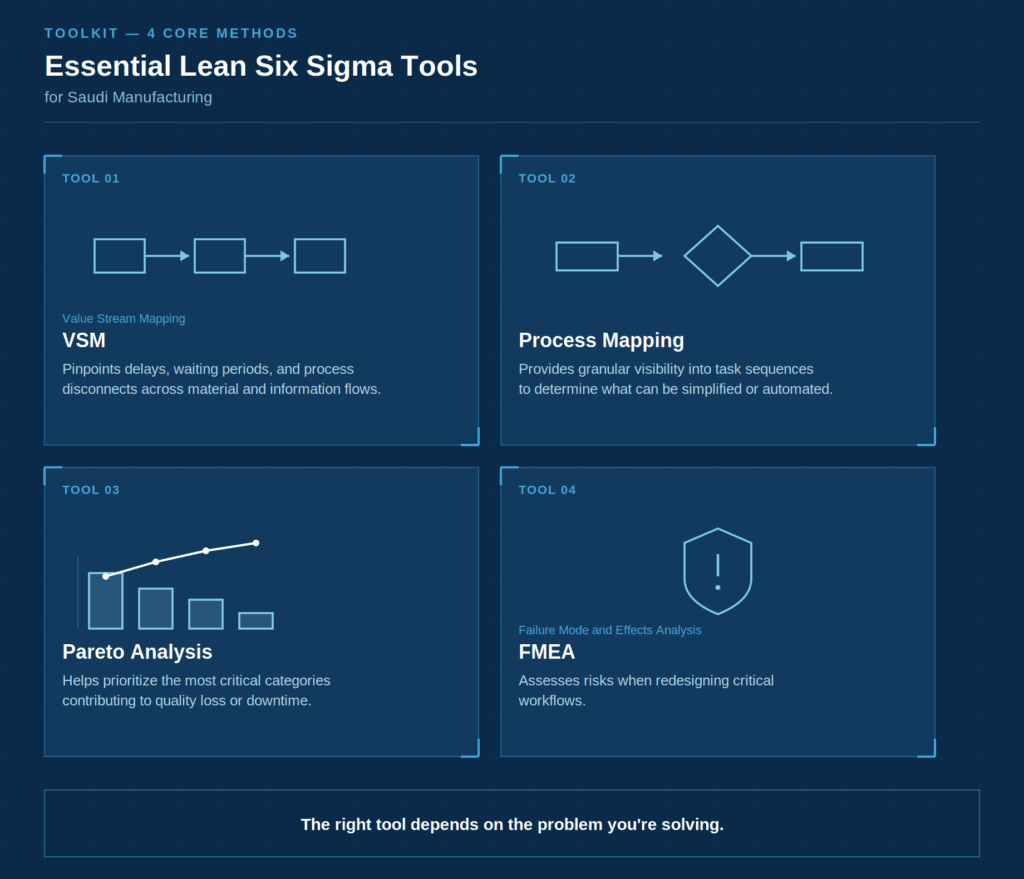
Essential Lean Six Sigma Tools for Saudi Manufacturing
Organizations can leverage specific Lean Six Sigma tools in Saudi Arabia which facilities can trust to drive digital success:
- Value Stream Mapping (VSM): Pinpoints delays, waiting periods, and process disconnects across material and information flows.
- Process Mapping: Provides granular visibility into task sequences to determine what can be simplified or automated.
- Pareto Analysis: Helps prioritize the most critical categories contributing to quality loss or downtime.
- Failure Mode and Effects Analysis (FMEA): Assesses risks when redesigning critical workflows.
Common Pitfalls: Avoiding Digital Mistakes
- Automating Waste: Speeding up an inefficient process via automation only makes the waste more efficient. Always streamline first.
- Collecting Data Without Decisions: Accumulating massive data lakes without clear action triggers creates digital noise rather than insight.
- Ignoring Standardization: If different employees perform the same steps differently, digitizing the process simply standardizes inconsistency. Establish reliable standardized work baselines first.
The Role of External Expertise: Working with a Lean Six Sigma Consultant
Many organizations choose to partner with an experienced Lean Six Sigma consultant or specialized advisory firm to jump-start their transformations.
When evaluating Lean Six Sigma consulting services for KSA, business leaders should look for partners who emphasize practical implementation, workforce capability-building, and measurable cost savings rather than abstract methodology labels. A qualified Lean Six Sigma consulting partner ensures that internal teams develop the skills required to sustain continuous improvement independently over the long term.
Important Note: Achieving sustainable Lean Six Sigma impact on Operational Excellence in Saudi firms requires a balance of executive sponsorship, shop-floor engagement, and precise metric tracking.
Frequently Asked Questions
What is Lean Six Sigma and how it helps Saudi companies?
It is a structured methodology combining waste reduction (Lean) and variation minimization (Six Sigma) to help Saudi companies improve quality, cut costs, boost productivity, and streamline manufacturing operations.
How to Choose the Right Consultant in KSA?
Look for consultants with proven problem-solving methodologies, strong digital integration capabilities, a focus on measurable quality management, and a commitment to transferring knowledge to your internal workforce.
How does DMAIC improve operational performance in KSA firms?
DMAIC provides a disciplined, data-driven roadmap that prevents companies from jumping straight to technological fixes without properly understanding and fixing underlying process bottlenecks.
What Are the Benefits of Consulting in KSA?
Key benefits include enhanced process visibility, stronger problem-solving skills, reduced waste, improved product consistency, and a robust foundation for Industry 4.0 adoption across Saudi firms.
How Does DMAIC Drive Digital Integration?
DMAIC provides a disciplined, data-driven roadmap that prevents Saudi companies from jumping straight to technological fixes without properly understanding and fixing underlying process bottlenecks.