Egypt’s premier industrial and corporate organizations are navigating a highly dynamic economic era. Forward-thinking executives from major manufacturing hubs, logistics networks, and service sectors recognize that traditional, reactive cost-cutting measures no longer protect the bottom line. Instead, market leaders are looking inward, leveraging advanced Operational Excellence frameworks to achieve sustainable scalability.
By studying the top-performing enterprises across the region, clear operational success patterns emerge. These industry pioneers do not simply cut budgets; they systematically redesign workflows to eliminate waste (Muda), optimize labor capacity, and maximize asset utilization. This article examines the exact operational cost reduction methods used by Egypt leaders to insulate their profit margins from external input volatility and establish a lasting competitive advantage.
The Strategic Blueprint: How Market Leaders Approach Cost Control
Market leaders view cost management as an ongoing continuous improvement discipline rather than a one-time accounting task. When faced with rising raw material prices or adjusting energy tariffs, their immediate response is to improve their process conversion efficiency.
By analyzing the end-to-end value stream, leaders ensure that every pound spent on utilities, labor, or raw materials directly contributes to customer value. Standard operational benchmarks show that companies that transition from reactive budgeting to structured business process cost optimization regularly unlock 15% to 30% in capacity gains.
Core Operational Cost Reduction Methods Used by Egypt Leaders
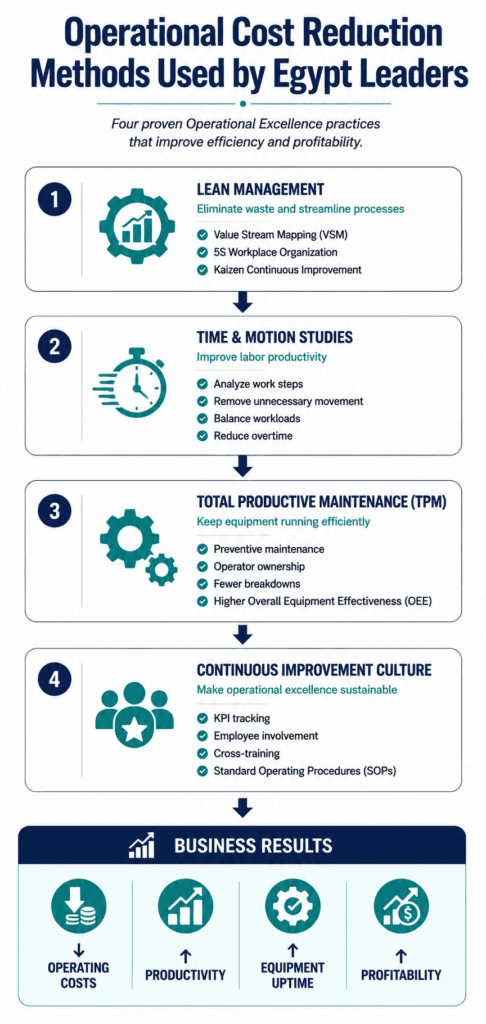
1. Embracing Data-Driven Lean Operational Cost Management
The most successful organizations in Egypt prioritize the absolute elimination of waste across all processes. Rather than managing by boardroom assumptions, operational leaders go straight to the shop floor (Gemba) to observe where time, material, and energy are actively leaking.
Key Lean tools utilized by market leaders include:
- Value Stream Mapping (VSM): Visually mapping material and information flows to expose hidden delays, excessive inventory build-ups, and operational bottlenecks. Leaders look at the exact ratio between value-added time and non-value-added time to re-engineer production lines.
- 5S Workplace Organization: Standardizing workstations to reduce time wasted searching for tools or components, directly increasing hourly output. This creates a highly visual workplace where abnormalities are caught instantly before they cause systemic delays.
- Kaizen Frameworks: Engaging the frontline workforce to implement continuous, incremental changes that collectively lower production cycle times.
2. Standardizing Labor Workflows via Time and Motion Studies
In manual and semi-automated production lines, labor inefficiencies directly inflate the total cost per finished unit. Top-tier enterprises partner with operational cost reduction experts in Egypt to conduct scientific Time and Motion Studies.
By measuring the exact duration of human tasks and breaking them down into individual movements, leaders eliminate non-value-added steps. Standardizing physical work methods, balancing production lines, and optimizing workstation ergonomics allow organizations to eliminate unnecessary overtime premiums while keeping their existing workforce capacity fully intact.
3. Transitioning to Total Productive Maintenance (TPM)
Waiting for a critical manufacturing asset to suffer a catastrophic breakdown is one of the most expensive errors an organization can make. Leading corporate entities mitigate this by deploying Total Productive Maintenance (TPM) frameworks.
TPM involves floor operators directly in routine, daily equipment upkeep; such as basic cleaning, lubrication, and loose-bolt inspections. This concept of autonomous maintenance shifts the operational culture from reactive firefighting to proactive ownership. When paired with structured preventive and predictive maintenance schedules, companies experience a dramatic surge in Overall Equipment Effectiveness (OEE), maximizing the financial returns on their existing machinery.
Building a Culture of Sustainable Continuous Improvement
A critical methodology shared by Egypt’s top industrial leaders is the institutionalization of an Operational Excellence mindset across all organizational tiers. Isolated technical updates fail if the cultural infrastructure does not support them. Leaders bypass this risk by establishing clear operational Key Performance Indicators (KPIs) that connect everyday shop-floor activities directly to macro-level financial statements.
By prioritizing worker cross-training and creating robust reward systems for successful Kaizen ideas, these companies ensure that waste elimination becomes an active, daily habit rather than a top-down mandate. This cultural alignment ensures that long-term enterprise operational cost control remains self-sustaining, protecting the organization from decaying back into legacy operational behaviors.
The Operational Transformation Matrix: Leader Frameworks vs. Legacy Approaches
| Operational Area | Legacy Industry Approach | Market Leader Methodology | Strategic ROI |
| Problem Solving | Reactive firefighting | Root-cause data analysis | Permanent waste elimination |
| Asset Upkeep | Run-to-failure maintenance | Total Productive Maintenance (TPM) | Maximized equipment OEE |
| Labor Management | Overtime allocation | Time and Motion Studies | Optimized labor cost-per-unit |
| Material Flow | High batch inventories | Lean pull systems and low WIP | Accelerated cash flow cycles |
How Operational Cost Reduction Improves Profit in Egypt
The answer lies in structural operational performance gains that convert directly into bottom-line profit margins.
- Minimized Scrap Rates: Reducing material waste ensures more finished, shippable products are produced from the exact same volume of raw materials.
- Reduced Equipment Downtime: Higher asset availability prevents expensive production backlogs, emergency repair costs, and rushed shipping premiums.
- Optimized Workflows: Eliminating unnecessary material transport and operator waiting times allows businesses to expand their daily output capacity without increasing their operational footprints.
Sustaining the Transformation Through Specialized Advisory
Uncovering deeply embedded process waste requires specialized diagnostic tools, objective analysis, and structured execution. Because internal operations managers are frequently fully occupied with day-to-day production requirements, market leaders often engage external expertise to accelerate their results.
Partnering with an established operational cost reduction consulting firm in Egypt introduces the external objectivity and proven toolsets required to execute sustainable changes. A dedicated transformation partner works directly on the shop floor alongside your teams, ensuring that optimized processes are fully institutionalized through visual Standard Operating Procedures (SOPs) to prevent any drift back into legacy habits.
Conclusion
Adopting business operational cost reduction methods used by market leaders in Egypt is a proven blueprint for driving long-term corporate competitiveness. By moving away from arbitrary budget freezes and committing to structured frameworks like Lean management, Time and Motion optimization, and Total Productive Maintenance, Egyptian enterprises can successfully insulate their margins, protect their workforce, and fund sustainable regional growth.
Frequently Asked Questions (FAQs)
What are the best operational cost reduction strategies that Egypt leaders use?
Market leaders rely on structured, data-driven frameworks such as Lean operational cost management to strip out process waste, Time and Motion Studies to maximize labor efficiency, and Total Productive Maintenance (TPM) to eliminate unplanned machine downtime.
Why is operational cost reduction important for Egypt firms?
It provides local businesses with the internal capabilities to absorb rising utility fees and raw material fluctuations without being forced to raise consumer prices, thereby protecting both their profit margins and market competitiveness.
How does operational cost reduction help Egypt companies scale?
It systematically liberates trapped working capital by reducing material waste, lowering inventory carrying costs, and increasing asset OEE. This newly available capital can be directly reinvested into digital transformation or regional export initiatives.
Can a firm achieve enterprise operational cost control without impacting quality?
Yes. True process optimization identifies and eliminates non-value-added waste while actively standardizing operational workflows. This structural control stabilizes machine and labor outputs, which routinely reduces product defect rates and improves quality.