For many organizations, operational cost reduction is historically associated with emergency expense elimination during sudden macroeconomic pivots. In reality, it is a long-term, disciplined corporate strategy designed to maximize process capability, secure organizational cash flow, and build structural resilience without compromising product quality or customer satisfaction.
For businesses operating in Egypt, managing operational expenses has transformed into a core strategic mandate. Local companies must navigate dynamic market parameters, including fluctuating raw material costs, changing exchange rates, and rising utility pricing structures. Relying solely on top-line revenue growth is no longer a dependable strategy to sustain an enterprise. Instead, long-term success requires an equally intensive internal focus on driving Operational Excellence. Organizations that proactively eliminate process waste, improve asset uptime, and optimize resource yields are consistently better positioned to protect their margins and fund future market expansion.
Understanding Operational Cost Reduction vs. Arbitrary Budget Cuts
True operational cost reduction refers to the systematic refinement of business workflows to lower running expenses while actively maintaining or enhancing; product precision, service metrics, and overall output. Unlike short-term budget freezes, which often introduce hidden operational risks, structural optimization identifies and extracts the root causes of financial waste (Muda) across the entire value chain.
High-impact targets for structural cost optimization typically include:
- Eliminating Production Waste: Catching material scrap, overprocessing, and defects early.
- Improving Workflow Efficiency: Reducing bottlenecks and unnecessary steps in administrative or industrial processes.
- Optimizing Labor Utilization: Standardizing tasks to reduce idle times and operational fatigue.
- Minimizing Equipment Downtime: Transitioning from reactive firefighting to proactive maintenance frameworks.
- Streamlining Inventory Flow: Lowering capital tied up in excess raw materials and Work-in-Progress (WIP) storage.
Focusing on these strategic areas enables deep business process cost optimization, allowing organizations to lower baseline operational costs while keeping their core capabilities intact.
Why Operational Cost Reduction Is Critical for Egypt Firms
1. Offsetting Persistent Input Inflation with Process Efficiency
Industrial and corporate sectors across Egypt frequently face cost pressures from external variables that lie entirely outside their direct control. These include localized adjustments to energy tariffs, complex logistics expenses, and currency-driven inflation affecting imported technical components.
When external inputs become volatile, a firm’s internal conversion efficiency dictates its financial survival. If an enterprise relies on an outdated floor layout that requires excessive material handling, or runs a machine that leaks energy through poor calibration, it is essentially burning capital. Achieving robust enterprise operational cost control turns efficiency into a powerful internal lever to offset unpredictable macroeconomic pressures.
2. Safeguarding Profitability Through Workflow Reliability
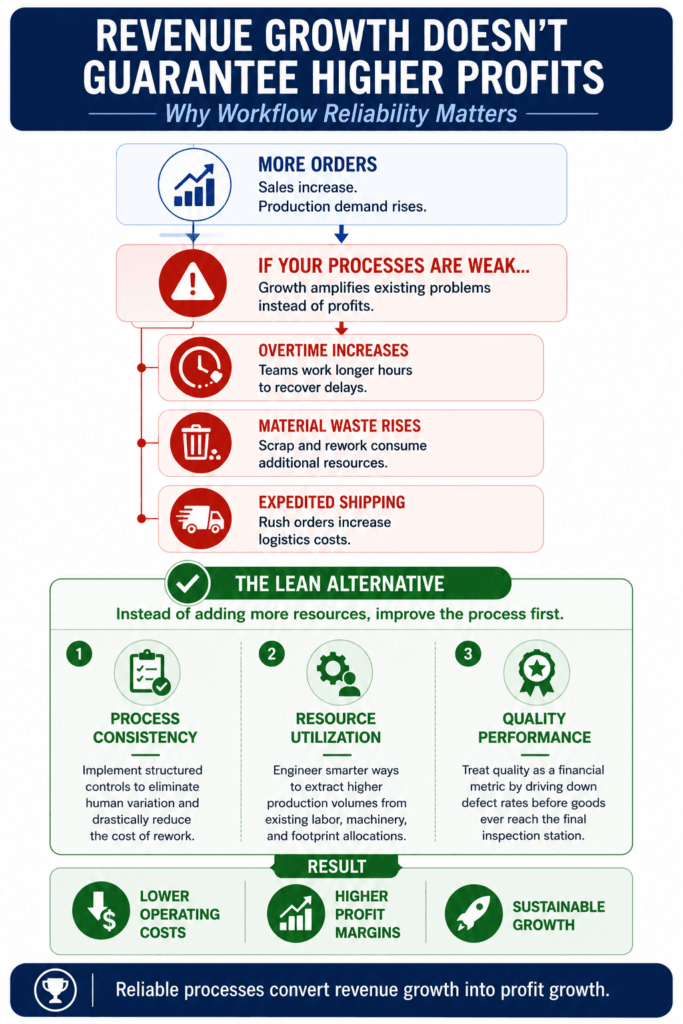
Scaling sales volumes does not automatically equate to a healthy net profit margin. If fundamental workflow inefficiencies are left unaddressed on the shop floor, a sudden spike in order volumes will simply magnify operational friction; triggering expensive employee overtime, excessive material scrap, and rushed shipping premiums.
To ensure that revenue growth flows directly to the bottom line, Egyptian business leaders focus heavily on three core areas:
- Process Consistency: Implementing structured controls to eliminate human variation and drastically reduce the cost of rework.
- Resource Utilization: Engineering smarter ways to extract higher production volumes from existing labor, machinery, and footprint allocations.
- Quality Performance: Treating quality as a financial metric by driving down defect rates before goods ever reach the final inspection station.
3. Liberating Trapped Capital to Fund Sustainable Growth
True corporate growth requires liquid capital. Organizations need reliable cash reserves to expand their facilities, purchase advanced machinery, invest in digital transformation, and elevate the customer experience.
When a company allows operational inefficiencies to persist, it effectively traps its own capital inside avoidable waste. Partnering with professional operational cost reduction services in Egypt helps leadership teams isolate these hidden cash drains. The liberated capital can then be instantly pivoted toward high-growth, strategic initiatives rather than being absorbed by daily operational losses.
The Strategic Relationship Matrix: Operational Excellence and Competitive Advantage
| Operational Area | Legacy Process Impact | Optimized Process Impact | Market Advantage |
| Workflow Design | Long cycle times, high WIP | Streamlined, single-piece flow | Faster Market Delivery |
| Quality Control | Reactive sorting, high defects | Proactive statistical control | Consistent Quality & Trust |
| Maintenance | Costly breakdown repairs | Total Productive Maintenance (TPM) | Asset Reliability & Agility |
| Workplace Setup | Disorganized, high motion waste | 5S Workplace Organization | High Labor Productivity |
How Operational Cost Reduction Improves Profit in Egypt
Operational cost reduction improves profit in Egypt by eliminating structural waste, which adds directly to net profit.
Consider the compounding effect of targeted operational interventions:
- Lower Production Waste: Reducing material scrap means a factory generates a higher volume of finished, sellable products from the exact same batch of raw material inputs.
- Maximized Equipment OEE: Raising Overall Equipment Effectiveness (OEE) enables an enterprise to defer expensive capital expenditures on new machinery by maximizing the capacity of assets already on the floor.
- Lean Inventory Management: Reducing total lead times accelerates cash conversion cycles, drastically lowering inventory carrying costs and warehouse footprint requirements.
- Optimized Workforce Ergonomics: Eliminating unnecessary physical movements, walking distances, and waiting periods directly improves human productivity per shift.
Proven Methodologies Used by Operational Cost Reduction Experts in Egypt
To achieve sustainable transformations, Egyptian organizations routinely move away from isolated, ad-hoc fixes and embrace globally validated industrial engineering frameworks.
Lean Management Practices
Lean focuses heavily on defining value strictly from the customer’s perspective and systematically eliminating any activity that does not contribute to that value. Enlisting operational cost reduction consulting in Egypt allows firms to properly deploy advanced Lean tools such as Value Stream Mapping (VSM) to track material flows, Kaizen for continuous frontline improvements, and Standard Work to lock in baseline efficiency gains.
Six Sigma Precision
Six Sigma relies on rigorous, data-driven analysis to minimize process variation. By targeting the root causes of process instability, Six Sigma helps organizations dramatically reduce their Cost of Poor Quality (COPQ). As highlighted by the American Society for Quality (ASQ), poor quality can sap up to 15% to 20% of an enterprise’s total revenue—making variation reduction an absolute financial priority.
Time and Motion Studies
This classic industrial engineering technique breaks down human tasks into distinct physical components. By studying these actions scientifically, business operational cost reduction specialists in Egypt eliminate non-value-added motions, redesign workstations ergonomically, and balance production lines perfectly to ensure zero labor idling.
Total Productive Maintenance (TPM)
Unplanned equipment failures represent a massive drain on operational efficiency. TPM changes the maintenance dynamic by involving machine operators directly in daily, routine asset upkeep; such as basic lubrication, cleaning, and inspections. This proactive discipline enhances equipment reliability, stabilizes daily throughput, and significantly extends the total lifecycle of critical corporate assets.
Common Pitfalls to Avoid in Cost Management
When attempting to implement operational efficiency improvement strategies, businesses often stumble by targeting short-term financial metrics rather than the underlying operational root causes. Leadership teams must actively avoid these common pitfalls:
- Treating Layoffs as the Primary Cost Tool: Reducing headcount without first simplifying and fixing the workflow merely overburdens the remaining staff, driving up error rates and damaging product quality.
- Operating Without Granular Data: Without objective shop-floor metrics, cost-control efforts become entirely reactive instead of strategic and data-driven.
- Overloading the Organization: Trying to deploy too many continuous improvement initiatives at once dilutes focus. Prioritizing high-impact, targeted pilots always delivers superior financial ROI.
- Failing to Sustain Standards: Without clear, visual Standard Operating Procedures (SOPs) and ongoing managerial audits, operations will naturally drift back to old, inefficient habits.
Conclusion
Embracing a structured approach to operational cost reduction is a fundamental prerequisite for Egyptian companies aiming to capture market share and protect their profitability. As the regional operating environment becomes more sophisticated, organizations that commit to continuous process optimization, waste minimization, and asset reliability will inevitably secure a strong competitive edge.
For corporate entities looking to partner with specialized operational cost reduction experts in Egypt, the journey begins with an objective, data-backed diagnostic of current shop-floor realities. By addressing embedded waste through disciplined, scientific methodologies, Egyptian firms can build lean, agile, and highly profitable enterprises capable of scaling securely into the future.
Frequently Asked Questions (FAQs)
Why is operational cost reduction important for Egypt firms?
It provides local businesses with the internal capabilities to absorb rising utility fees and material price fluctuations without being forced to raise consumer prices, thereby protecting both their profit margins and their market share.
How does operational cost reduction help Egypt companies?
It systematically removes embedded process waste, reduces costly equipment downtime, and minimizes material scrap rates, which frees up vital internal capital that can be directly reinvested into strategic growth initiatives.
What are the best operational cost reduction strategies in Egypt?
The most reliable and proven strategies include Lean operational cost management to eliminate process waste, Time and Motion studies to optimize labor capacity, Total Productive Maintenance (TPM) to boost asset OEE, and structured data analysis to lower defect rates.
How can operational cost reduction improve profit in Egypt?
By directly lowering the direct cost-per-unit produced. When an organization eliminates waste like material scrap, processing errors, and idle times, the financial savings move directly to the company’s bottom line as increased net profit.
How long does it take to see financial results from operational cost consulting?
While full organizational continuous improvement transformations generally require a cultural shift over 12 to 18 months, targeted initial pilot programs; such as machine changeover reductions or layout optimization; frequently yield measurable, audited savings within 3 to 6 months.