Egypt’s economic landscape is evolving rapidly, presenting local industries with a unique mix of expanding market opportunities and tightening operational pressures. Rising utility fees, fluctuating raw material expenses, and increasing currency realities mean that business leaders can no longer rely purely on sales growth to protect their margins. To thrive, organizations must look inward.
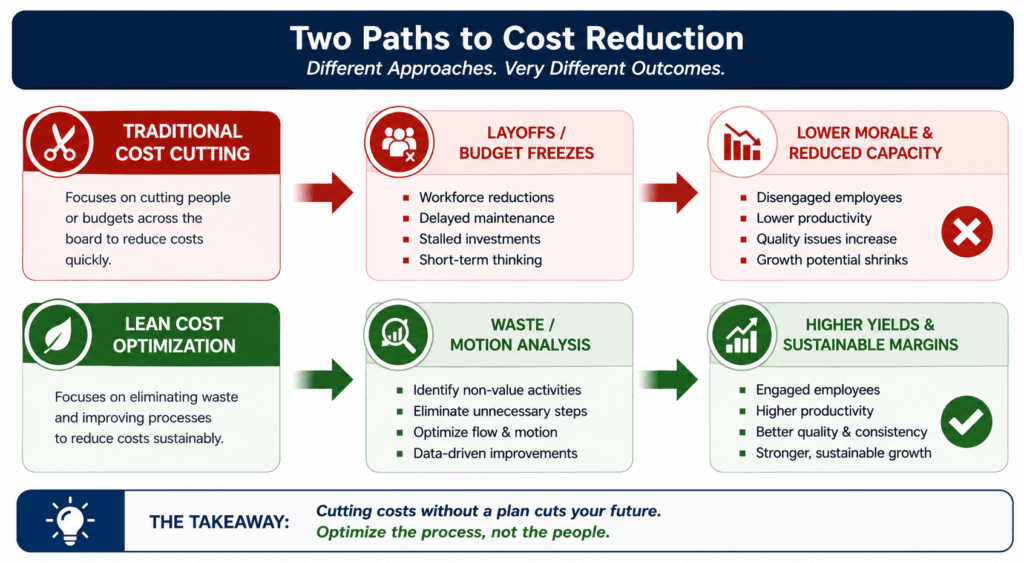
For Egypt’s businesses, implementing structured operational cost reduction strategies has shifted from a year-end financial exercise to an ongoing strategic necessity. However, traditional cost-cutting, such as sweeping budget freezes or workforce reductions, often backfires. It compromises output quality, dampens employee morale, and shrinks production capacity.
True, sustainable cost management relies on process optimization: removing waste, boosting capacity from existing assets, and improving resource yields. This comprehensive guide outlines the exact industrial frameworks required to eliminate hidden cost leakages and build a highly resilient operation in Egypt.
The Strategic Lens: Cost Reduction vs. Cost Optimization
Before deploying specific tactics, it is critical to distinguish between reactive cost cutting and structured cost optimization.
- Cost Reduction: Often focuses on immediate, short-term expense elimination (e.g., cutting an operational shift or reducing maintenance budgets). While this drops overhead quickly, it introduces systemic risks like machine breakdowns or production backlogs.
- Cost Optimization: A strategic, data-driven approach that balances structural changes with overall performance gains. For instance, rather than eliminating a shift, an organization optimizes its current workflow to achieve the same daily output in fewer hours.
For enterprise operational cost control to be successful, Egyptian businesses must focus heavily on structural optimization. This approach guarantees that expenses decline while production capacity, product quality, and system safety remain fully intact.
4 High-Impact Operational Cost Reduction Strategies for Businesses in Egypt
To systematically lower operating expenses, organizations must address root-cause inefficiencies across the shop floor and administrative workflows. Partnering with operational cost reduction experts in Egypt allows companies to deploy the following validated, industrial engineering methods.
1. Eliminating the 8 Critical Wastes Through Lean Management
Lean operational cost management centers on identifying and stripping out non-value-added activities; actions that consume time, labor, or utilities without increasing the product’s value to the customer.
Egyptian factories and distribution centers frequently suffer from hidden operational drains. By implementing Value Stream Mapping (VSM), teams can visualize the end-to-end operational journey and systematically target the core industrial wastes:
- Excess Transport & Motion: Unnecessary material movement across poorly configured plant layouts. Restructuring a floor layout to create a linear, single-piece flow can drastically reduce forklift fuel costs and material transit times.
- Waiting Time: Operators standing idle due to slow machine cycles, delayed component deliveries, or delayed managerial sign-offs.
- Overproduction & Inventory: Creating batches ahead of immediate demand, which ties up vital liquid capital in raw material and Work-in-Progress (WIP) storage overhead.
- Defects & Rework: The double-cost of burning labor, machine time, and materials to fix errors that should have been caught early or avoided entirely.
2. Conducting Time and Motion Studies for Labor Optimization
In manual or semi-automated production lines across Egypt, labor inefficiencies directly inflate the total cost per finished unit. A structured Time and Motion Study (TMS) systematically measures the exact duration of human tasks, breaking operations down into individual physical movements.
Through comprehensive observation, operational cost reduction consulting in Egypt uncovers direct cost leakages, such as operators walking excessive distances to retrieve basic hand tools or repeated manual handling of heavy items. By standardizing physical work methods, balancing production lines, and ergonomic station design, businesses routinely eliminate unnecessary overtime premiums without placing an unfair physical burden on their workforce.
3. Mitigating the Cost of Poor Quality (COPQ) via Six Sigma
According to data from the American Society for Quality (ASQ), the Cost of Poor Quality (COPQ) can drain a staggering 15% to 20% of an enterprise’s total sales revenue. COPQ includes direct scrap material, customer rejections, warranty claims, and post-delivery sorting labor.
By adopting Six Sigma and the structured DMAIC (Define, Measure, Analyze, Improve, Control) framework, Egyptian industrial firms can shift from reactive quality checks to proactive process stability. Utilizing tools like Statistical Process Control (SPC) allows operators to monitor variations in raw materials or machine calibrations in real time. Stabilizing these parameters protects the plant’s first-pass yield, ensuring that inputs become high-quality, shippable outputs on the first attempt.
4. Transitioning to Total Productive Maintenance (TPM)
Waiting for a critical manufacturing asset to experience catastrophic failure before servicing it is one of the most expensive operational mistakes an organization can make. Emergency equipment breakdowns demand premium rush shipping for replacement parts, cause expensive labor idleness, and lead to missed client delivery schedules.
Total Productive Maintenance (TPM) mitigates these losses by involving floor operators directly in routine, daily equipment upkeep; such as basic lubrication, cleaning, and loose-bolt inspection. When paired with structured preventive and predictive maintenance schedules, companies see a dramatic increase in Overall Equipment Effectiveness (OEE), maximizing the financial returns on existing capital equipment.
Real-World Industrial Insights: Operational Success Patters
Structured operational interventions in manufacturing and engineering environments consistently unlock 15% to 30% in capacity gains by eliminating process waste and workflow bottlenecks.
In a validated regional case study focusing on heavy industrial cost tracking, a plant experiencing extreme baseline costs due to energy draw and scrap rates implemented a tripartite approach:
- A targeted utility assessment optimized furnace and compressed air layouts.
- Rigorous material sorting and melting controls were introduced.
- Scheduled preventive maintenance was institutionalized across major assets.
The audited results showed an 18% decline in direct utility expenses, a 25% reduction in total raw material scrap, and a 30% drop in emergency asset breakdowns. This real-world example reinforces that cost saving is a science derived from process efficiency, not arbitrary resource deprivation.
Roadmap: Deploying Business Operational Cost Reduction in Egypt
For Egyptian business owners ready to transition from survival mode to aggressive scalability, this structured roadmap outlines the implementation journey:
- Conduct a Diagnostic Assessment: Analyze financial statements alongside physical floor maps to locate your highest cost-concentration zones. Do not manage by boardroom assumptions; observe where time and material are actively being lost.
- Quantify Financial Leaks: Calculate your exact baseline metrics; including OEE, scrap rates per shift, and labor cost-per-unit produced.
- Map the Workflows: Execute Value Stream Mapping and Time and Motion studies to isolate bottlenecks and non-value-added delays.
- Deploy Target Lean & TPM Pilots: Select a single production cell or a specific departmental workflow to run an initial optimization pilot. Measure performance before and after to prove the financial ROI.
- Standardize and Scale: Document optimized processes via visual Standard Operating Procedures (SOPs). Once a pilot succeeds, roll the framework out enterprise-wide while training internal staff to maintain standard discipline.
Conclusion
Sustained business operational cost reduction in Egypt is achieved by refining processes, not by shrinking organizational capability. By embedding frameworks like Lean Manufacturing, Six Sigma precision, and Time and Motion optimization, Egyptian enterprises can build a fortress around their profit margins.
When you eliminate systemic operational waste, you do not just lower costs today; you create a lean, agile, and highly competitive business model that is structurally equipped to scale safely into tomorrow.
Frequently Asked Questions (FAQs)
What are the best operational cost reduction strategies Egypt’s businesses can implement?
The most reliable and repeatable strategies include Lean waste elimination, line-balancing via Time and Motion studies, Total Productive Maintenance (TPM) to boost asset lifespan, and Six Sigma to lower the cost of poor quality (COPQ). These frameworks target structural operational waste rather than relying on short-term budget cuts.
How does operational cost reduction help Egypt’s companies remain competitive?
It addresses profit margin compression caused by macroeconomic factors like raw material price fluctuations and rising utility costs. By decreasing the direct cost-per-unit produced, businesses can maintain competitive marketplace pricing while freeing up capital to reinvest in market expansion.
Why should a business prioritize process optimization over direct workforce layoffs?
Layoffs reduce near-term payroll expenses but shrink total production capacity, trigger severe workplace stress, and damage long-term output quality. Process optimization through operational cost reduction services in Egypt removes non-value-added tasks instead, enabling your current workforce to achieve significantly higher output volumes safely and efficiently.
How long does it take to see measurable financial results from operational cost consulting?
While full enterprise-wide continuous improvement transformations require 12 to 18 months of disciplined execution, targeted initial pilot programs (such as changeover time reduction or layout adjustments) regularly deliver visible, audited cost optimization within 3 to 6 months.