Operational efficiency has become an increasingly important priority for organizations looking to improve productivity, manage operating costs, strengthen quality, and make better use of available resources.
For companies focused on operational efficiency in manufacturing Saudi Arabia, the objective is not simply to produce more. It is to create processes that deliver the required output with less unnecessary time, movement, material, waiting, rework, and resource consumption.
In 2026, this increasingly involves combining proven improvement approaches with better operational data and appropriate manufacturing technologies.
The most effective strategy, however, remains fundamentally process-focused: understand how work is performed, identify where efficiency is being lost, and systematically improve the causes.
What Is Operational Efficiency in Manufacturing?
Operational efficiency refers to how effectively an organization converts available resources into useful output.
Those resources can include:
- Workforce time
- Equipment capacity
- Materials
- Energy
- Production space
- Information
- Working capital
An efficient operation minimizes unnecessary consumption while maintaining the required quality, safety, reliability, and customer requirements. This is different from simply increasing production speed.
If output increases but defects, rework, downtime, or inventory also increase, overall efficiency may not have improved.
For manufacturing efficiency in KSA, organizations therefore need to consider the entire process rather than one performance metric.
Why Operational Efficiency Matters in 2026
Manufacturing organizations are operating in an environment where productivity, digital transformation, cost efficiency, and process resilience increasingly intersect.
Saudi Arabia’s broader industrial transformation agenda also places emphasis on manufacturing capabilities, digital transformation, productivity, and advanced technologies.
This makes operational efficiency an important foundation for organizations pursuing longer-term manufacturing transformation in Saudi Arabia.
However, technology alone does not create efficiency. Organizations still need stable processes, clear standards, capable employees, reliable performance measures, and structured improvement methods.
1. Improve Production Flow
One of the most direct ways to improve operational efficiency is to improve how work moves through the process.
Production can lose efficiency when work is delayed between process stages, materials are unavailable, or activities are performed in an uneven sequence.
Teams can use process mapping and Value Stream Mapping (VSM) to understand the current flow. This can reveal:
- Waiting
- Bottlenecks
- Excess work-in-process
- Unnecessary movement
- Repeated activities
- Information delays
The goal is to improve the overall flow rather than simply make individual workstations faster.
A faster workstation does not necessarily improve the entire operation if the next stage cannot absorb its output.
2. Improve Equipment Utilization
Equipment represents an important source of productive capacity. When equipment is unavailable, operating below expected performance, or producing defective output, available capacity is lost.
Overall Equipment Effectiveness (OEE) can provide a structured way to examine equipment performance through availability, performance, and quality.
Organizations can use OEE analysis to identify where equipment-related losses are occurring and determine which problems deserve attention.
This makes how to use OEE to improve operational efficiency in Saudi factories a practical question for organizations establishing performance improvement systems.
The metric itself is not the solution. Its value comes from using the information to investigate and address recurring losses.
3. Reduce Process Waste
Waste reduction remains one of the most practical approaches to improving efficiency. Lean manufacturing identifies several forms of waste, including:
- Waiting
- Overproduction
- Excess inventory
- Unnecessary transportation
- Unnecessary motion
- Overprocessing
- Defects
These losses can consume resources without creating corresponding customer value.
A process review can help determine where unnecessary activity exists and whether it can be removed, simplified, combined, or redesigned. This connects Lean manufacturing initiatives across Saudi Arabia directly with operational efficiency.
4. Strengthen Standardized Work
Process variation can make performance difficult to control. When employees perform the same activity using substantially different methods, cycle times, quality outcomes, and resource requirements can vary.
Standardized work establishes the current best-known method for performing a process. It can define:
- Work sequence
- Required materials
- Process conditions
- Quality requirements
- Expected timing
Standardization creates a baseline for improvement. It also makes it easier to identify when actual performance deviates from the expected process.
5. Improve Material and Supply Chain Flow
Operational efficiency does not stop at the production process. Materials, information, and supplies need to reach the right location at the right time.
Poor material flow can create waiting, excess inventory, unnecessary movement, and production interruptions.
Organizations can examine:
- Material replenishment
- Inventory levels
- Storage locations
- Internal transportation
- Supplier coordination
- Production scheduling
This supports the long-tail objective of developing strategies to optimize supply chain operations for Saudi manufacturing.
The goal is not necessarily to minimize inventory. It is to establish reliable flow while avoiding unnecessary inventory and handling.
6. Use Technology Where It Solves a Real Problem
Technology is increasingly becoming part of digital transformation manufacturing initiatives in Saudi Arabia. Connected production systems, automated data collection, advanced analytics, and AI-enabled analysis can improve visibility into operational performance.
For example, automated data collection can provide more consistent information about production activity. Advanced analytics can help identify recurring patterns. AI can support the analysis of large quantities of operational information.
However, organizations should first understand the process problem. Digitizing an inefficient process does not automatically make it efficient. A practical sequence is:
Understand the process → identify the loss → improve the process → determine where technology adds value.
7. Improve Workforce Productivity Through Better Processes
Productivity improvement should not be reduced to asking employees to work faster. The process itself can create barriers to productivity. Employees may lose time because of:
- Missing materials
- Equipment interruptions
- Unclear instructions
- Poor workplace organization
- Excessive movement
- Repeated work
- Waiting for information
Removing these barriers can improve workforce productivity without simply increasing individual workload.
Employee involvement is also valuable because people working directly with a process often understand practical problems that are difficult to identify from reports alone.
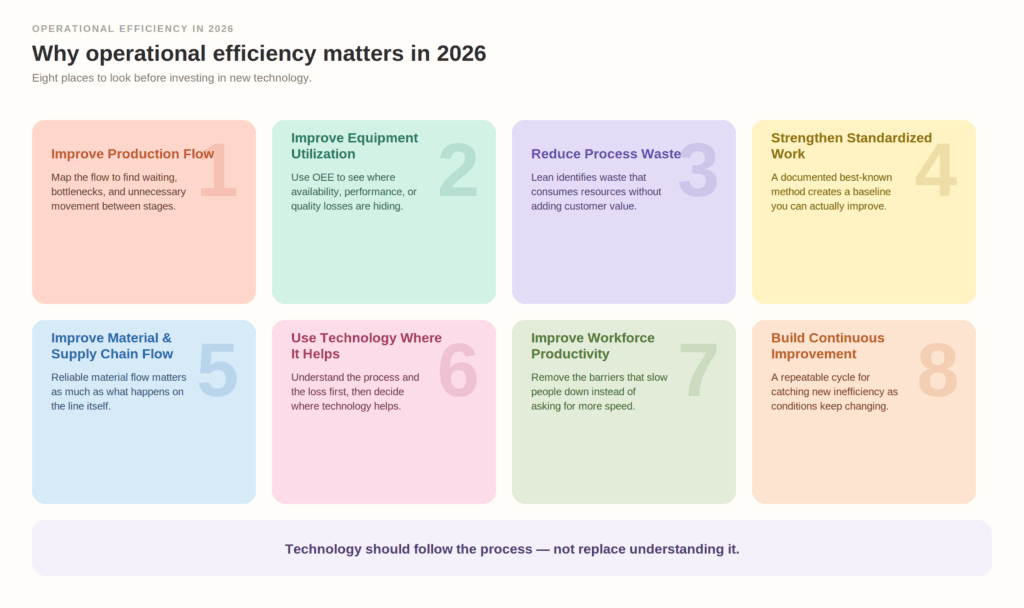
8. Build a Continuous Improvement System
Operational efficiency is not a one-time project. Processes change. New products, equipment, materials, technologies, workforce requirements, and customer expectations can introduce new sources of inefficiency.
Continuous improvement creates a repeatable approach for responding to these changes. A practical improvement cycle is:
- Identify the problem
- Understand the current state
- Establish a baseline
- Investigate the root cause
- Test an improvement
- Measure the outcome
- Standardize the successful change
This provides the foundation for continuous improvement strategies for Saudi manufacturing success.
Tracking Efficiency KPIs in KSA Manufacturing
Measurement is essential for understanding whether an efficiency initiative has actually worked. However, organizations do not need dozens of KPIs. The most useful indicators depend on the operational objective. Relevant measures may include:
- Cycle time
- Throughput
- OEE
- Downtime
- Defects
- Rework
- Scrap
- Inventory
- Process lead time
- Waiting time
- Productivity
How Saudi Companies Can Combine Lean and Technology
Lean manufacturing and manufacturing technology can complement each other. Lean can identify waste and improve process flow. Technology can improve visibility, automate information collection, and support analysis.
For example, a Lean assessment may identify recurring equipment downtime as an important operational loss. Automated monitoring can then provide more consistent information about when and how the interruptions occur.
The improvement team can investigate the causes and determine whether process changes, maintenance improvements, or technology interventions are appropriate.
This creates a connection between smart manufacturing and continuous improvement in KSA. The technology serves the improvement process rather than becoming the improvement strategy itself.
Conclusion
Improving operational efficiency is not about finding one universal solution.
For organizations pursuing manufacturing efficiency in KSA, meaningful improvement can come from better production flow, stronger equipment utilization, waste reduction, standardized work, improved material management, workforce involvement, and appropriate technology adoption.
Frequently Asked Questions
What is operational efficiency in manufacturing?
Operational efficiency is the ability to convert resources such as workforce time, equipment, materials, and information into the required output while minimizing unnecessary waste and maintaining quality and performance requirements.
How can Saudi manufacturers improve operational efficiency?
Manufacturers can improve efficiency by reducing process waste, improving production flow, optimizing equipment utilization, standardizing work, improving material flow, tracking relevant KPIs, and applying technology where it addresses a clearly defined operational problem.
How can OEE improve operational efficiency?
OEE helps organizations examine equipment availability, performance, and quality. By analyzing the losses behind the metric, teams can identify recurring equipment-related problems and prioritize improvement actions.
What KPIs should manufacturers track for operational efficiency?
Depending on the objective, useful KPIs can include cycle time, throughput, OEE, downtime, defects, rework, scrap, inventory, process lead time, waiting time, and productivity.
How does continuous improvement support manufacturing efficiency?
Continuous improvement provides a repeatable method for identifying problems, investigating root causes, testing solutions, measuring results, and standardizing successful changes. This helps efficiency improvement become an ongoing practice rather than a one-time project.