
Organizations looking to improve operational efficiency in Saudi Arabia need more than isolated process improvements. Sustainable efficiency comes from aligning processes, people, performance management, technology, and continuous improvement around clear organizational objectives. Different organizations may face different sources of inefficiency, but common challenges include unnecessary process steps, inconsistent execution, poor information flow, limited performance visibility, and ineffective use of resources. A structured Operational Excellence approach helps organizations identify the right improvement priorities and build systems that support better performance over time.
Key Takeaways
- Operational efficiency improves when organizations address processes, people, resources, and management systems together.
- Lean management provides practical methods for reducing waste and improving process flow.
- Workforce productivity depends heavily on process design, standardization, skills, and management support.
- Digital transformation can strengthen efficiency when technology is aligned with clearly defined operational needs.
- Continuous improvement is essential for sustaining operational gains and adapting to changing business requirements.
What Does It Mean to Improve Operational Efficiency?
Operational efficiency is the ability to achieve desired organizational outcomes while making effective use of available resources.
Those resources can include:
- People
- Time
- Equipment
- Materials
- Information
- Technology
- Financial resources
Improving efficiency does not simply mean doing more work. It means finding better ways to perform work while reducing unnecessary effort, delays, waste, variation, and resource consumption.
For organizations in Saudi Arabia, operational efficiency improvement can therefore support broader objectives related to productivity, Operational Excellence, organizational effectiveness, and sustainable business performance.
Why Operational Efficiency Requires a Strategic Approach
Operational inefficiencies rarely exist in isolation.
A process delay may be caused by unclear responsibilities. A productivity issue may be caused by unnecessary administrative work. A recurring quality problem may be caused by process variation. A reporting problem may be caused by fragmented information.
This means organizations should avoid treating every issue as an individual problem.
A strategic approach examines how different parts of the operating system interact.
This includes:
- Process design
- Workforce capability
- Leadership
- Performance management
- Technology
- Information
- Continuous improvement
The objective is to create alignment between these elements.
10 Strategies to Improve Operational Efficiency in Saudi Arabia
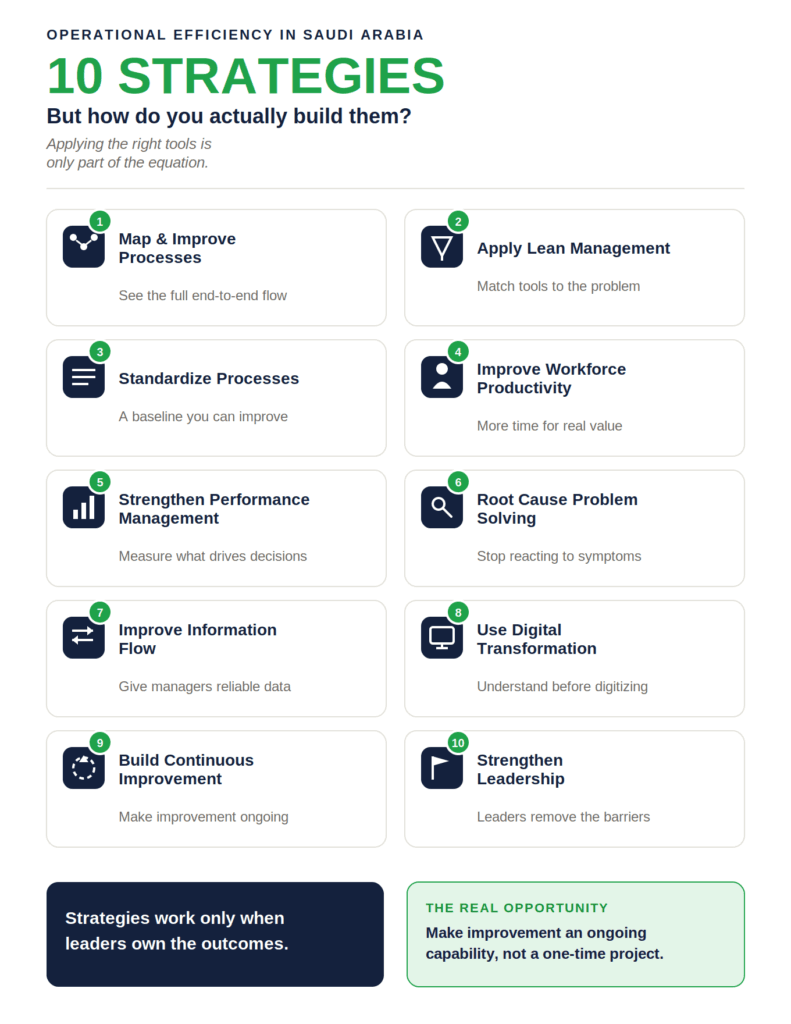
1. Map and Improve Critical Processes
Process improvement should begin with understanding how work actually moves through the organization.
Process mapping can help identify:
- Activities
- Decision points
- Handoffs
- Delays
- Bottlenecks
- Inputs
- Outputs
- Responsibilities
Once the current state is understood, teams can identify unnecessary steps and opportunities to improve process flow.
The focus should be on end to end processes rather than individual departments. A department may appear efficient when measured independently while creating delays elsewhere in the process.
2. Apply Lean Management
Lean management provides a structured approach to identifying and reducing waste.
Common forms of waste include:
- Waiting
- Rework
- Unnecessary movement
- Overprocessing
- Defects
- Excessive inventory
- Duplicate activities
- Underused employee capabilities
Organizations seeking to improve operational efficiency using Lean management in KSA can select Lean methods according to the specific problems they need to solve.
Useful methods include:
Value Stream Mapping
Helps teams understand the flow of work and information across a process.
5S
Supports workplace organization, visibility, and standardization.
Kaizen
Encourages incremental improvements involving employees.
Standardized Work
Creates a consistent baseline for important activities.
Visual Management
Makes important information and abnormalities easier to see and act upon.
Lean should be treated as a management approach rather than simply a collection of tools.
3. Standardize Important Processes
Standardization creates consistency.
When employees perform similar activities in significantly different ways, organizations may experience variation in quality, cycle time, resource consumption, and outcomes.
A standardized process can provide:
- Clear expectations
- Consistent execution
- Easier training
- Better performance monitoring
- A baseline for improvement
Standardization should not make processes rigid. Instead, it should create a clear current standard that can be improved when better methods are identified.
4. Improve Workforce Productivity
People are an important component of operational efficiency. However, improving workforce productivity should not simply mean increasing employee workloads.
Organizations should examine how employee time is being used.
Questions worth asking include:
- How much time is spent on repetitive activities?
- Where do employees wait for information?
- Which tasks require duplicate effort?
- Are responsibilities clearly defined?
- Are employees spending time correcting avoidable errors?
- Do employees have the information and skills needed to perform effectively?
Improving processes can allow employees to spend more time on higher value activities.
Employee involvement is equally important because people performing processes every day often have direct knowledge of operational problems.
5. Strengthen Performance Management
Operational efficiency requires reliable visibility into performance. Organizations should establish relevant performance measures that help teams understand whether processes are working as intended.
Depending on the organization’s objectives, measures can include:
- Productivity
- Quality
- Cycle time
- Delivery performance
- Resource utilization
- Rework
- Cost
- Process adherence
The purpose of measurement is not to create more reporting. It is to support better decisions. Performance measures should therefore be connected to specific organizational objectives and improvement priorities.
6. Use Root Cause Problem Solving
Organizations can lose significant resources when the same problems are repeatedly corrected.
Root cause problem solving helps teams move beyond symptoms and investigate why an issue occurs.
A practical approach includes:
- Define the problem clearly
- Understand the current condition
- Collect relevant information
- Identify possible causes
- Validate the underlying cause
- Develop corrective actions
- Measure the outcome
- Standardize the successful solution
This improves organizational capability because teams become better at solving problems rather than simply reacting to them.
7. Improve Information and Decision Flow
Operational efficiency can suffer when information is incomplete, delayed, duplicated, or difficult to access.
Organizations should examine how important information moves through processes. Potential improvement areas include:
- Information ownership
- Reporting processes
- Approval workflows
- Data availability
- Communication between teams
- Performance visibility
Better information flow can reduce delays and help managers make decisions based on more reliable information.
8. Use Digital Transformation Where It Creates Value
Digital transformation can support operational efficiency when it addresses clearly defined business problems.
Potential applications include:
- Workflow automation
- Digital reporting
- Data analysis
- Information management
- Performance monitoring
- Process visibility
- Decision support
Organizations seeking to improve operational efficiency through digital transformation in Saudi Arabia should first understand the process they want to improve.
A useful sequence is:
Understand → Simplify → Standardize → Digitize → Measure → Improve
This helps prevent technology from being used to automate unnecessary activities.
9. Build Continuous Improvement Into Management
Operational efficiency is not a one time objective. Processes change, customer expectations evolve, organizational priorities shift, and new inefficiencies emerge.
A continuous improvement system creates a mechanism for regularly identifying and addressing these issues.
A practical cycle includes:
- Identify a performance gap
- Analyze the current condition
- Determine the root cause
- Develop an improvement
- Implement the change
- Measure the result
- Standardize the improvement
- Continue looking for further opportunities
This turns improvement into an ongoing organizational capability.
10. Strengthen Leadership and Accountability
Operational improvement requires leadership involvement.
Leaders establish priorities, allocate resources, remove barriers, and reinforce expectations. They also influence whether continuous improvement becomes part of organizational culture.
Effective leadership can support efficiency by:
- Establishing clear objectives
- Reviewing operational performance
- Supporting problem solving
- Encouraging employee participation
- Removing organizational barriers
- Following up on improvement actions
Accountability should focus on outcomes and improvement rather than simply assigning responsibility for problems.
How to Prioritize Operational Efficiency Strategies
Organizations do not need to implement every strategy simultaneously. Prioritization is important.
A practical assessment can consider:
Business Impact
How significantly could the improvement affect organizational performance?
Feasibility
Does the organization have the resources and capabilities required?
Process Readiness
Is the process sufficiently understood and stable to improve?
Risk
Could the change create operational, financial, compliance, or other risks?
Sustainability
Can the organization maintain the improvement after implementation?
Prioritizing opportunities based on these factors can help organizations focus resources where they are most likely to create meaningful value.
Creating an Operational Excellence System
Operational Excellence initiatives are stronger when improvement activities are connected through a consistent management system.
Such a system can connect:
Strategy → Processes → People → Performance → Improvement
Strategy establishes what the organization wants to achieve. Processes define how work is performed. People execute and improve those processes.Performance measures show whether the organization is achieving its objectives. Continuous improvement provides the mechanism for closing performance gaps.
This creates a more integrated approach than managing individual improvement projects separately.
How to Improve Operational Efficiency and Reduce Costs
Efficiency and cost are closely connected.
When organizations reduce waiting, rework, unnecessary activities, process variation, and resource waste, they can often reduce the resources required to deliver desired outcomes.
However, cost reduction should not become the only objective. Organizations should consider whether an efficiency initiative affects:
- Quality
- Productivity
- Customer value
- Employee capability
- Responsiveness
- Long-term organizational performance
The strongest cost improvements generally come from improving the process that generates the cost.
The Role of Organizational Culture
Operational efficiency depends partly on how people respond to problems.
An organization that treats problems as opportunities for learning is more likely to develop continuous improvement capability.
A strong improvement culture encourages employees to:
- Identify problems
- Raise concerns
- Suggest improvements
- Participate in problem solving
- Share knowledge
- Follow standards
- Challenge ineffective processes constructively
Leadership behavior is particularly important. If employees are encouraged to identify problems but receive no support when they raise them, continuous improvement will struggle to develop.
A Practical Roadmap for Operational Efficiency Improvement
Organizations can structure an operational efficiency program around the following stages.
Stage 1: Assess
Understand current performance, processes, resources, and major operational challenges.
Stage 2: Prioritize
Identify the improvement opportunities with the greatest potential organizational impact.
Stage 3: Analyze
Use process mapping, data, employee knowledge, and root cause analysis to understand the causes of inefficiency.
Stage 4: Improve
Apply Lean management, process improvement, standardization, workforce improvement, or technology according to the specific need.
Stage 5: Measure
Determine whether the improvement achieved the intended outcome.
Stage 6: Standardize
Document and reinforce successful changes.
Stage 7: Sustain
Use management routines, performance monitoring, and employee involvement to maintain the improvement.
Stage 8: Continue
Treat each improvement as part of an ongoing cycle rather than the final destination.
Common Mistakes to Avoid
Trying to Improve Everything at Once
Too many improvement priorities can dilute organizational focus.
Choosing Tools Before Defining Problems
Lean, automation, and other methods should be selected based on the problem rather than applied for their own sake.
Ignoring Process Interdependencies
Improving one department without considering the complete process can move problems rather than eliminate them.
Focusing Only on Short Term Savings
Efficiency should support sustainable organizational performance.
Ignoring Employee Knowledge
Employees can provide valuable insights into how processes actually work.
Failing to Sustain Improvements
Without standards, accountability, and follow up, improvements can gradually disappear.
Conclusion
Organizations looking to improve operational efficiency in Saudi Arabia should approach the challenge as a connected organizational system rather than a collection of isolated problems.
Process improvement, Lean management, workforce productivity, standardization, performance management, digital transformation, root cause problem solving, and continuous improvement can all contribute to stronger operational performance when applied according to specific organizational needs.
The most effective strategy is not necessarily to introduce more initiatives. It is to identify the causes of inefficiency, prioritize the right opportunities, involve the people who perform the work, and establish management systems that sustain improvement.
Operational efficiency ultimately comes from creating better ways of working. When improvement becomes part of everyday management, organizations can build stronger Operational Excellence capabilities and create a foundation for sustainable performance.
Frequently Asked Questions
How can organizations improve operational efficiency in Saudi Arabia?
Organizations can improve operational efficiency by mapping critical processes, identifying waste, standardizing work, improving workforce productivity, strengthening performance management, applying Lean management, and using digital transformation where it creates measurable value.
What are the best strategies to improve operational efficiency?
Key strategies include process improvement, Lean management, standardization, workforce productivity improvement, root cause problem solving, performance management, digital transformation, and continuous improvement.
How can Lean management improve operational efficiency in KSA?
Lean management can improve efficiency by identifying waste, improving process flow, reducing unnecessary activities, standardizing work, and involving employees in continuous improvement.
How can digital transformation improve operational efficiency in Saudi Arabia?
Digital transformation can improve operational efficiency by automating suitable activities, improving information flow, strengthening performance visibility, supporting data analysis, and enabling better decision making. Technology should be aligned with clearly defined operational needs.
How can organizations sustain operational efficiency improvements?
Organizations can sustain improvements by standardizing successful processes, monitoring relevant performance measures, involving employees, addressing recurring problems, maintaining leadership accountability, and embedding continuous improvement into daily management.