
Improving operational efficiency and reducing costs are closely connected, but sustainable cost reduction does not come from cutting resources indiscriminately. Organizations need to understand where costs originate, identify waste within processes, and improve how people, time, materials, information, and technology are used.
For organizations across Saudi Arabia, a structured approach can connect cost improvement with Operational Excellence, Lean management, process improvement, and workforce productivity. The objective is to create more efficient ways of working that reduce unnecessary expenditure while protecting quality, performance, and long-term organizational capability.
Key Takeaways
- Sustainable cost reduction starts by understanding the processes that generate unnecessary expenditure.
- Lean management can help organizations identify waste and improve resource utilization.
- Workforce productivity should be improved through better processes rather than simply increasing workloads.
- Process standardization and root cause problem solving can reduce recurring operational losses.
- Continuous improvement helps organizations sustain efficiency and cost improvements over time.
Why Operational Efficiency and Cost Reduction Are Connected
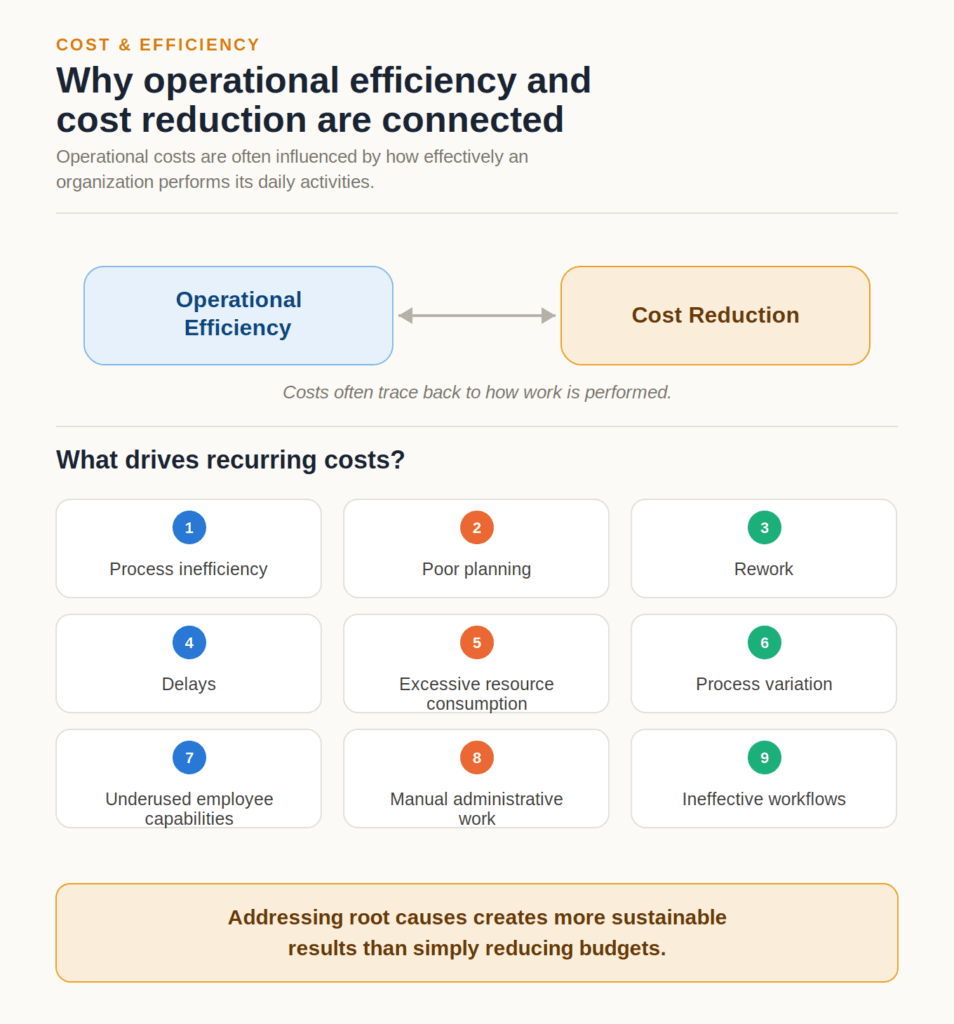
Operational costs are often influenced by how effectively an organization performs its daily activities.
Unnecessary process steps, waiting, rework, excessive movement, poor information flow, inefficient resource utilization, and recurring problems can all consume resources without creating proportional value.
This means organizations looking to improve operational efficiency and reduce costs in Saudi Arabia should look beyond financial reports and examine the operational processes behind those costs.
For example, a recurring cost may be caused by:
- Process inefficiency
- Poor planning
- Rework
- Delays
- Excessive resource consumption
- Process variation
- Underused employee capabilities
- Manual administrative work
- Ineffective workflows
Addressing the underlying causes can create more sustainable results than simply reducing budgets.
What Is Operational Cost Optimization?
Operational cost optimization is the process of improving how resources are used while maintaining or improving desired business outcomes.
It is different from indiscriminate cost cutting.
Cost cutting may reduce spending in the short term, but it can also affect quality, employee capability, service levels, or organizational resilience if not carefully managed.
Cost optimization focuses on understanding where resources are being consumed and determining whether those resources can be used more effectively.
This makes operational efficiency improvement an important part of sustainable cost management.
Identify Where Operational Costs Come From
Before attempting to reduce costs, organizations should understand the activities and processes responsible for them.
A practical assessment can examine:
Process Costs
How much time and effort are required to complete important processes?
Quality Related Costs
How much effort is spent correcting errors, resolving defects, or repeating work?
Waiting and Delay
How much time is lost while work waits for information, approvals, resources, or decisions?
Resource Utilization
Are people, equipment, materials, and other resources being used effectively?
Administrative Effort
Are employees spending unnecessary time on manual reporting, duplicate data entry, or repetitive coordination?
Process Variation
Are inconsistent methods creating additional effort or unpredictable outcomes?
Understanding these factors creates a stronger basis for cost optimization in Saudi Arabia that organizations can sustain.
Use Lean Management to Reduce Waste
Lean management provides practical methods for identifying and reducing activities that consume resources without creating sufficient value.
The objective is not simply to reduce the amount of work performed.
Instead, Lean asks:
What does the customer or organization actually need, and what activities are required to deliver it effectively?
Common sources of waste include:
- Waiting
- Unnecessary movement
- Overprocessing
- Rework
- Defects
- Excessive inventory
- Duplicate activities
- Underused employee capabilities
When organizations systematically identify these sources of waste, they can improve efficiency while reducing unnecessary resource consumption.
Improve Operational Efficiency Using Lean Management in KSA
Organizations seeking to improve operational efficiency using Lean management in KSA can apply different Lean methods according to the problems they are trying to solve.
Value Stream Mapping (VSM)
Value Stream Mapping helps teams understand how work and information move through a process.
It can reveal:
- Delays
- Bottlenecks
- Excessive handoffs
- Unnecessary activities
- Process interruptions
This provides a foundation for redesigning the process.
5S
5S supports workplace organization, visibility, and standardization.
Better organization can reduce unnecessary searching, movement, and confusion while making abnormalities easier to identify.
Kaizen
Kaizen encourages employees to identify practical improvement opportunities and implement incremental changes.
This can help organizations build a culture in which cost and efficiency improvements are continuously identified rather than addressed only during formal improvement projects.
Standardized Work
Standardized work creates a consistent baseline for important activities.
Once a process has a defined standard, organizations can identify deviations and determine whether further improvements are needed.
Reduce Costs by Improving Quality
Poor quality can create significant operational inefficiency.
When work has to be corrected, repeated, inspected, or reprocessed, additional resources are consumed.
Quality improvement can therefore support cost reduction by addressing the causes of recurring problems. Organizations should investigate:
- Why errors occur
- Where defects originate
- Why rework is required
- Whether standards are clear
- Whether employees have the necessary information and skills
- Whether process conditions contribute to variation
Root cause problem solving is more effective than repeatedly correcting the same issue.
Improve Workforce Productivity
Workforce productivity should be considered carefully when organizations pursue cost reduction.
Reducing headcount or increasing workloads may produce an immediate financial effect, but it does not necessarily improve operational efficiency.
A stronger approach is to examine how employee time is used.
Organizations can identify opportunities by asking:
- Which activities consume the most employee time?
- Which tasks are repetitive?
- Where do employees wait for information?
- Which activities require duplicate effort?
- Where are responsibilities unclear?
- Which processes generate avoidable administrative work?
Removing unnecessary effort allows employees to spend more time on activities that contribute meaningful organizational value.
This supports both workforce productivity and long-term organizational effectiveness.
Standardize Processes to Reduce Unnecessary Variation
Inconsistent processes can create additional cost.
When similar activities are performed differently without a clear reason, organizations may experience differences in quality, processing time, resource consumption, or outcomes.
Standardization provides a baseline for consistent execution.
A practical standardization approach can include:
- Identify the process.
- Document the current method.
- Determine the most effective approach.
- Define the standard.
- Train relevant employees.
- Monitor adherence.
- Review and improve the standard.
Standardization should remain flexible enough to support continuous improvement.
Reduce Rework Through Root Cause Analysis
Rework is often a symptom of an underlying process problem. If the same issue repeatedly occurs, organizations should investigate the cause instead of continuously correcting the result.
Root cause analysis can help identify whether the problem originates from:
- Incomplete information
- Unclear procedures
- Process design
- Training gaps
- Communication failures
- Equipment or system issues
- Inconsistent execution
Removing the root cause can reduce recurring effort and improve overall process stability.
Improve Operational Efficiency Through Digital Transformation
Technology can support cost and efficiency improvements when applied to clearly defined operational problems. Potential applications include:
- Automating repetitive administrative tasks
- Improving data collection
- Reducing manual reporting
- Strengthening workflow visibility
- Supporting information retrieval
- Improving performance monitoring
- Supporting operational decision making
However, organizations should avoid using technology simply because it is available.
A poorly designed process can remain inefficient after automation.
A stronger approach is:
Understand the process → Remove unnecessary work → Standardize → Automate where appropriate → Monitor → Improve
This provides a practical framework for organizations looking to improve operational efficiency through digital transformation in Saudi Arabia.
Improve Resource Utilization
Operational efficiency is closely connected to how effectively resources are used.
Organizations should evaluate whether available resources are:
- Properly allocated
- Available when needed
- Used according to demand
- Supporting value creating activities
- Being affected by process bottlenecks
Better resource utilization does not necessarily mean using resources less. It means using them more effectively.
This distinction is important when balancing cost reduction with organizational capability.
Use Performance Measures to Control Operational Costs
Cost and efficiency improvements should be measurable. Relevant measures can help organizations determine whether changes are producing the intended results.
Depending on the organization’s objectives, useful measures may include:
- Process cycle time
- Productivity
- Rework
- Quality performance
- Resource utilization
- Delivery performance
- Process adherence
- Operating cost
Organizations should avoid creating unnecessary measurement complexity.
The most useful indicators are those that help teams understand performance and take action.
Build Continuous Improvement Into Cost Management
Cost improvement should not depend entirely on occasional cost reduction programs.
Organizations can create stronger long-term results by integrating continuous improvement into everyday management.
A continuous improvement cycle can include:
- Identify a performance or cost problem.
- Understand the current state.
- Determine the root cause.
- Develop an improvement.
- Implement the change.
- Measure the outcome.
- Standardize the successful approach.
- Continue looking for further opportunities.
This creates a system where cost and efficiency improvements become part of normal organizational behavior.
Common Mistakes in Cost Reduction
Cutting Resources Without Understanding the Process
Reducing resources without understanding how they contribute to performance can create new inefficiencies.
Focusing Only on Financial Measures
Financial indicators are important, but operational measures provide insight into the causes behind financial outcomes.
Ignoring Quality
Reducing costs while allowing quality problems to increase can create additional costs elsewhere in the organization.
Automating Inefficient Processes
Technology should not be used to preserve unnecessary process steps.
Treating Cost Reduction as a One Time Exercise
Operational costs can increase again when processes change or improvements are not sustained.
Excluding Employees
Employees often have direct knowledge of operational waste and practical opportunities to improve resource utilization.
A Practical Roadmap to Improve Efficiency and Reduce Costs
Organizations can use the following sequence to approach operational cost improvement.
Step 1: Define the Objective
Determine which operational or financial outcome needs to improve.
Step 2: Understand the Current Process
Map and observe how work is actually performed.
Step 3: Identify Waste and Cost Drivers
Look for delays, rework, unnecessary activities, variation, and poor resource utilization.
Step 4: Prioritize Opportunities
Focus on problems that have meaningful operational or financial impact.
Step 5: Improve the Process
Apply Lean management, standardization, root cause analysis, or other appropriate improvement methods.
Step 6: Evaluate Technology Opportunities
Determine whether automation or digital tools can provide additional value.
Step 7: Measure Results
Use relevant performance indicators to evaluate the impact.
Step 8: Sustain the Improvement
Standardize successful practices and continue monitoring performance.
Conclusion
Organizations seeking to improve operational efficiency and reduce costs in Saudi Arabia should focus on improving the systems that generate operational expenditure rather than relying only on budget reductions.
Lean management, process improvement, workforce productivity, standardization, root cause problem solving, and appropriate digital transformation can work together to reduce waste and improve resource utilization.
The most sustainable approach connects cost management with Operational Excellence. When organizations understand their processes, address root causes, involve employees, and continuously improve the way work is performed, cost reduction becomes an outcome of better operations rather than an isolated financial exercise.
Frequently Asked Questions
How can organizations improve operational efficiency and reduce costs in Saudi Arabia?
Organizations can improve efficiency and reduce costs by identifying operational waste, improving process flow, reducing rework, standardizing activities, improving workforce productivity, and using technology where it provides measurable value.
How does Lean management help reduce operational costs?
Lean management helps reduce costs by identifying waste, improving process flow, reducing unnecessary activities, addressing root causes, and encouraging continuous improvement.
How can workforce productivity contribute to cost reduction?
Workforce productivity improves when employees spend less time on unnecessary, repetitive, or avoidable activities and more time on value creating work. Better process design is an important part of achieving this.
Can digital transformation reduce operational costs?
Digital transformation can reduce operational costs by automating suitable repetitive activities, improving information flow, reducing manual reporting, and strengthening process visibility. Results depend on selecting appropriate use cases and improving the underlying processes.
How can organizations sustain operational cost improvements?
Organizations can sustain improvements through standardization, performance monitoring, employee involvement, root cause problem solving, leadership accountability, and continuous improvement.