
Operational cost reduction is becoming an important priority for large organizations seeking stronger productivity, efficiency, and long-term performance. For businesses operating in Saudi Arabia, the challenge is not simply to spend less. It is to identify where resources are being consumed unnecessarily and improve the processes responsible for those costs.
Effective operational cost reduction for Saudi Arabia businesses should therefore balance cost control with productivity, quality, reliability, and operational continuity.
This requires a structured approach. Lean principles, Six Sigma, process improvement, equipment optimization, energy efficiency, automation, and performance management can all contribute when applied to clearly defined operational problems.
Below are ten practical strategies large Saudi organizations can consider.
1. Map Processes to Identify Hidden Costs
Large organizations often have complex processes involving multiple teams, systems, approvals, and handoffs. Over time, unnecessary steps can become part of standard operations without being questioned.
Process mapping helps make these inefficiencies visible.
Teams can examine where work waits, where information is duplicated, where materials move unnecessarily, and where approvals or handoffs create delays.
The objective is not to make every individual activity faster. It is to understand how the entire process creates cost.
For example, an administrative process may involve several manual entries of the same information. A production process may involve unnecessary movement between work areas. A material process may include multiple handling stages.
Identifying these activities creates opportunities for cost optimization without simply reducing essential resources.
2. Reduce Operational Waste
Lean provides a practical framework for identifying activities that consume resources without creating equivalent value.
Common forms of waste include:
- Waiting
- Excess inventory
- Unnecessary transportation
- Excess movement
- Overprocessing
- Defects
- Overproduction
For large organizations, these losses can exist across multiple processes and locations.
Lean cost reduction for Saudi Arabian businesses should therefore begin with understanding where waste occurs and why it exists.
A Value Stream Mapping (VSM) exercise can help teams see how materials, information, and work move through a process. Once major sources of waste are visible, improvement teams can prioritize the opportunities with the greatest operational impact.
The objective is not to remove activities indiscriminately. It is to remove unnecessary consumption while preserving activities that genuinely create value.
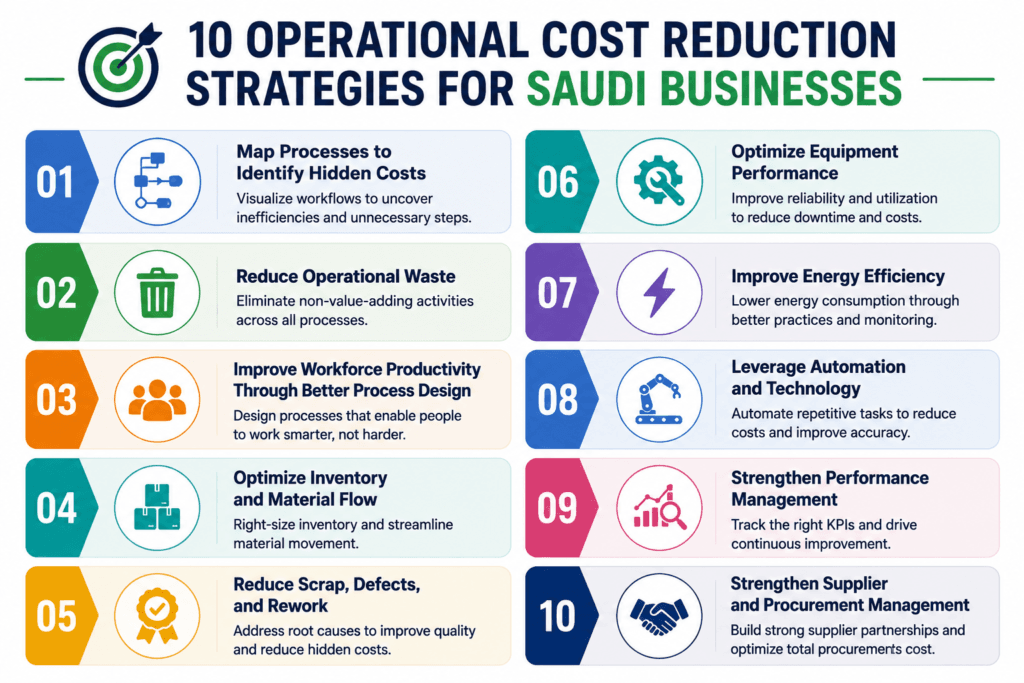
3. Improve Workforce Productivity Through Better Process Design
Workforce productivity is closely connected to process design.
Employees may spend significant time waiting for materials, searching for information, correcting errors, repeating activities, or moving unnecessarily between locations.
These activities consume labor capacity without necessarily increasing output.
Time and motion studies, standardized work, workplace organization, and process observation can help identify these losses.
The focus should be on improving the system in which people work.
For example, reorganizing material placement may reduce unnecessary movement. Improving information availability may reduce time spent searching for documents or instructions. Standardizing repetitive activities may reduce variation in execution.
This approach supports productivity improvement without assuming that employees simply need to work faster.
4. Optimize Inventory and Material Flow
Inventory is necessary for many large operations, but excessive inventory can create avoidable costs. These can include storage, handling, working capital, space requirements, internal transportation, and the risk of obsolescence.
Reducing inventory without understanding why it exists can create operational problems.
High inventory may be compensating for unreliable supply, inconsistent production, long replenishment cycles, or poor demand visibility.
A better approach is to examine the causes of inventory accumulation.
Organizations can review:
- Material replenishment
- Inventory turnover
- Internal material movement
- Production requirements
- Replenishment lead times
- Slow-moving materials
The goal is to create a more reliable flow and maintain inventory at an appropriate level. This connects inventory optimization with broader business efficiency.
5. Reduce Scrap, Defects, and Rework
Quality losses can create costs throughout an operation. A defective output may require additional material, labor, inspection, repair, replacement, or production capacity.
Repeated defects can also disrupt production schedules and reduce available capacity.
Organizations should therefore investigate the causes behind recurring quality problems rather than relying only on additional inspection.
Root cause analysis can help determine whether defects are associated with process conditions, equipment, materials, work methods, or other factors. Standardized work and appropriate process controls can then help prevent recurrence.
The financial benefit of quality improvement should be considered alongside the operational benefit.
Reducing defects can free capacity, reduce material consumption, and improve process stability.
6. Improve Equipment Reliability
Equipment downtime can create significant operational losses.
When an important asset becomes unavailable, the impact may extend beyond maintenance. Production schedules can be disrupted, employees may be unable to perform planned activities, and downstream processes may experience delays.
A structured equipment improvement program should examine the causes of these losses.
Organizations can analyze:
- Equipment downtime
- Recurring failures
- Minor stoppages
- Maintenance response
- Performance losses
- Quality problems associated with equipment
OEE can provide a useful framework for examining availability, performance, and quality. However, improving the OEE figure should not become the sole objective. The real objective is to understand the losses behind the measure and address their causes.
7. Improve Energy Efficiency
Energy efficiency can contribute to both operational performance and cost control. Large organizations can begin by understanding how energy is consumed across equipment, processes, and operating periods.
Potential areas for investigation include idle equipment, inefficient operating conditions, unnecessary operating time, and maintenance-related losses.
Energy efficiency should also be considered alongside productivity.
For example, improving equipment utilization can potentially reduce unnecessary operating time while supporting production performance.
Organizations evaluating cost savings through green energy adoption in Saudi industry should similarly assess the operational requirements, implementation considerations, and measurable outcomes of the proposed initiative.
The objective should be practical resource efficiency rather than sustainability initiatives disconnected from operational priorities.
8. Use Automation Where It Creates Measurable Value
Automation can support cost reduction for KSA organizations, particularly where repetitive activities consume significant resources or where consistency is important.
Potential applications can include:
- Repetitive production activities
- Data collection
- Reporting
- Material handling
- Process monitoring
- Selected inspection activities
However, automation should not be treated as an automatic solution to high operating costs.
Before automating a process, organizations should understand its current performance. Important questions include:
- What problem is the automation solving?
- What does the current process cost?
- What improvement is expected?
- What resources will implementation require?
- How will the result be measured?
If an inefficient process is automated without addressing its underlying problems, the organization may simply digitize or automate existing waste.
9. Apply Lean and Six Sigma to High-Impact Cost Problems
Lean and Six Sigma can provide complementary approaches to operational cost reduction.
Lean focuses on eliminating waste and improving flow.
Six Sigma focuses on reducing variation and improving process consistency.
DMAIC provides a structured approach for more complex problems.
Define
Clearly establish the problem and desired outcome.
Measure
Understand current performance and establish a baseline.
Analyze
Investigate the factors contributing to the performance gap.
Improve
Develop and implement appropriate solutions.
Control
Monitor performance and establish mechanisms to sustain the improvement.
This approach can support Six Sigma operational savings across KSA organizations by connecting improvement projects to measurable operational outcomes.
For large organizations, the ability to prioritize improvement projects is particularly important. Not every process requires a formal Six Sigma project. The methodology should match the complexity and importance of the problem.
10. Strengthen Performance Measurement and Continuous Improvement
Cost reduction should not be treated as a one-time exercise.
Large organizations need performance systems that show whether improvements are working and whether gains are being sustained.
Relevant operational KPIs can include:
- Productivity
- OEE
- Downtime
- Scrap
- Rework
- Cycle time
- Inventory
- Process lead time
- Energy consumption
The right KPIs depend on the specific cost reduction objective.
If an initiative focuses on equipment reliability, equipment performance should be closely monitored. If the objective is waste reduction, scrap, rework, inventory, and process flow may be more relevant.
This creates a connection between operational performance and financial outcomes.
A simple continuous improvement cycle can then be established:
Identify → Measure → Analyze → Improve → Standardize → Monitor
Over time, this can make cost optimization part of everyday operational management.
How Digital Transformation Supports Cost Reduction
Digital transformation can strengthen cost reduction initiatives when it improves visibility, data collection, automation, or decision-making.
Digital production monitoring can provide more timely performance information. Automated data collection can reduce manual reporting. Advanced analytics can help identify recurring operational losses. AI-supported analysis can assist teams in interpreting complex operational information.
The key is to connect technology with a defined operational objective.
A digital initiative should not be justified simply because the technology is available.
It should answer:
- What problem will it solve?
- What process will change?
- What improvement is expected?
- How will the result be measured?
This ensures digital transformation supports operational efficiency for KSA manufacturing organizations rather than becoming a separate technology exercise.
Conclusion
Effective operational cost reduction for Saudi Arabia organizations should focus on eliminating the causes of unnecessary resource consumption.
The strongest cost reduction programs do not treat cost as an isolated financial problem. They connect financial performance with operational performance.
When organizations understand where costs originate, address their root causes, measure the results, and standardize successful improvements, cost reduction can become part of a broader continuous improvement system.
Frequently Asked Questions
What are the best operational cost reduction strategies for Saudi businesses?
Key strategies include process mapping, Lean waste reduction, workforce productivity improvement, inventory optimization, quality improvement, equipment reliability, energy efficiency, selective automation, Six Sigma, and performance management.
How can Lean reduce operational costs?
Lean helps organizations identify and eliminate activities that consume resources without creating equivalent value. Reducing waiting, excess inventory, unnecessary movement, overprocessing, defects, and other forms of waste can improve efficiency and reduce operating costs.
How can Six Sigma help reduce operational costs?
Six Sigma can help organizations identify and reduce process variation, defects, and recurring quality problems. DMAIC provides a structured method for investigating causes, implementing improvements, and sustaining results.
Can automation reduce operational costs?
Automation can reduce costs when it addresses suitable repetitive or inefficient activities. Organizations should first understand the existing process and establish how the automation will create measurable operational value.
How should large organizations measure cost reduction?
Organizations should establish a baseline and monitor relevant operational and financial indicators. Productivity, OEE, downtime, scrap, rework, inventory, cycle time, process lead time, and energy consumption can help demonstrate whether improvements are producing sustainable results.