
Operational costs dictate a foundational role in shaping corporate profitability, productivity, and long-term business resilience. For commercial enterprises, industrial plants, and manufacturing facilities operating in the Kingdom of Saudi Arabia, achieving genuine cost efficiency is rarely about blunt budget cuts. Instead, it involves understanding how resources are consumed, mapped, and deployed to deliver required outputs with minimal waste, variation, and unnecessary friction.
This dynamic makes effective operational cost reduction in Saudi Arabia a much broader, more strategic discipline than traditional expense slashing. A sustainable approach harmonizes process improvement, Lean manufacturing principles, systematic performance measurement, targeted waste reduction, smart automation, and robust financial controls. The ultimate objective is to cultivate cost-effective operations without ever compromising product quality, workplace safety, operational reliability, or customer value.
What Is Operational Cost Reduction?
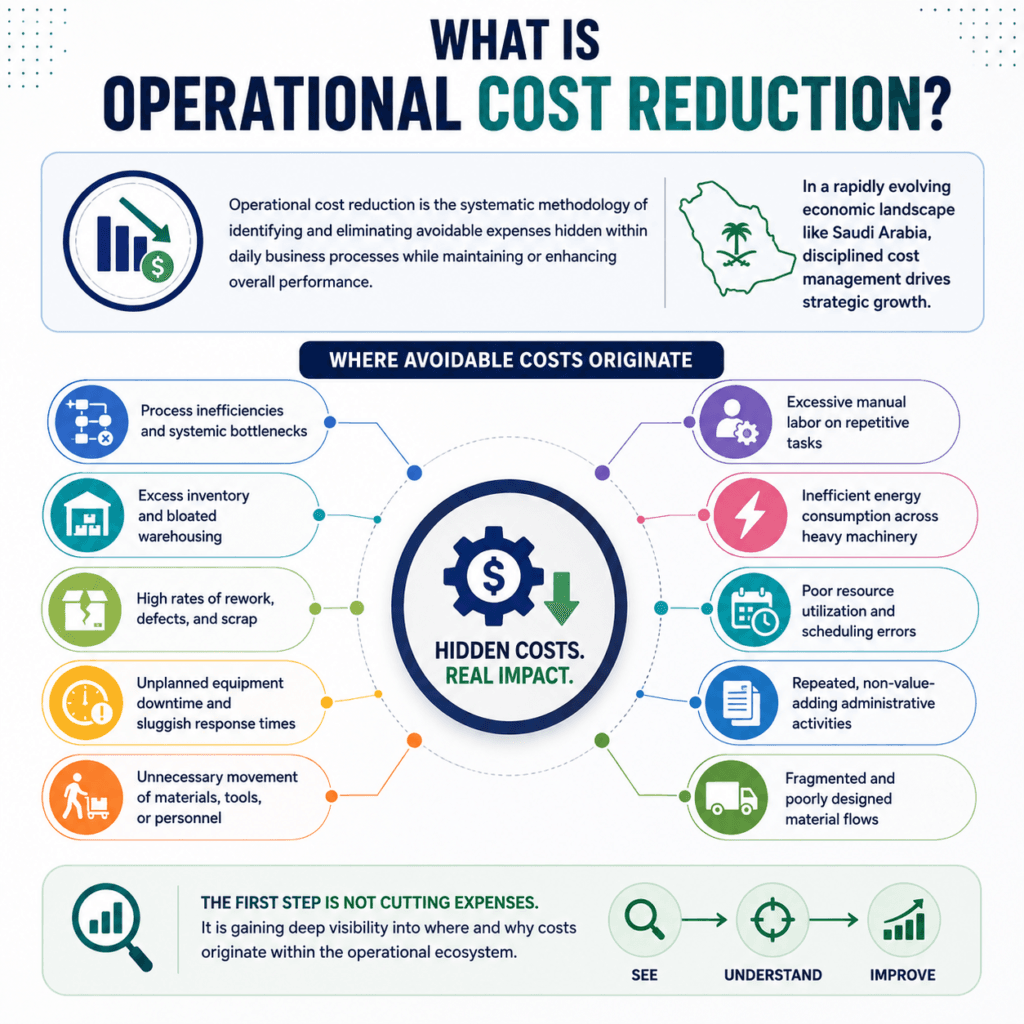
Operational cost reduction is the systematic methodology of identifying and eliminating avoidable expenses hidden within daily business processes while maintaining or enhancing overall performance.
In a rapidly evolving economic landscape like Saudi Arabia, companies face shifting market demands, making disciplined cost management a core pillar of strategic growth.
These avoidable expenses typically originate from a variety of structural bottlenecks:
- Process inefficiencies and systemic bottlenecks
- Excess inventory and bloated warehousing
- High rates of rework, defects, and scrap
- Unplanned equipment downtime and sluggish response times
- Unnecessary movement of materials, tools, or personnel
- Excessive manual labor on repetitive tasks
- Inefficient energy consumption across heavy machinery
- Poor resource utilization and scheduling errors
- Repeated, non-value-adding administrative activities
- Fragmented and poorly designed material flows
The initial step in this journey is never cutting corporate expenditure arbitrarily. Rather, it requires deep visibility into where and why costs originate within the operational ecosystem.
Why Cost Reduction Should Begin With Process Improvement
A high operating cost is frequently nothing more than a physical symptom of an inefficient underlying process. Treating the symptom through budget freezes without fixing the process rarely yields long-term success.
For example, soaring labor expenditures are often heavily influenced by excessive manual handling caused by poor workstation layout. High raw material costs frequently connect directly to excessive scrap rates and rework loops. Surging maintenance budgets often mirror recurring, unresolved equipment failures. Large inventory requirements typically signal unreliable production runs or sluggish replenishment cycles.
This direct correlation is precisely why process improvement must tie directly into corporate cost optimization. Instead of asking only where a firm can spend less, leadership teams should ask: “Why is this resource being consumed in the first place?”
Answering this single question unlocks sustainable pathways for structural enhancement and margin expansion.
10 Operational Cost Reduction Strategies for Saudi Businesses
1. Identify the Main Sources of Operational Waste
Lean methodologies provide a practical framework for identifying and eliminating waste across any enterprise. Common forms of waste include waiting periods, overproduction, excess inventory, unnecessary transportation, excessive motion, overprocessing, and defects.
Each form of waste generates direct or indirect financial drains. For instance, waiting times reduce overall plant capacity, while excess inventory consumes valuable working capital and storage space. Identifying these losses creates an immediate starting point for Lean cost reduction that Saudi Arabia organizations can readily apply across sectors.
2. Use Value Stream Mapping
Value stream mapping (VSM) helps organizations visualize how materials, information, and people move through a production or service process. It exposes hidden pockets where time and resources are squandered.
Cross-functional teams can pinpoint delays, bottlenecks, excess work-in-process, and redundant activities. This macro-perspective is vital because individual workstations may appear efficient on paper while the overall end-to-end flow remains heavily congested. Once major waste streams are mapped, teams can prioritize interventions based on immediate operational impact.
3. Reduce Rework and Defects
Quality failures multiply operational costs across multiple layers. A defective output demands additional inspection, repair, replacement, extra material consumption, and extra labor hours, all while disrupting the broader production schedule.
Organizations can mitigate these expenses by tracing defects to their root causes. Valuable methodologies include root cause analysis, standardized work protocols, continuous process monitoring, statistical quality controls, and corrective action programs. The primary goal is moving beyond catching errors late to preventing them from occurring at all.
4. Improve Equipment Utilization
Machinery and industrial assets represent immense capital investments. When equipment sits idle, operates below capacity, or suffers from frequent stoppages, the business loses vital productive potential.
Tracking Overall Equipment Effectiveness (OEE) allows teams to measure performance through availability, performance rate, and quality yield. By investigating the losses behind these metrics: such as micro-stoppages, speed reductions, and major breakdowns, plant managers can make data-driven maintenance and upgrade decisions that secure lasting savings.
5. Use Automation Where It Creates Measurable Value
Strategic automation can strongly contribute to the automation cost reduction goals that KSA enterprises seek, provided it targets genuine operational bottlenecks. Ideal applications include repetitive assembly tasks, hazardous material handling, automated visual inspection, and real-time data collection.
However, automation should never be treated as a cure-all. Before investing in robotic systems or advanced software, organizations must thoroughly understand their current processes, existing waste, manual effort involved, and expected performance gains. Automating a fundamentally flawed process only locks in inefficiency at a higher capital cost.
6. Apply Lean and Six Sigma to Cost Reduction
Lean and Six Sigma function as powerful complementary philosophies. Lean zeroes in on waste elimination, smooth flow, and process velocity, while Six Sigma focuses on reducing process variation and improving consistency through structured analytical problem-solving.
Together, they power the Six Sigma operational savings that regional businesses pursue. The DMAIC framework (Define, Measure, Analyze, Improve, Control) guides structured projects where financial savings are directly linked to verified operational enhancements rather than isolated accounting adjustments.
7. Improve Energy Efficiency
Energy consumption represents a massive operational expenditure, particularly for heavy industries and manufacturing plants. Enhancing energy efficiency begins with auditing where energy is consumed under varying load conditions.
Firms can examine equipment idle patterns, power footprints, energy-intensive process steps, and maintenance-related losses. Upgrading asset performance often satisfies both environmental and financial productivity goals. This principle underscores why cost savings through green energy adoption in Saudi industry are gaining traction, marrying sustainability with rigorous operational feasibility.
8. Optimize Inventory
While buffer inventory remains necessary for supply chain stability, bloated inventory creates massive avoidable costs spanning warehousing, handling, capital lockup, and risk of obsolescence.
The correct solution is rarely a sudden, blanket reduction in stock levels. Instead, businesses must examine why the inventory exists. If high stock buffers compensate for unreliable supplier lead times or unstable production runs, cutting inventory prematurely will cause catastrophic shortages. The correct path is fixing process flow first, then right-sizing inventory thresholds.
9. Improve Workforce Productivity
Labor efficiency is inextricably linked to workstation design. Employees frequently waste hours waiting for parts, searching for documentation, moving items manually, or executing unnecessary administrative steps.
Time and motion studies, standardized work procedures, ergonomic workstation organization, and 5S principles help uncover these hidden labor drains. The objective is optimizing how work is structured, enabling teams to perform more effectively without burning out workforce capacity.
10. Strengthen Cost Control With Better KPIs
Effective financial management demands reliable operational data. Organizations should track key performance indicators (KPIs) such as labor productivity, OEE, cycle times, downtime hours, scrap rates, inventory turns, energy usage, and lead times.
When financial accounting metrics connect directly to these operational indicators, such as tracking how scrap reduction directly lowers material cost statements, leadership gains clear visibility into how Operational Excellence translates straight to the bottom line.
Conclusion
Effective operational cost reduction for organizations in Saudi Arabia relies on systematically eliminating unnecessary consumption rather than slashing budgets indiscriminately.
For corporate leaders and manufacturing consulting firms, the core priority remains clear: understand how costs are generated, isolate root operational causes, optimize processes, measure performance gains, and institutionalize lasting changes. True cost optimization reaches peak power when embedded directly inside a culture of continuous improvement.
Frequently Asked Questions
What is operational cost reduction?
Operational cost reduction is the disciplined practice of identifying and removing unnecessary expenses within business processes while safeguarding product quality, safety, productivity, and customer value.
How can Lean and Six Sigma reduce manufacturing costs?
Lean targets waste elimination and process flow acceleration, while Six Sigma minimizes variation and defects. Combined, they drive predictable, highly efficient, and cost-effective operations.
How can automation reduce operational costs?
Automation cuts operational expenses by removing repetitive manual labor, minimizing human error, accelerating throughput, and improving process consistency, provided it is applied to optimized workflows.
How can companies measure the success of cost reduction initiatives?
Firms measure success by combining operational metrics: such as OEE, scrap rates, cycle times, and inventory turns, with verified financial statements reflecting reduced resource consumption.