
Implementing Lean Six Sigma requires far more than introducing isolated improvement tools or training employees in abstract methodology. Manufacturing organizations across Saudi Arabia need to identify meaningful operational problems, understand current processes thoroughly, involve frontline employees, analyze root causes, implement targeted improvements, and establish rigorous controls that sustain results over the long term.
A structured approach can help organizations implementing Lean Six Sigma initiatives across Saudi Arabia to successfully improve quality management, productivity, process flow, and overall operational performance.
The most effective implementation always begins with actual business needs rather than the methodology itself. Organizations should carefully adapt their programs to local processes, workforce capabilities, emerging technologies, and strategic improvement priorities while maintaining a disciplined focus on measurable outcomes.
Key Takeaways
- Lean Six Sigma implementation should always begin with a clearly defined, measurable operational problem.
- The DMAIC framework provides a robust, structured pathway for moving from problem identification to sustained optimization.
- Workforce involvement is essential because frontline employees understand how processes actually operate on the shop floor.
- Improvement tools must be selected according to the specific operational problem rather than applied as a generic checklist.
- Sustainable results require standardized work, precise measurement, management follow-up, and a culture of continuous improvement.
Why Implementation Matters in KSA Factories
Manufacturing organizations frequently encounter recurring friction points, including unexpected process delays, chronic quality issues, excessive rework, unnecessary movement, idle inventory, high process variation, and inefficient workflows. These challenges often stem from multiple interconnected causes. A quick corrective action may address an immediate symptom, but it typically fails to prevent recurrence. A professional Lean Six Sigma consultant can guide organizations through investigating the underlying process rather than just fighting daily fires. Establishing a structured framework helps businesses achieve lasting cost savings and eliminate systemic waste.
Step 1: Establish the Business Need
The foundation of any successful project begins with understanding why the organization wants to implement Lean Six Sigma. Potential objectives can include:
- Improving overall labor and machine productivity
- Reducing defect rates and scrap
- Improving manufacturing process flow
- Eliminating organizational waste elimination targets
- Reducing total lead times
- Strengthening baseline process consistency
The objective should be specific enough to guide the project team. A broad ambition like “improve performance” is difficult to act on, whereas “reduce recurring rework within line three by 30%” provides a clear, actionable target for the business.
Step 2: Identify and Prioritize Improvement Opportunities
Organizations often face dozens of potential improvement areas simultaneously. Trying to address everything at once dilutes resources and leads to burnout. A practical approach is to prioritize problems based on:
- Operational impact and frequency
- Customer satisfaction and service risk
- Cost implications and financial drag
- Process stability and improvement feasibility
- The most appropriate project is not necessarily the most visible or dramatic problem, but rather the one where a structured approach can unlock the highest operational value.
Step 3: Build the Cross-Functional Improvement Team
Successful implementation should never be isolated within a single department like quality assurance or management. Depending on the nature of the problem, the project team should include individuals who understand daily operations, maintenance, planning, supply chains, data analytics, and management.
Employees who perform the work every day understand constraints and hidden bottlenecks that may never show up in high-level executive reports. Their active involvement improves both problem diagnosis and ultimate solution adoption on the factory floor.
Step 4: Define and Execute Using DMAIC
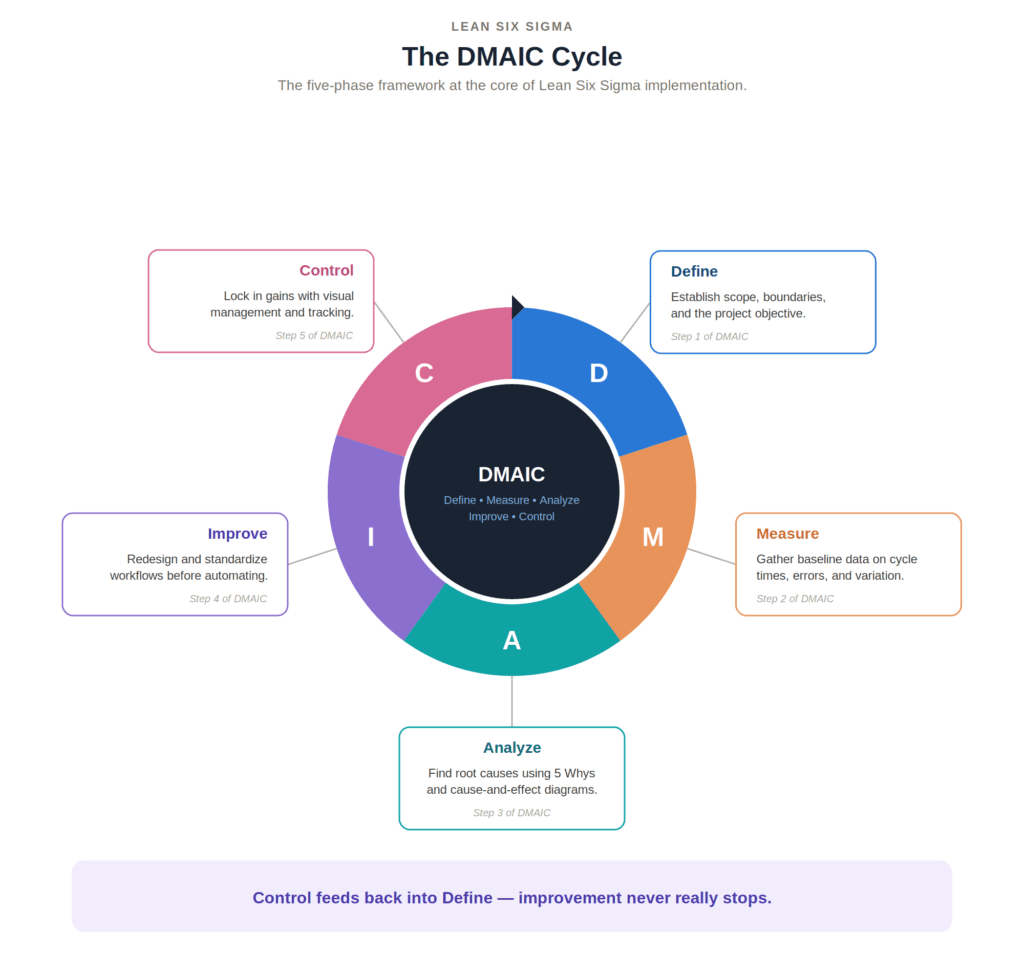
DMAIC (Define, Measure, Analyze, Improve, Control) is the gold standard framework associated with Six Sigma. It brings disciplined structure to manufacturing transformations:
- Define: Establish the project scope, boundaries, and objective by answering what is happening, where, when, and what successful improvement looks like.
- Measure: Understand current performance by gathering baseline data regarding cycle times, error frequencies, and process variation.
- Analyze: Investigate true root causes using advanced Six Sigma techniques for KSA (such as the 5 Whys and Cause-and-Effect diagrams) to separate symptoms from systemic failures.
- Improve: Redesign, simplify, and standardize workflows before applying automated tools or technology.
- Control: Lock in gains using visual management, performance audits, and tracking charts.
Essential Tools for Saudi Manufacturing
Organizations can leverage specific Lean Six Sigma tools to help Saudi Arabia facilities drive Operational Excellence:
- Value Stream Mapping (VSM): Pinpoints waiting periods, transportation losses, and process disconnects across end-to-end material flows.
- Process Mapping: Provides granular visibility into task sequences to determine what can be simplified or automated.
- Pareto Analysis: Helps prioritize the vital few categories contributing most significantly to quality loss or downtime.
- Failure Mode and Effects Analysis (FMEA): Assesses risks when redesigning critical workflows or machinery sequences.
Common Pitfalls to Avoid
Even the best initiatives can fail if organizations fall into common implementation traps:
- Starting With Tools: Deciding to implement 5S or Kaizen without first defining the operational problem.
- Treating Training as Implementation: Assuming classroom training alone changes shop-floor behavior without applying concepts to real projects.
- Ignoring Process Variation: Relying solely on average performance metrics while missing dangerous spikes in process variation.
- Failing to Sustain: Allowing improved processes to revert to old habits due to a lack of formal control routines.
Working With a Consultant in Saudi Arabia
Many KSA manufacturers choose to partner with specialized firms for Lean Six Sigma consulting support. When evaluating Lean Six Sigma consulting services for KSA, business leaders should look for partners who emphasize practical shop-floor application, employee capability development, and long-term sustainability rather than mere certification badges. A qualified Lean Six Sigma consulting partner ensures internal teams build the muscle memory required to drive continuous improvement independently.
Frequently Asked Questions
How do you implement Lean Six Sigma step by step?
Implementation involves defining the business case, measuring current metrics, analyzing root causes via DMAIC, developing process improvements, standardizing workflows, and locking in control mechanisms to sustain the gains.
What are the main tools used for process improvement?
Common tools include Value Stream Mapping (VSM), 5S, Kaizen events, standardized work, Pareto analysis, cause-and-effect diagrams, FMEA, and control charts tailored directly to the operational problem at hand.
How does Lean Six Sigma reduce defects?
It reduces defects by analyzing process variation, identifying structural root causes, optimizing operating conditions, and establishing rigorous controls to prevent recurring issues from ever surfacing again.
What should you look for in consulting services?
Organizations should evaluate practical manufacturing experience, structured methodology, measurement capabilities, workforce engagement practices, and the ability to connect projects directly to real operational objectives.