
Manufacturing is undergoing a significant shift as organizations focus on productivity, operational efficiency, digital transformation, workforce capability, sustainability, and supply chain resilience.
For manufacturing consulting firms, understanding these changes is important because manufacturers increasingly need practical solutions that connect strategic priorities with day-to-day operational performance.
The role of manufacturing consulting in Saudi Arabia is therefore moving beyond isolated improvement projects. Organizations are looking for structured approaches that help them understand operational challenges, prioritize opportunities, and implement improvements that can be measured and sustained.
Several trends are shaping this environment.
1. Greater Focus on Operational Efficiency
Manufacturers are placing greater attention on how effectively they use available resources.
The focus is not simply on increasing production. It includes improving process flow, reducing waste, controlling quality losses, improving equipment utilization, and making better use of workforce capacity.
This creates demand for approaches such as Lean manufacturing, process improvement, standardized work, and performance management.
For a manufacturing consultant in KSA, understanding the relationship between these areas is essential.
A productivity problem, for example, may not actually be caused by workforce performance. It could originate from material delays, equipment interruptions, poor process design, or unnecessary movement.
Consulting should therefore begin with process understanding rather than assumptions.
2. Industry 4.0 Adoption Is Becoming More Practical
Industry 4.0 is increasingly being considered as part of broader operational improvement rather than as a standalone technology initiative.
Manufacturers can use digital production monitoring, automated data collection, advanced analytics, automation, and AI-supported analysis to improve visibility and decision-making.
However, technology should be connected to a clearly defined operational problem.
A manufacturer experiencing recurring downtime, for example, may benefit from better equipment monitoring. Another organization may gain more value from automated production reporting or improved quality data.
This is where Industry 4.0 consulting can play a practical role by connecting technology choices with operational priorities in KSA.
3. Automation With a Clear Business Purpose
Automation can improve consistency, reduce repetitive work, and support productivity.
But automation is not automatically the right answer to every efficiency problem.
Before automating a process, organizations should understand:
- What problem needs to be solved?
- How stable is the current process?
- What resources are being consumed?
- What performance improvement is expected?
- How will the result be measured?
If an inefficient process is automated without first understanding its weaknesses, existing problems may simply become embedded in a more sophisticated system.
This makes process improvement and automation complementary rather than interchangeable.
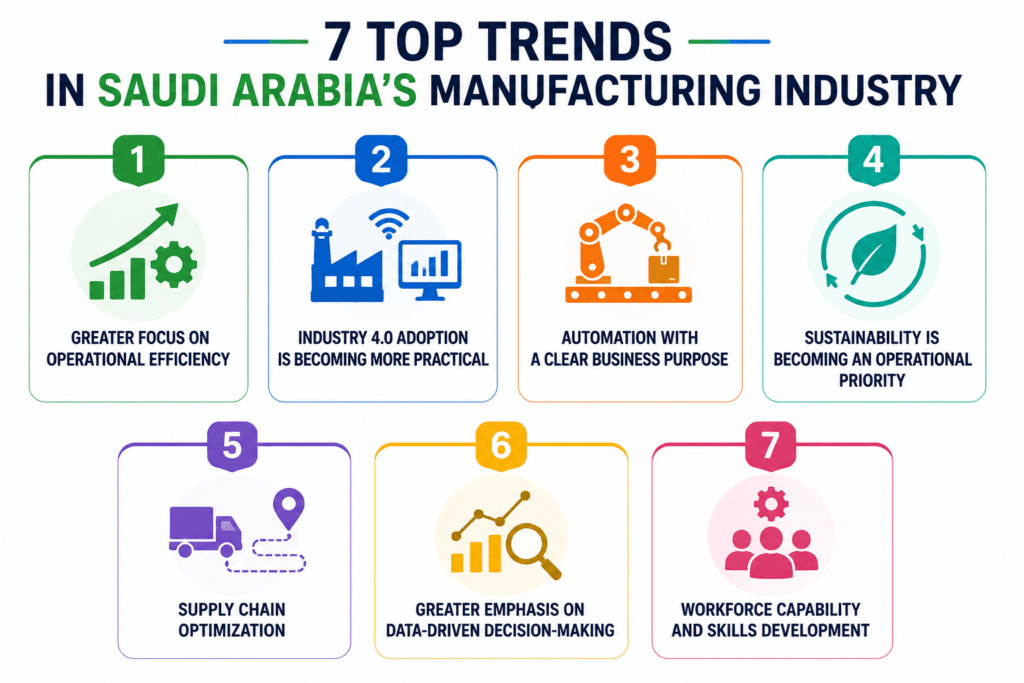
4. Sustainability Is Becoming an Operational Priority
Sustainability is increasingly connected with operational performance.
Reducing material waste, improving energy efficiency, minimizing unnecessary transportation, reducing scrap, and improving process utilization can support both operational and sustainability objectives.
Green manufacturing strategies for Saudi industrial firms can therefore include practical improvements within existing processes.
For example, reducing rework can lower unnecessary material consumption. Improving equipment performance can reduce avoidable operating time. Improving production flow can reduce unnecessary movement and handling.
The strongest sustainability initiatives are often those that can be connected to measurable operational improvements.
5. Supply Chain Optimization
Manufacturing efficiency depends partly on what happens before materials enter production.
Unreliable material availability, excessive inventory, inefficient replenishment, and poor coordination can affect production flow.
This makes supply chain optimization an important part of manufacturing improvement.
Consultants can help organizations examine the relationship between supply chain performance and manufacturing operations rather than treating the two as completely separate areas.
Questions may include:
- Where does material flow become disrupted?
- Why is excess inventory being maintained?
- Which materials create recurring production delays?
- How does replenishment affect production stability?
- Where can internal material movement be simplified?
The objective is to create a more reliable flow without simply increasing inventory.
6. Greater Emphasis on Data-Driven Decision-Making
Manufacturers generate information across production, quality, maintenance, inventory, and other processes.
The challenge is turning that information into useful decisions.
Organizations increasingly need performance information that can answer practical questions:
- Where is capacity being lost?
- Which problems occur repeatedly?
- Which processes create the most delay?
- Where are quality losses occurring?
- Which improvement opportunities should be prioritized?
This is where manufacturing expertise becomes important.
Technology can provide information, but operational knowledge is required to interpret it correctly.
7. Workforce Capability and Change Management
Technology and process improvements can only deliver sustainable results when people can use and maintain them effectively.
Manufacturing transformation may require employees to work with new systems, follow revised processes, interpret performance information, or participate more actively in problem-solving.
This makes workforce capability an important component of manufacturing transformation.
Consulting approaches should therefore consider not only the technical solution but also how changes will be adopted and sustained.
A Practical Manufacturing Transformation Approach
Organizations considering transformation can use a structured sequence.
Step 1: Assess the Current State
Understand current processes, performance, constraints, and sources of waste.
Step 2: Define Priorities
Identify the problems that have the greatest operational impact.
Step 3: Establish Baselines
Measure current performance so improvements can be evaluated objectively.
Step 4: Develop the Improvement Roadmap
Determine which process, technology, workforce, or supply chain interventions are appropriate.
Step 5: Implement in Manageable Stages
Avoid attempting to transform every process simultaneously.
Step 6: Measure Results
Track the KPIs connected to the original objectives.
Step 7: Standardize and Sustain
Successful improvements should become part of normal operating practices.
This provides a practical step-by-step manufacturing digital transformation guide for Saudi companies, while allowing organizations to adapt the approach to their specific circumstances.
How Consulting Can Address Manufacturing Challenges
Manufacturing consulting is most valuable when it helps organizations move from identifying a problem to implementing a measurable solution.
Common manufacturing challenges which Saudi Arabia’s organizations may encounter include:
- Process inefficiency
- Production bottlenecks
- Equipment losses
- Quality variation
- Excess inventory
- Material flow problems
- Limited performance visibility
- Technology integration challenges
- Workforce capability gaps
These challenges are often interconnected.
For example, unreliable production flow can lead to higher inventory requirements. Poor equipment reliability can create production delays. Process variation can contribute to quality problems and rework.
A consulting approach should therefore examine the wider system rather than treating every issue as an isolated problem.
What to Look for in Manufacturing Consulting Services
Organizations evaluating manufacturing consulting services in Saudi Arabia should consider several factors.
Relevant Manufacturing Expertise
Consultants should understand manufacturing processes and the operational realities behind performance metrics.
Structured Problem-Solving
Recommendations should be based on evidence, process analysis, and clearly defined objectives.
Practical Implementation
A strategy has limited value if it cannot be translated into practical operational changes.
Measurable Outcomes
Improvement initiatives should have appropriate KPIs and clear baselines.
Sustainable Improvements
The objective should be to establish improvements that organizations can maintain after implementation.
These factors can help organizations distinguish between generic advice and genuinely useful consulting solutions for manufacturing in KSA.
Conclusion
The manufacturing environment is increasingly shaped by operational efficiency, Industry 4.0 adoption, automation, sustainability, supply chain optimization, data-driven decision-making, and workforce capability.
For manufacturing consulting firms, these trends create a need for practical, integrated approaches.
The strongest consulting strategies begin with the current state.
They identify the actual causes of operational problems, establish measurable baselines, prioritize improvement opportunities, and connect process improvement with technology where appropriate.
Frequently Asked Questions
How can manufacturing consulting firms help Saudi manufacturers?
Manufacturing consulting firms can help organizations identify operational inefficiencies, analyze process problems, develop improvement strategies, support Lean initiatives, assess digital opportunities, and establish performance measures for sustainable improvement.
What are the major manufacturing challenges in Saudi Arabia?
Common challenges can include process inefficiency, equipment losses, quality variation, production bottlenecks, material flow problems, technology integration, workforce capability, and the need to improve operational performance.
How can consultants support Industry 4.0 adoption?
Consultants can help organizations identify suitable use cases, assess current processes and data readiness, prioritize technology opportunities, develop implementation roadmaps, and connect digital initiatives with measurable operational objectives.
What are green manufacturing strategies for Saudi industrial firms?
Green manufacturing strategies can include reducing material waste, improving energy efficiency, minimizing scrap and rework, optimizing material movement, and improving process efficiency. The most effective initiatives connect sustainability with measurable operational improvement.
What should companies look for in a manufacturing consultant?
Companies should consider manufacturing expertise, structured problem-solving capabilities, practical implementation experience, measurable improvement methods, and the ability to develop sustainable solutions rather than only providing high-level recommendations.