Improving efficiency and productivity requires more than asking teams to produce more with the same resources. Organizations need to understand how work is performed, identify sources of waste and delay, and create systems that make better performance easier to sustain. For businesses across Saudi Arabia, this increasingly connects with broader Operational Excellence and business transformation priorities. A structured approach to improving efficiency can combine process optimization, Lean management, performance management, employee involvement, and appropriate use of technology. The objective is not simply to increase output, but to create more effective, consistent, and sustainable ways of working.
Key Takeaways
- Improving efficiency and productivity starts with understanding how work actually flows through an organization.
- Lean management can help identify waste, variation, bottlenecks, and activities that do not create value.
- Productivity improvement requires attention to people, processes, performance systems, and technology together.
- Digital tools and automation should support clearly defined business needs rather than automate inefficient processes.
- Continuous improvement helps organizations sustain productivity gains instead of treating improvement as a one time project.
Why Efficiency and Productivity Matter in Saudi Arabia
Organizations across Saudi Arabia are operating in an environment where efficiency, accountability, and continuous improvement are increasingly important to long-term competitiveness.
Saudi Vision 2030 identifies a thriving economy and a focus on efficiency and accountability as important elements of the country’s broader development direction.
For individual organizations, however, improving efficiency is not achieved simply by adopting a new system or setting higher performance targets. It requires a systematic understanding of how resources are being used and where operational losses occur.
These losses can appear in many forms, including:
- Unnecessary movement
- Waiting time
- Rework
- Excessive approvals
- Poor information flow
- Unbalanced workloads
- Process variation
- Equipment downtime
- Unclear responsibilities
- Ineffective meetings
- Manual activities that could be simplified
Identifying and addressing these issues creates the foundation for productivity improvement which Saudi Arabia businesses can sustain over time.
What Is the Difference Between Efficiency and Productivity?
Efficiency and productivity are related but not identical.
Efficiency generally focuses on how effectively resources are used to achieve a desired result. It considers factors such as time, labor, materials, equipment, and process effort.
Productivity focuses on the relationship between outputs and the resources used to produce those outputs.
An organization may increase output while still having poor efficiency if it requires excessive resources, rework, overtime, or unnecessary process steps to achieve that result.
This distinction matters because the goal should not simply be to increase activity. The goal is to improve the way work is designed and executed.
How to Improve Efficiency and Productivity in Saudi Organizations
1. Understand the Current State
The first step is to understand how work is currently performed.
Organizations should observe processes at the point where work actually happens rather than relying entirely on assumptions or high-level reports.
Process observation can reveal:
- Where work waits
- Where information is lost
- Where resources are underused
- Where employees repeat activities
- Where bottlenecks occur
- Where quality problems originate
- Where responsibilities overlap
The right approach is based on real places, real people, real problems, and real time, reflecting the importance of understanding actual operating conditions before designing improvements.
2. Map Processes and Identify Waste
Business process optimization becomes more effective when organizations have visibility into the complete flow of work.
Process mapping and Value Stream Mapping (VSM) can help teams understand how activities, information, materials, and decisions move through an organization.
The objective is to distinguish between activities that create value and activities that consume resources without contributing sufficient value.
Lean management provides a structured way to identify common forms of waste and improve process flow.
Lean Management, process improvement, cost reduction, and continuous improvement are among the methodologies used to support Operational Excellence.
3. Standardize Important Processes
Productivity becomes difficult to sustain when the same task is performed differently by different people or teams without a clear reason.
Standardization creates a defined way of performing important activities while making deviations easier to identify.
Standardized work can help organizations:
- Reduce unnecessary variation
- Clarify responsibilities
- Improve training
- Make performance easier to measure
- Support consistent quality
- Create a baseline for improvement
Standardization does not mean preventing improvement. It creates a stable starting point from which teams can identify better ways of working.
4. Improve Workforce Productivity
People are central to productivity improvement.
Organizations should examine how employee time is being used and identify activities that prevent people from focusing on higher value work.
Time and motion studies, workload analysis, process observation, and workplace organization can help identify opportunities to improve workforce efficiency.
Manpower efficiency and Time and Motion Studies (TMS) are among the top Operational Excellence capabilities, alongside Lean management and process improvement.
The objective should not be simply to increase employee workload. Sustainable productivity improvement comes from removing unnecessary effort, improving work methods, and enabling employees to perform effectively.
5. Strengthen Performance Management
Organizations cannot improve what they cannot effectively observe.
A practical performance management system should connect business objectives with relevant operational indicators.
Depending on the organization, these may include measures related to:
- Productivity
- Quality
- Lead time
- Delivery performance
- Resource utilization
- Process adherence
- Downtime
- Improvement activity
The important consideration is not the number of metrics being tracked. It is whether the selected measures help people understand performance and take appropriate action.
Performance management systems form a core part of any organizations’ Operational Excellence capabilities, with a focus on tracking and enhancing organizational performance.
The Role of Lean Management in Productivity Improvement
Lean management provides a practical framework for improving efficiency by focusing on customer value, process flow, waste elimination, standardization, and continuous improvement.
For organizations looking to improve efficiency and productivity using Lean management in KSA, the methodology can be applied across different organizational environments rather than being limited to a particular sector.
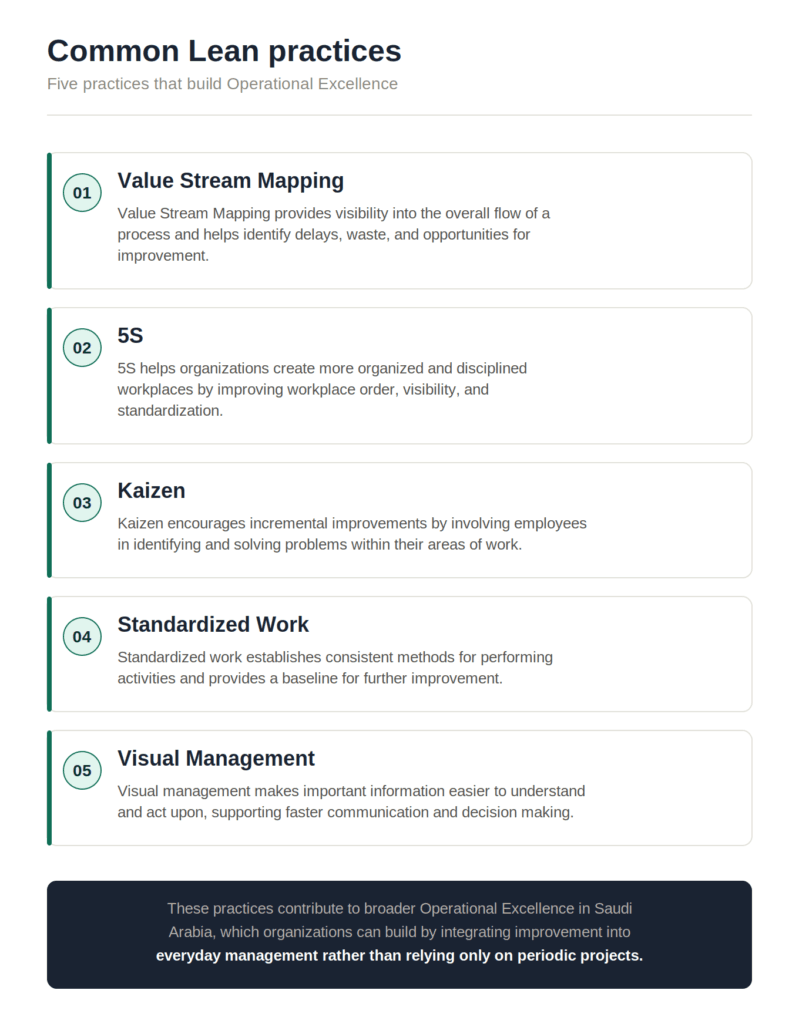
Common Lean practices include:
Value Stream Mapping
Value Stream Mapping provides visibility into the overall flow of a process and helps identify delays, waste, and opportunities for improvement.
5S
5S helps organizations create more organized and disciplined workplaces by improving workplace order, visibility, and standardization.
Kaizen
Kaizen encourages incremental improvements by involving employees in identifying and solving problems within their areas of work.
Standardized Work
Standardized work establishes consistent methods for performing activities and provides a baseline for further improvement.
Visual Management
Visual management makes important information easier to understand and act upon, supporting faster communication and decision making.
These practices contribute to broader Operational Excellence in Saudi Arabia, which organizations can build by integrating improvement into everyday management rather than relying only on periodic projects.
Build Continuous Improvement Into Daily Operations
One of the biggest challenges in productivity improvement is sustaining results.
An organization may successfully redesign a process, remove waste, or improve a workflow, but performance can gradually return to previous levels if the new approach is not reinforced.
Continuous improvement addresses this challenge by making improvement part of normal management activity.
A sustainable improvement system can include:
- Regular performance reviews
- Identification of operational gaps
- Root cause analysis
- Corrective and improvement actions
- Follow up reviews
- Standardization of successful changes
This creates a cycle in which teams continuously evaluate performance and improve the way work is performed.
Use Automation and Digital Transformation Carefully
Technology can play an important role in productivity improvement, but automation should not be the first response to every inefficiency.
A poorly designed process that is automated may simply become a faster version of an inefficient process.
Organizations should first understand the current process, simplify unnecessary steps, standardize important activities, and then determine where technology can create additional value.
This principle is particularly relevant to digital transformation initiatives across Saudi Arabia.
Potential applications of technology include:
- Automating repetitive administrative tasks
- Improving performance visibility
- Supporting data collection
- Reducing manual reporting
- Improving information flow
- Supporting operational decision making
Technology is an important enabler of business growth and more efficient processes, emphasizing the interaction between people, processes, and technology.
Improve Efficiency Through Better Problem Solving
Productivity problems are often symptoms of deeper process issues.
For example, repeated delays may be caused by unclear responsibilities, poor information flow, unbalanced workloads, or unnecessary approval steps.
Rather than repeatedly correcting the visible symptom, organizations should investigate the underlying cause.
Structured problem solving can help teams:
- Define the problem clearly
- Establish the current condition
- Identify potential causes
- Validate root causes
- Develop corrective actions
- Monitor results
- Standardize successful improvements
This approach supports sustainable productivity improvement strategies for Saudi businesses because it addresses the system behind the problem rather than relying on temporary fixes.
Align People, Processes, and Technology
Efficiency improvement is strongest when organizations consider three connected dimensions:
People
Employees need clear responsibilities, appropriate skills, effective communication, and opportunities to participate in improvement.
Processes
Processes should be structured, standardized, measurable, and designed around value creation.
Technology
Technology should support business objectives by improving information flow, automation, visibility, or decision making where appropriate.
The key, when improving organizational performance, lies in the interaction between people, processes, and technology.
Treating these areas independently can create disconnected initiatives. Aligning them creates a more coherent approach to operational improvement.
A Practical Roadmap for Productivity Improvement
Organizations looking to improve efficiency and productivity in Saudi Arabia can use a structured sequence:
Step 1: Establish the Business Objective
Define what improvement means for the organization. This may relate to productivity, cost, quality, delivery, responsiveness, or resource utilization.
Step 2: Assess the Current State
Collect relevant operational information and observe actual processes.
Step 3: Identify Major Losses
Prioritize bottlenecks, delays, waste, rework, unnecessary activities, and other sources of inefficiency.
Step 4: Design Improvements
Use Lean, process improvement, standardization, and appropriate technology to address identified causes.
Step 5: Implement and Monitor
Introduce changes with clear responsibilities, performance measures, and follow-up mechanisms.
Step 6: Sustain the Improvements
Standardize successful practices and establish continuous review mechanisms to prevent performance from deteriorating.
Conclusion
To improve efficiency and productivity sustainably, organizations need to look beyond short-term output increases. The stronger approach is to understand how work flows, identify operational losses, simplify processes, engage employees, strengthen performance management, and apply technology where it genuinely improves the way work is performed.
For organizations across Saudi Arabia, Lean management and continuous improvement provide practical foundations for strengthening Operational Excellence. Digital tools and automation can complement these efforts when they are introduced as part of a clearly defined business improvement strategy.
The most effective productivity improvement journey is therefore not about working harder. It is about designing better systems, removing unnecessary effort, improving flow, and creating management practices that allow better performance to become sustainable.
Frequently Asked Questions
How can organizations improve efficiency and productivity in Saudi Arabia?
Organizations can improve efficiency and productivity by assessing current processes, identifying waste and bottlenecks, standardizing work, improving workforce utilization, strengthening performance management, and applying Lean and digital improvement methods where appropriate.
What are effective productivity improvement strategies for Saudi businesses?
Effective strategies include process mapping, Lean management, standardization, waste reduction, structured problem solving, employee involvement, performance management, and continuous improvement.
How does Lean management improve efficiency and productivity?
Lean management improves efficiency by identifying waste, improving process flow, standardizing work, solving root causes, and encouraging continuous improvement across daily operations.
What role does digital transformation play in productivity improvement?
Digital transformation can improve productivity by automating repetitive activities, strengthening information flow, improving performance visibility, and supporting faster decision making. Technology is most effective when applied to processes that have already been understood and appropriately designed.
How can organizations sustain productivity improvements?
Organizations can sustain improvements through standardized work, regular performance reviews, clear accountability, employee involvement, structured problem solving, and continuous improvement practices.