
Improving efficiency and productivity requires organizations to understand how work is performed, where resources are lost, and which processes prevent teams from achieving consistent results. Lean management provides a structured approach to addressing these challenges by focusing on value, waste reduction, process flow, standardization, and continuous improvement. For organizations across Saudi Arabia, Lean can support broader Operational Excellence objectives by helping teams improve existing processes rather than relying only on additional resources or technology. The strongest results come when Lean principles become part of everyday management, decision making, and problem solving.
Key Takeaways
- Lean management improves productivity by reducing waste and strengthening process flow.
- Sustainable improvement starts with understanding the current state of work.
- Standardization provides a foundation for consistent performance and continuous improvement.
- Employee involvement is essential for identifying and sustaining operational improvements.
- Lean works best as a management system and culture rather than as a one-time improvement project.
What Is Lean Management?
Lean management is a systematic approach to improving organizational performance by focusing on customer value, reducing waste, improving process flow, and creating a culture of continuous improvement.
Rather than focusing exclusively on increasing output, Lean asks organizations to examine how work is performed and whether each activity contributes meaningful value.
This distinction is important when organizations want to improve efficiency and productivity. Higher productivity should not come from simply increasing workloads. It should come from improving the system in which people perform their work.
Lean management provides organizations with practical methods for identifying inefficiencies, addressing root causes, and creating more consistent processes.
Why Lean Management Matters for Productivity in KSA
Organizations across Saudi Arabia are strengthening their focus on Operational Excellence, business transformation, and sustainable performance improvement. Lean management can support these objectives by providing a structured approach to improving processes and developing stronger problem-solving capabilities.
The principles are broadly applicable because Lean focuses on how work flows through an organization rather than being tied to one specific industry.
For organizations pursuing productivity improvement across Saudi Arabia, Lean can help address issues such as:
- Process delays
- Unnecessary activities
- Rework
- Poor workplace organization
- Excessive movement
- Process variation
- Ineffective handoffs
- Unclear work standards
- Weak problem solving
Addressing these sources of inefficiency can create a stronger foundation for the operational efficiency Saudi Arabian organizations are seeking.
How Lean Management Improves Efficiency and Productivity
Identify and Eliminate Waste
One of the central principles of Lean is identifying activities that consume resources without creating sufficient value.
Waste can occur through waiting, unnecessary movement, excessive processing, defects, overproduction, inventory, underused capabilities, and other forms of inefficiency.
The objective is not simply to eliminate activities. Organizations need to understand why those activities exist and whether removing or redesigning them would improve the overall process.
Improve Process Flow
Work can become inefficient when it repeatedly stops, waits, moves between departments, or requires unnecessary approvals.
Lean encourages organizations to examine the complete flow of work and identify where interruptions occur.
Improving flow can reduce delays, improve responsiveness, and make process performance more predictable.
Standardize Work
Standardization establishes a clear baseline for how important activities should be performed.
Without standardization, it becomes difficult to determine whether performance differences are caused by process conditions, resource availability, training, or variations in how work is performed.
Standardized work supports productivity by improving consistency while creating a foundation for future improvements.
Solve Root Causes
Lean emphasizes addressing the underlying causes of problems rather than repeatedly correcting symptoms.
Structured problem solving enables teams to investigate why an issue occurs, validate the causes, and implement corrective actions.
This reduces the likelihood of recurring problems while strengthening organizational problem solving capability.
Improve Workplace Organization
The physical and information environment in which work takes place can influence productivity.
Lean practices such as 5S help organizations improve workplace organization, visibility, accessibility, and standardization.
A well-organized work environment can make abnormalities easier to identify and reduce unnecessary searching, movement, and confusion.
Lean Tools That Support Productivity Improvement
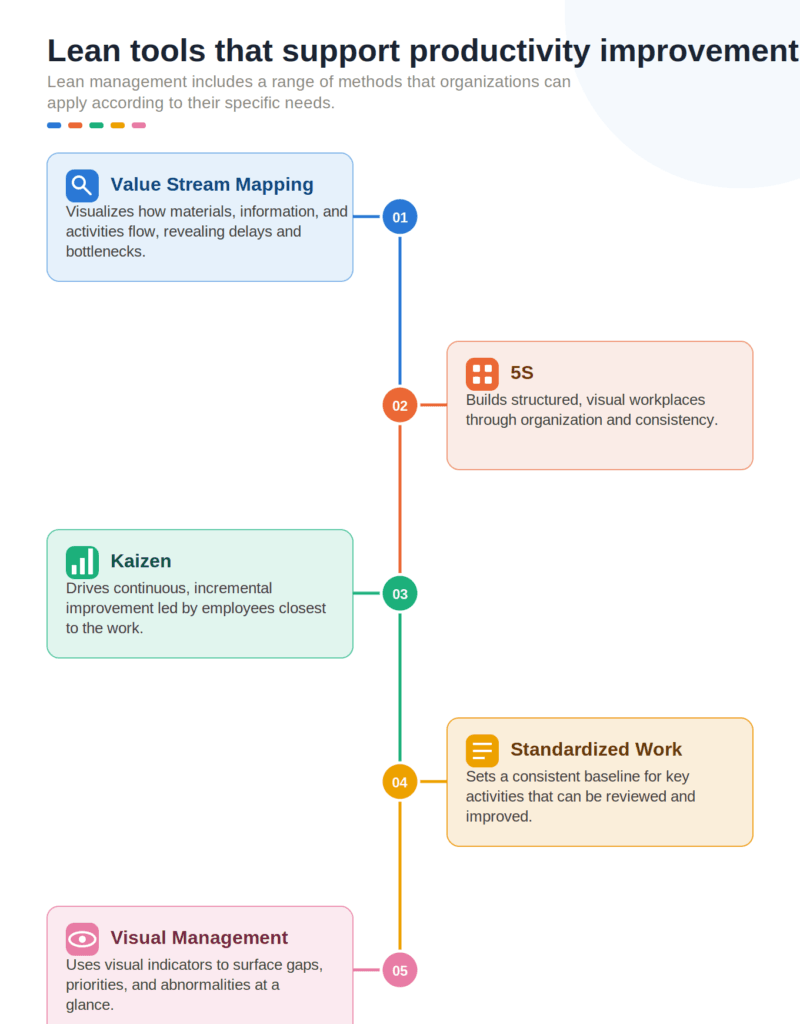
Lean management includes a range of methods that organizations can apply according to their specific needs.
Value Stream Mapping (VSM)
Value Stream Mapping provides a visual representation of how materials, information, and activities move through a process.
It helps organizations identify delays, bottlenecks, unnecessary steps, and opportunities to improve flow.
5S
5S provides a structured approach to workplace organization and visual management.
Its principles can help teams create cLeaner, more organized, and more consistent work environments.
Kaizen
Kaizen focuses on continuous, incremental improvement.
It encourages employees to identify practical opportunities for improvement within their areas of responsibility and participate in implementing solutions.
Standardized Work
Standardized Work establishes consistent methods for performing important activities.
It creates a baseline that can be monitored, reviewed, and improved over time.
Visual Management
Visual management makes important information easier to understand and act upon.
Clear visual indicators can help teams identify performance gaps, priorities, abnormalities, and improvement activities.
The Role of Employees in Lean Productivity Improvement
Lean management cannot be sustained through management decisions alone.
Employees who perform processes every day often have valuable knowledge about operational challenges, unnecessary steps, recurring problems, and opportunities for improvement.
For this reason, employee participation is a fundamental component of sustainable productivity improvement.
Organizations can encourage participation through:
- Structured improvement discussions
- Problem solving activities
- Employee feedback mechanisms
- Cross functional improvement teams
- Kaizen activities
- Regular performance reviews
When employees are involved in improvement, Lean becomes part of organizational behavior rather than a project imposed from outside.
Leadership and Lean Management
Leadership plays an important role in establishing the conditions required for Lean to succeed.
Leaders should provide direction, remove barriers, allocate appropriate resources, and reinforce the importance of continuous improvement.
Effective Lean leadership also requires leaders to spend time understanding actual operating conditions rather than relying entirely on reports.
This supports a practical approach for applying Operational Excellence strategies across KSA, where leadership connects strategic priorities with operational execution.
Lean and Continuous Improvement
Lean management and continuous improvement are closely connected.
The purpose of Lean is not to complete a defined list of improvement activities and then stop. It is to create a system in which organizations continually evaluate how work is performed and look for better ways to deliver value.
A continuous improvement cycle can include:
- Identify a performance gap
- Understand the current condition
- Investigate root causes
- Develop and test improvements
- Measure the results
- Standardize successful changes
- Continue looking for further opportunities
This creates a sustainable improvement loop rather than a one time intervention.
Lean Management and Business Process Optimization
Business process optimization and Lean management complement one another.
Process optimization focuses on improving how a process operates, while Lean provides principles and methods for identifying waste, improving flow, standardizing work, and engaging employees in improvement.
Organizations can apply these concepts to processes such as:
- Customer service
- Administration
- Procurement
- Planning
- Maintenance
- Operations
- Information management
- Internal approvals
The focus should remain on the process rather than the department. A process often crosses multiple organizational boundaries, making cross functional analysis important.
Lean Management and Digital Transformation
Digital transformation can support Lean initiatives, but technology should not replace process improvement fundamentals.
Organizations should first understand the current process and determine where waste, delays, or variation exist.
Once processes are understood and appropriately designed, digital solutions can help improve:
- Data visibility
- Performance monitoring
- Information flow
- Repetitive activities
- Reporting
- Decision support
This is particularly relevant to organizations pursuing digital transformation initiatives in Saudi Arabia.
The principle is straightforward: improve the process first, then determine where technology can provide additional value.
How to Implement Lean for Productivity Improvement
Start With a Clear Business Objective
Define what the organization wants to improve.
The objective could involve productivity, lead time, quality, cost, responsiveness, or resource utilization.
Assess the Current State
Observe how work is actually performed and collect relevant operational information.
Identify Priority Opportunities
Not every problem needs to be addressed simultaneously.
Focus on areas where improvement can meaningfully affect business performance.
Select Appropriate Lean Methods
Choose tools according to the problem rather than applying every Lean technique at once.
Engage Employees
Involve the people closest to the process in identifying problems and developing improvements.
Measure and Standardize
Track relevant performance indicators and standardize successful improvements.
Sustain Through Management Routines
Regular reviews, accountability, coaching, and continuous improvement help prevent gains from being lost.
Common Lean Implementation Mistakes
Treating Lean as a Cost Cutting Exercise
Lean is fundamentally about improving value and eliminating waste. Focusing exclusively on cost reduction can overlook quality, customer value, employee capability, and long-term process performance.
Implementing Tools Without Understanding the Problem
Using Lean tools without first understanding the underlying problem can create activity without meaningful improvement.
Ignoring Leadership Behavior
Lean requires leaders to reinforce improvement principles consistently.
Excluding Employees
Employees should be involved in identifying problems and developing solutions.
Failing to Sustain Improvements
Without standardization, performance reviews, and follow up, improvements can gradually disappear.
Conclusion
The role of Lean management in improving efficiency and productivity in KSA extends beyond individual tools or improvement projects. Lean provides a management philosophy and practical framework for understanding processes, reducing waste, improving flow, standardizing work, solving problems, and engaging employees in continuous improvement.
For organizations across Saudi Arabia, Lean can provide a strong foundation for Operational Excellence and productivity improvement. Its effectiveness depends on how consistently the principles are applied, how actively leaders participate, and whether employees are empowered to contribute to improvement.
The most sustainable approach is to make Lean part of everyday management rather than treating it as a temporary initiative. When organizations continuously examine how work is performed and systematically improve it, productivity becomes an outcome of better processes rather than simply greater effort.
Frequently Asked Questions
How does Lean management improve efficiency and productivity in KSA?
Lean management improves efficiency and productivity by identifying waste, improving process flow, standardizing work, addressing root causes, and encouraging employees to participate in continuous improvement.
What Lean tools can improve productivity?
Common Lean tools include Value Stream Mapping, 5S, Kaizen, Standardized Work, and Visual Management. The appropriate tool depends on the specific process challenge being addressed.
How can Saudi organizations implement Lean management?
Organizations can begin by defining a business objective, assessing the current state, identifying priority improvement opportunities, selecting appropriate Lean methods, engaging employees, measuring results, and standardizing successful improvements.
Is Lean management only suitable for manufacturing?
No. Lean principles can be applied across different organizational environments because they focus on improving processes, reducing waste, strengthening flow, and creating value.
How does Lean management support continuous improvement?
Lean creates structured methods for identifying problems, investigating root causes, implementing improvements, measuring results, and standardizing successful changes. This turns continuous improvement into an ongoing management practice.